
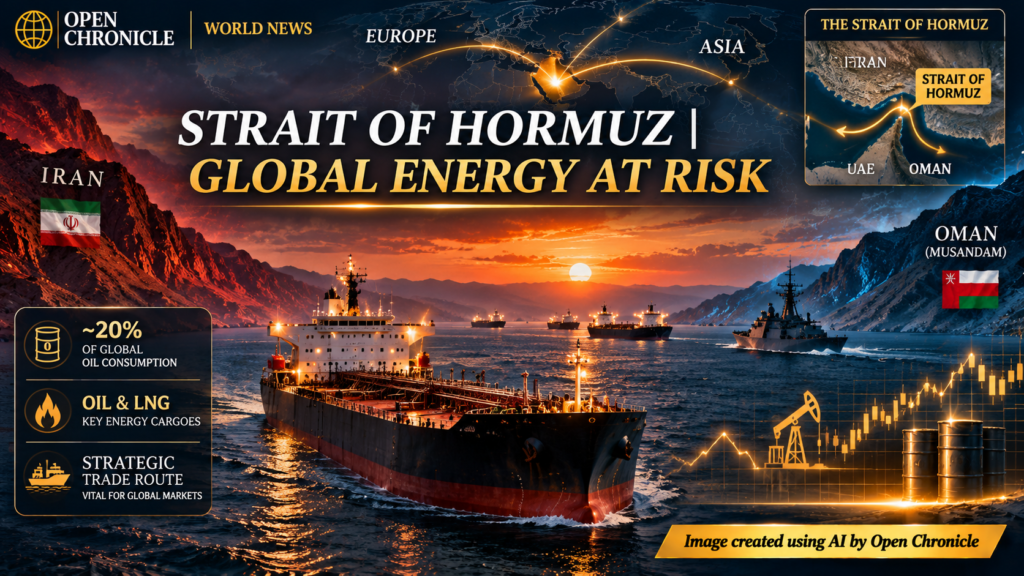
Reports of attacks on commercial shipping near Oman are renewing concerns over one of the world’s most strategically important waterways. The consequences could extend far beyond the Middle East, affecting energy markets, international trade and the security of global supply chains.
By Open Chronicle News Desk
November 21, 2026 | Middle East, Maritime Security & Global Economy
The Strait of Hormuz is once again at the centre of international security concerns.
Reports of commercial vessels being struck by unidentified projectiles near Oman have renewed fears that military confrontation in the Middle East could threaten one of the world’s most important maritime trade corridors.
The immediate concern is the safety of ships and their crews.
The wider concern is economic.
The narrow waterway connecting the Persian Gulf with the Gulf of Oman and the Arabian Sea is a vital route for oil, liquefied natural gas and commercial shipping.
A serious disruption could affect energy prices, maritime insurance, freight costs and the stability of international supply chains.
For governments and businesses already navigating geopolitical uncertainty, the latest reports highlight an uncomfortable reality.
A security incident involving a single vessel can have consequences extending far beyond the waters in which it occurs.
The precise circumstances of the reported incidents, including the identity of those responsible, require confirmation through maritime security advisories and independent reporting.
But the strategic vulnerability of the Strait of Hormuz is well established.
Its importance makes even limited attacks potentially significant for the global economy.
1. Why the Strait of Hormuz matters
The Strait of Hormuz lies between Iran to the north and Oman and the United Arab Emirates to the south.
At its narrowest point, it is approximately 33 kilometres wide.
Despite its limited width, it serves as a major passage for energy exports from the Persian Gulf.
Saudi Arabia, Iraq, Kuwait, Qatar, the United Arab Emirates and Iran all depend, to varying degrees, on the surrounding maritime network for access to international markets.
The United States Energy Information Administration has historically estimated that approximately one-fifth of global petroleum liquids consumption passes through the strait.
The precise share changes over time with production, consumption and shipping patterns.
Nevertheless, the underlying strategic reality remains unchanged.
Few maritime corridors carry such a concentration of globally important energy supplies.
Liquefied natural gas exports, particularly from Qatar, add another dimension to its importance.
For energy-importing economies in Asia and elsewhere, prolonged instability in the strait could become a direct economic concern.
For European governments, disruption could also affect global benchmark prices even when their immediate supplies originate elsewhere.
Energy markets are interconnected.
A shortage or perceived risk in one region can influence prices internationally.
2. Reports of attacks near Oman raise security concerns
The latest developments centre on reports that two oil tankers were struck by unidentified projectiles in waters near Oman.
The incidents have intensified attention on the safety of commercial navigation and the possibility of further attacks.
At the time of this editorial assessment, the information available from the news monitoring material does not independently establish the exact sequence of events, the extent of damage or the identity of those responsible.
Those distinctions are essential.
Maritime incidents can involve missiles, drones, explosive devices or other hazards, and initial reports may change as investigations progress.
Attribution is particularly sensitive.
An attack occurring near Iranian waters does not, by itself, establish Iranian responsibility.
Likewise, the existence of regional hostilities does not automatically identify the perpetrator of an individual incident.
Official maritime advisories, ship operator statements, naval assessments and independently verified evidence are necessary before assigning responsibility.
For shipping companies, however, uncertainty itself creates operational problems.
Vessel operators must assess whether routes remain safe, whether additional security precautions are required and whether commercial schedules can be maintained.
Insurance companies must evaluate the possibility of further losses.
Governments must decide whether naval protection or diplomatic intervention is necessary.
The result is a security problem with immediate commercial implications.
3. The economic consequences of maritime insecurity
Strait of Hormuz | Strategic Exposure
Geographic and energy-flow figures are approximate reference indicators, not measurements of the reported November 21 incidents.
Maritime Insecurity Can Affect Markets Before Shipping Stops
The consequences of maritime insecurity do not begin only when a shipping route closes.
Markets respond to risk.
Even without a complete interruption, attacks can increase the cost of moving goods through a vulnerable region.
Higher maritime insurance costs
Commercial ships operating in areas considered dangerous may face increased insurance premiums.
Additional war-risk coverage can become more expensive when insurers perceive a higher probability of attack or damage.
Those costs can be passed through shipping contracts and ultimately influence the price of transported goods.
Freight and logistics disruption
Shipping companies may delay departures, adjust schedules or introduce additional safety measures.
For routes that cannot easily be replaced, disruption can create bottlenecks.
The Strait of Hormuz presents a particular challenge because its geographic position limits practical alternatives for many Gulf energy exports.
Some regional producers possess pipelines capable of bypassing the strait.
However, available pipeline capacity cannot necessarily replace all maritime exports passing through the waterway.
Energy market volatility
Oil prices reflect not only current production and demand but also expectations about future supply.
If traders believe that a significant portion of Gulf exports could become unavailable, prices may rise before any measurable shortage occurs.
Conversely, prices may stabilise if authorities confirm that shipping continues normally and the immediate threat has diminished.
The distinction between actual disruption and perceived risk is therefore central to understanding market reactions.
Inflation and consumer prices
Higher energy costs can eventually affect transport, manufacturing, electricity generation and household spending.
The impact depends on how long the disruption lasts, how much prices change and how governments and businesses respond.
A short-lived security incident may have limited economic consequences.
A prolonged confrontation affecting shipping volumes could produce much wider effects.
4. What the official maritime warnings confirm
The latest UK Maritime Trade Operations advisories provide important details about the incidents.
Verified Incident Reports
November 20, 15:00 UTC
UKMTO warning 214-26 reported a tanker struck on its port bow by an unidentified projectile. A fire was reported aboard the vessel. No casualties were reported at the time of the advisory.
November 21, 05:00 UTC
UKMTO warning 215-26 reported that an outbound tanker was struck on its stern by an unidentified projectile. No casualties were reported; the environmental impact remained unconfirmed.
November 21, 05:50 UTC
UKMTO warning 216-26 reported that an outbound tanker was struck in its engine room. No casualties were reported at the time, and the environmental impact remained unconfirmed.
Sources: UKMTO incident advisories 214-26, 215-26 and 216-26. Reuters noted that it was not yet clear whether the two reports on November 21 involved separate vessels.
These reports establish that maritime authorities received multiple notifications of tanker attacks in the area.
They do not establish who launched the projectiles.
Nor do they confirm that three separate ships were necessarily involved.
The distinction matters because repeated reports, updates and overlapping accounts can produce an inaccurate impression of the number of vessels affected.
For maritime operators, the immediate operational concern is nevertheless substantial.
UKMTO has advised vessels to transit cautiously and report suspicious activity while investigations continue.
The concentration of incidents around Khasab, near the entrance to the Strait of Hormuz, underscores the vulnerability of commercial shipping in a geographically constrained corridor.
5. The Iran conflict and the risk of wider escalation
The maritime attacks are unfolding against the background of the broader conflict involving Iran, the United States and Israel.
Reuters reported on November 21 that shipping through the strait had been disrupted since Iran moved to close it following the beginning of the US and Israeli military campaign on February 28, 2026.
This context is essential to understanding the current security environment.
The Strait of Hormuz has long been a strategic pressure point in relations between Iran and Western powers.
Iran’s geographic position gives it proximity to the waterway, while the United States and its regional partners have maintained significant naval capabilities intended to protect maritime navigation.
Military confrontation creates several potential dangers.
One is the possibility of deliberate attacks on commercial shipping.
Another is miscalculation, in which a limited military action produces a larger response.
A third is the growing difficulty of distinguishing state-directed attacks from operations involving allied groups, irregular forces or other actors.
These possibilities should not be confused with established responsibility for the incidents near Oman.
Attribution requires evidence.
The wider conflict, however, increases the importance of that investigation.
An incident that might otherwise be treated primarily as a maritime security matter can become a diplomatic or military flashpoint when regional tensions are already elevated.
6. Why Asia is particularly exposed
The economic consequences of instability in the Strait of Hormuz are not distributed evenly.
Asian economies have historically been major destinations for Gulf crude oil and liquefied natural gas.
China, India, Japan and South Korea are among the countries with substantial interests in the uninterrupted movement of energy supplies from the region.
The effects of a disruption would depend on each country’s energy mix, strategic reserves, import contracts and ability to obtain alternative supplies.
But the broader challenge is common.
Modern industrial economies require predictable access to energy.
Manufacturing, electricity generation, aviation, shipping and petrochemical production can all be affected by changes in energy availability and prices.
For countries dependent on imported fuels, sustained volatility can also create pressure on trade balances and currencies.
That is why the security of the Strait of Hormuz is not solely a Middle Eastern concern.
It is an issue for economic policymakers across the Indo-Pacific.
7. Europe cannot remain insulated
Europe’s exposure is different, but it remains significant.
European energy security has undergone substantial changes in recent years, with governments attempting to diversify supplies and reduce dependence on vulnerable external relationships.
Yet diversification does not eliminate exposure to international prices.
Oil is traded in a global market.
A major supply shock in the Persian Gulf can affect European refiners and consumers even when the physical barrels normally imported into Europe originate elsewhere.
Natural gas markets are more regionally segmented, but international LNG competition can transmit supply pressures between regions.
If Asian buyers seek replacement cargoes following disruption in the Gulf, competition for available LNG may intensify.
The resulting price effects would depend on market conditions, inventories and alternative production.
For European policymakers, the situation reinforces the connection between energy security, industrial competitiveness and strategic autonomy.
It also illustrates the limits of treating maritime security as a distant regional problem.
8. Naval protection and the limits of military deterrence
Protecting commercial shipping in contested waters presents difficult operational choices.
Naval forces can monitor threats, share intelligence, escort vessels and respond to attacks.
However, the presence of warships does not guarantee that every commercial vessel can be protected against every possible threat.
The Strait of Hormuz combines intense shipping activity with restricted geography.
Missiles, drones and other relatively inexpensive systems can complicate defensive operations.
The economic imbalance between attacking and defending maritime targets can be substantial.
A comparatively inexpensive weapon may force the deployment of sophisticated surveillance and air defence systems.
The challenge becomes greater when military forces must protect large numbers of commercial vessels over an extended period.
Naval escorts may reduce certain risks, but they can also become politically sensitive.
A defensive operation conducted during a wider regional conflict could increase the possibility of direct confrontation.
Diplomacy, intelligence sharing and military deterrence therefore remain interconnected.
No single measure can eliminate every threat to maritime navigation.
9. Could the Strait of Hormuz be bypassed?
One of the most important questions for energy markets is whether producers could continue exporting if maritime traffic through the strait were severely restricted.
Some Gulf states possess infrastructure that provides alternative export routes.
Saudi Arabia’s East-West Pipeline connects eastern oil-producing regions with facilities on the Red Sea.
The United Arab Emirates also has pipeline infrastructure allowing some crude oil exports to bypass the strait through Fujairah.
These routes provide strategic flexibility.
However, they have finite capacity.
They also cannot necessarily accommodate every type of cargo or replace the full volume of oil and LNG normally transported through Hormuz.
Alternative maritime routes may themselves face security risks, infrastructure constraints or commercial limitations.
For Qatar’s LNG exports, the geographic challenge is particularly significant because the country’s principal export terminals are located inside the Persian Gulf.
The existence of bypass infrastructure therefore reduces vulnerability without removing it.
A sustained interruption of the strait would remain a major international energy security problem.
10. Three scenarios for the coming weeks
Strait of Hormuz | Three Possible Scenarios
Contained Maritime Incidents
Authorities investigate the attacks, shipping continues with heightened precautions and insurers adjust their assessments. The economic consequences remain manageable, although uncertainty persists.
Sustained Disruption
Additional attacks lead to operational delays, reduced traffic and higher transport costs. Energy markets experience greater volatility as companies and governments seek alternative arrangements.
Major Regional Escalation
A wider military confrontation severely restricts commercial navigation. Energy exports face substantial disruption, creating international economic and diplomatic pressure.
These are analytical scenarios, not predictions. No probability ranking is assigned because the available evidence does not support reliable estimates.
The scenarios illustrate the range of possible outcomes.
The most consequential variable is not simply the number of incidents.
It is whether the attacks become part of a sustained campaign that materially reduces shipping capacity.
Why It Matters
The Strait of Hormuz is a reminder that globalisation depends on physical infrastructure.
International markets may appear increasingly digital, but energy supplies and manufactured goods still move through ports, pipelines, roads and maritime corridors.
These networks contain vulnerabilities.
Some are technological.
Others are geographic.
The Strait of Hormuz is among the clearest examples of the latter.
Its narrow passage concentrates enormous economic value in a limited area.
That concentration creates opportunities for trade, but also risks during military confrontation.
The incidents near Oman demonstrate how quickly maritime security can become an international economic concern.
They also raise questions about the resilience of global energy systems and the ability of governments to protect commercial activity during prolonged geopolitical crises.
The Bigger Picture | The global economy’s maritime vulnerabilities
The importance of Hormuz extends beyond the immediate conflict.
Other strategic waterways, including the Suez Canal, Bab el-Mandeb, the Panama Canal and the Strait of Malacca, also play critical roles in international trade.
Disruption in one corridor can increase pressure on others.
Shipping companies may face longer routes, higher operating costs and more complicated scheduling.
Governments may respond by expanding strategic reserves, investing in alternative infrastructure or increasing naval cooperation.
Businesses may reconsider supply chains built primarily around efficiency rather than resilience.
These developments reflect a wider transformation in economic policy.
Security considerations are becoming increasingly important in decisions about trade, energy, transport and industrial investment.
The Strait of Hormuz illustrates why.
When international commerce depends on a small number of vulnerable routes, regional instability can become a global economic problem.
What to Watch Next
STRAIT OF HORMUZ | DEVELOPING SITUATION
Official incident investigations: Confirmation of the vessels involved, damage assessments and any evidence identifying those responsible.
Further UKMTO warnings: Whether additional attacks are reported in the strait or nearby Gulf waters.
Shipping traffic: Evidence of changes in tanker movements, delays, diversions or commercial operations.
Energy prices: Whether market reactions reflect temporary uncertainty or sustained reductions in supply.
Naval and diplomatic responses: Any new security measures, international consultations or attempts to reduce regional tensions.
Environmental consequences: Confirmation of any oil leakage or other damage resulting from the incidents.
Sources and Further Reading
Official maritime security advisories, international reporting and institutional reference material concerning tanker incidents near Oman, the strategic importance of the Strait of Hormuz and the potential consequences for global energy markets and commercial shipping.
UK Maritime Trade Operations | Warning 216-26, Tanker Attack East of Khasab
Official warning documenting a tanker struck in its engine room approximately 17 nautical miles east of Khasab, Oman.
UK Maritime Trade Operations | Recent Maritime Incidents
Official incident register containing warnings 214-26, 215-26 and 216-26, as well as earlier reports involving commercial vessels in the region.
Reuters | Two Tanker Attack Incidents Reported Near Oman’s Khasab
Reporting on the two incidents, the uncertainty over whether both involved separate vessels and the wider maritime security situation.
U.S. Energy Information Administration | World Oil Transit Chokepoints
Reference material concerning the strategic importance of the Strait of Hormuz, energy flows and alternative export infrastructure.
International Maritime Organization | Maritime Security
Institutional reference on maritime security, international shipping safety and the protection of commercial navigation.
The UKMTO advisories document reported maritime incidents but do not, by themselves, establish responsibility for the attacks. Reuters reporting provides additional context concerning the number of vessels potentially involved and the wider security situation. Energy and maritime reference sources are included to explain the strategic significance of the Strait of Hormuz rather than to confirm the circumstances of individual incidents.
Editorial Transparency
This article was prepared by Open Chronicle News Desk using official maritime incident reporting from United Kingdom Maritime Trade Operations, international reporting from Reuters and established reference information concerning energy transportation and maritime security. The incidents reported near Khasab on November 20 and 21, 2026, are distinguished from allegations concerning responsibility, which remains unconfirmed in the sources consulted. Geographic and historical energy-flow indicators are provided for context and should not be interpreted as current measurements of shipping volumes or economic losses. Discussion of energy prices, insurance costs, supply chains, naval protection and possible escalation represents independent editorial analysis. The three scenarios are illustrative assessments rather than forecasts. Information may change as maritime authorities release additional findings.