
OPEN CHRONICLE | WORLD NEWS | POLITICS & GEOPOLITICS
The White House is confronting renewed questions about Iran’s nuclear capabilities, allegations of unconventional weapons threats and the future of a conflict that has already transformed security across the Middle East. But the evidence behind some of Washington’s most alarming claims remains disputed.
By Open Chronicle News Desk
November 21, 2026 | Washington, D.C.
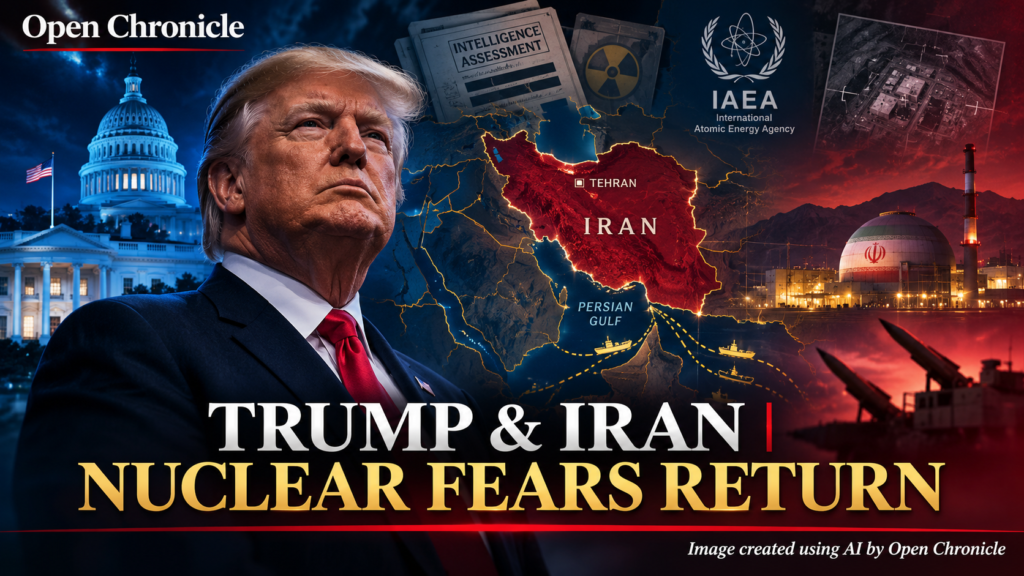
President Donald Trump is once again placing Iran at the centre of American national security policy, warning that Tehran must never acquire a nuclear weapon while leaving open the possibility of renewed military action.
Yet the administration’s latest statements reveal a complicated strategic picture.
Trump has suggested that a decision on additional major strikes against Iran could wait until 2027. At the same time, he has rejected the terms currently available for a diplomatic settlement and raised concerns about alleged Iranian interest in chemical, biological and radiological weapons.
Iran has denied the accusations.
The dispute comes amid fresh scrutiny of intelligence assessments, unresolved questions about Iran’s nuclear material and a war that has already disrupted regional security and international energy markets.
The central question is no longer simply whether Washington can prevent Iran from developing a nuclear weapon. It is whether military pressure can deliver a stable political outcome without producing an even more dangerous confrontation.
For the United States, the challenge involves military deterrence, intelligence credibility and the political consequences of a prolonged conflict.
For Iran, it concerns national security, economic survival and the conditions under which negotiations might resume.
For the wider international community, the stakes include nuclear proliferation, regional escalation and the security of global energy supplies.
1. Trump signals patience, but not a retreat
On November 19, Trump told Reuters that he was prepared to wait until after the beginning of 2027 before deciding whether to authorise another major military operation against Iran.
The president also indicated in separate interviews that he was not rushing toward a decision.
The remarks suggest an effort to maintain military pressure while avoiding an immediate commitment to escalation.
However, postponement should not be confused with a change in strategic objectives.
Trump continues to insist that Iran must not acquire nuclear weapons, and Washington’s sanctions and maritime pressure remain central elements of its approach.
According to Reuters, the president has alternated between threatening additional military action and suggesting that the conflict could be brought to an end.
This ambiguity may be deliberate.
By refusing to establish a definitive timetable, the administration preserves room for diplomatic negotiations while retaining the threat of military intervention.
But uncertainty also creates risks.
Tehran may interpret the delay as an opportunity to strengthen its negotiating position.
American allies may question whether Washington intends to pursue a settlement or prepare for further strikes.
And financial markets must assess the possibility of renewed conflict without a clear political timetable.
2. The nuclear question remains unresolved
The Iranian nuclear programme has been a central source of international tension for more than two decades.
Its significance lies in the technical relationship between civilian nuclear activities and the potential development of nuclear weapons.
Uranium enrichment can support civilian nuclear energy production.
At substantially higher enrichment levels, however, the same underlying technology can produce material that could be used in a nuclear explosive device.
That dual-use capability makes verification essential.
The United States and Israel have repeatedly argued that Iran’s nuclear activities represent an unacceptable security risk.
Iran maintains that it is not seeking nuclear weapons.
The dispute intensified after military strikes against Iranian nuclear facilities in June 2025 and the broader conflict that began in February 2026.
Those operations damaged important elements of Iran’s known enrichment infrastructure.
But destroying facilities is not equivalent to establishing that every component of a nuclear programme has been eliminated.
Technical expertise, specialised equipment, enriched uranium inventories and undisclosed activities can complicate any assessment of a programme’s remaining capabilities.
The International Atomic Energy Agency has therefore become central to the debate.
Its inspectors are responsible for verifying nuclear material and monitoring compliance with applicable safeguards obligations.
Without adequate access, the agency cannot provide the same level of assurance about activities and inventories that it could before the attacks.
3. The IAEA’s growing verification problem
On November 19, the United States, Britain, France and Germany pressed Iran to restore access to nuclear facilities damaged during earlier military operations.
According to Reuters, the four governments expressed concern that the International Atomic Energy Agency had lost continuity of knowledge regarding previously verified stocks of highly enriched uranium.
Iran had not provided inspectors with access to the affected facilities since the June 2025 strikes.
The whereabouts and status of some previously documented nuclear material remained unresolved in the reporting available on November 21.
This is an important distinction.
An inability to verify the location of nuclear material does not establish that it has been diverted into a weapons programme.
But it prevents inspectors from confirming what has happened to that material.
The resulting uncertainty is a significant international security concern.
It also complicates diplomacy.
Any future agreement would need to address not only limits on enrichment but also the restoration of credible inspections and an accounting of relevant nuclear inventories.
Military action may damage facilities.
It cannot, by itself, substitute for a durable verification system.
4. A new controversy over alleged unconventional weapons
The latest dispute has expanded beyond uranium enrichment.
CNN reported on November 16, citing seven American officials, that US intelligence indicated Iran was developing options for a possible attack against senior Trump administration officials in Washington using a radiological dispersal device or chemical weapon.
The report described planning that officials considered specific, but it also emphasised uncertainty about whether Iran could or would attempt such an operation.
The reported intelligence was not made public for independent examination.
The Washington Post subsequently reported that it had not independently confirmed the allegations.
Trump said the government was examining the reports and treating the matter seriously.
Iran rejected the accusations as baseless.
These distinctions are fundamental to responsible reporting.
A reported intelligence assessment is not the same as a confirmed operational plan.
A possible contingency is not evidence of an imminent attack.
And the existence of allegations does not establish that a particular government has authorised or prepared an attack.
The available public evidence does not justify presenting the reported plot as an established fact.
Nevertheless, the allegations have intensified political attention because they concern possible threats within the United States itself.
That gives the dispute a domestic security dimension extending beyond the Middle Eastern battlefield.
5. Nuclear weapons, dirty bombs and chemical weapons are not the same
OPEN CHRONICLE | SECURITY EXPLAINER
Three different categories of threat
Nuclear weapon
Produces an explosion through nuclear reactions, with potentially catastrophic blast, thermal and radiation effects.
Radiological dispersal device, commonly called a dirty bomb
Uses conventional explosives or another dispersal mechanism to spread radioactive material. It does not produce a nuclear detonation.
Chemical weapon
Uses toxic chemical substances to cause injury, incapacitation or death. It is technologically and legally distinct from a nuclear or radiological weapon.
Biological weapons constitute a further, separate category involving biological agents or toxins. Allegations concerning one category do not establish capabilities or intentions involving another.
The distinction matters because the public debate has increasingly combined several different threats.
A nuclear weapons programme involves specialised materials, infrastructure and technical processes.
A radiological dispersal device involves a different mechanism and does not require a nuclear chain reaction.
Chemical and biological weapons involve their own distinct capabilities and international legal frameworks.
Trump has also suggested that Iran may be exploring chemical or biological weapons.
However, the public evidence supporting those specific allegations remains limited, and Iran has denied them.
Al Jazeera reported on November 19 that Trump made the claims without presenting supporting evidence.
Conflating these threats risks misleading the public about their scale, likelihood and implications.
It also complicates the assessment of intelligence.
Each allegation must be evaluated on its own evidence.
6. Washington faces questions about its intelligence claims
The renewed controversy comes at a politically sensitive moment.
Trump has defended the decision to launch military action against Iran in February 2026, arguing that preventing Tehran from obtaining nuclear weapons justified the operation.
But the strength of the administration’s earlier assessment has become a subject of renewed debate.
On November 21, Vice President JD Vance declined to directly endorse Trump’s assertion that Iran had been close to acquiring a nuclear weapon when the conflict began.
The exchange highlighted differences between political statements and publicly available intelligence assessments.
In March 2025, then Director of National Intelligence Tulsi Gabbard told Congress that the intelligence community assessed Iran was not building a nuclear weapon and that its supreme leader had not authorised the weapons programme suspended in 2003.
That assessment did not mean Iran lacked nuclear expertise or potentially concerning enrichment capabilities.
It concerned whether an active nuclear weapons programme had been authorised and was being pursued.
The distinction is central to understanding the controversy.
A government may possess the technical capacity to move toward a nuclear weapon without having made the political decision to build one.
Military planning must account for both possibilities.
Public debate, however, becomes distorted when capability, intention and imminence are treated as interchangeable.
7. Iran rejects the allegations
Iranian officials have denied that Tehran is pursuing nuclear weapons or the chemical and biological capabilities described in Trump’s recent remarks.
Tehran has also rejected reports of a radiological attack plan against Washington.
Iran’s position is that the allegations are being used to justify continued military and economic pressure.
The denials do not independently resolve the underlying intelligence questions.
They are nevertheless essential to presenting the dispute accurately.
The burden remains on those making specific allegations to provide evidence sufficient to support them.
This is especially important when claims could influence decisions involving military action.
The history of international security crises demonstrates how disputed intelligence can shape political decisions with consequences extending far beyond the original allegations.
The current debate therefore raises a broader question about transparency.
How much evidence can governments disclose without compromising intelligence sources and methods?
And how can democratic institutions assess major security claims when the underlying intelligence remains classified?
There is no simple answer.
But the absence of publicly available evidence should be acknowledged rather than concealed behind definitive language.
8. A diplomatic settlement remains possible, but difficult
Despite the military confrontation, diplomatic efforts have not disappeared.
Associated Press reported on November 21 that Trump believed Iran wanted an agreement but had not presented terms he considered acceptable.
The dispute includes the future of Iran’s nuclear programme, economic sanctions and security arrangements in the Persian Gulf.
Regional governments have also explored the possibility of limited arrangements intended to restore commercial shipping through the Strait of Hormuz.
Such proposals could potentially combine maritime de-escalation with sanctions relief and broader negotiations.
But the obstacles remain considerable.
Washington wants assurances that Iran will not develop nuclear weapons and that its military capabilities will not threaten American interests or regional partners.
Iran seeks relief from economic pressure and guarantees concerning its security.
Israel remains concerned about Iran’s remaining military and nuclear capabilities.
Gulf governments want to prevent further attacks on their territories and infrastructure.
These objectives are not necessarily impossible to reconcile.
But reaching an agreement would require concessions, credible verification and political confidence that the arrangement could survive future crises.
That confidence is currently limited.
9. The Strait of Hormuz connects the military crisis to the world economy
The conflict has already demonstrated how regional security and international economic stability are connected.
The Strait of Hormuz remains one of the world’s most strategically important energy corridors.
Disruption to commercial shipping can affect oil supplies, liquefied natural gas exports, insurance costs and global freight markets.
Even when a complete closure does not occur, uncertainty can increase the cost of moving energy and goods.
This creates a difficult relationship between military pressure and economic consequences.
Measures intended to weaken Iran may also contribute to instability affecting American allies and international markets.
The risk is particularly important for Asian economies dependent on Gulf energy supplies.
Europe is also exposed through international oil and gas prices.
A prolonged confrontation could therefore produce economic costs well beyond the immediate participants.
For Washington, this complicates the strategic calculation.
The administration must weigh the potential benefits of additional military pressure against the possibility of further market disruption and regional escalation.
10. The domestic political challenge facing Trump
The Iran conflict is also becoming a significant issue in American domestic politics.
Following Republican losses in the November midterm elections, the administration has faced renewed questions about the costs and objectives of the war.
Trump has defended his decision to confront Iran.
Vice President Vance has acknowledged the political consequences of the conflict while maintaining that preventing Iranian nuclear proliferation remains important.
Congress has also debated the extent of presidential authority to continue military operations.
On November 19, the Senate rejected a measure intended to restrict further US military involvement in the conflict.
The vote reflected continuing disagreements over the constitutional balance between executive military authority and congressional oversight.
The political challenge is substantial.
Military operations can be justified through immediate security objectives.
But prolonged conflicts require a convincing explanation of how those objectives translate into a sustainable outcome.
The administration must demonstrate not only what it seeks to prevent, but what political settlement it intends to achieve.
Without that clarity, tactical military successes may fail to produce strategic stability.
11. Three possible paths for US-Iran relations
OPEN CHRONICLE | STRATEGIC SCENARIO ASSESSMENT
Washington and Tehran at a crossroads
Three Scenarios for Washington and Tehran
Possible diplomatic and military pathways in the confrontation between the United States and Iran.
Negotiated Containment
Washington and Tehran reach a limited agreement involving nuclear inspections, restrictions on selected activities, maritime security arrangements and partial sanctions relief.
STRATEGIC IMPLICATION
Reduced immediate escalation risk, but continuing mistrust and unresolved security disputes.
Prolonged Confrontation
Military operations remain limited, sanctions continue and diplomacy produces no comprehensive settlement.
STRATEGIC IMPLICATION
Persistent regional instability, economic uncertainty and difficulty restoring comprehensive nuclear verification.
Renewed Major Escalation
Additional military strikes or a serious regional incident trigger a wider confrontation involving American, Iranian or allied forces.
STRATEGIC IMPLICATION
Greater military losses, increased pressure on international energy markets and a heightened risk of conflict spreading.
These scenarios are analytical possibilities, not forecasts. No probability ranking is assigned.
The three scenarios illustrate the choices facing Washington and Tehran.
The most important variable may be whether either side believes that negotiations can produce more favourable results than continued confrontation.
If that confidence disappears, the danger of escalation increases.
Why It Matters
The dispute over Iran has implications far beyond the country’s nuclear programme.
It concerns the credibility of intelligence assessments, the effectiveness of military deterrence and the ability of international institutions to verify sensitive nuclear activities.
It also raises fundamental questions about how governments communicate security threats.
Claims involving nuclear, radiological, chemical or biological weapons can influence public opinion and international policy.
When such claims remain unverified, political leaders face a responsibility to distinguish established evidence from intelligence assessments, allegations and speculation.
The consequences of failing to make those distinctions can be profound.
For the United States, the immediate challenge is to prevent further proliferation risks without becoming trapped in an open-ended confrontation.
For Iran, the challenge is to address international concerns while negotiating under substantial military and economic pressure.
For the wider international community, the priority is avoiding a conflict that could destabilise regional security and global energy markets.
The Bigger Picture | Military power cannot replace political strategy
The Iran conflict illustrates a recurring problem in international relations.
Military force can destroy infrastructure, disrupt operations and change the immediate balance of power.
It cannot automatically produce political legitimacy, lasting agreements or reliable verification.
Those outcomes require diplomacy, institutions and enforceable commitments.
The central difficulty in the Iranian nuclear dispute is not simply whether enrichment facilities can be damaged.
It is whether a system can be established that provides credible assurance about Iran’s nuclear activities while reducing incentives for further confrontation.
That requires more than threats.
It requires access for international inspectors, agreement on nuclear limitations and a political framework capable of surviving changes in leadership and regional conditions.
Trump’s decision to leave open the possibility of further military action preserves pressure on Tehran.
But the longer the conflict continues without a settlement, the more difficult it may become to distinguish tactical success from strategic progress.
The question confronting Washington is therefore increasingly clear.
Can the United States transform military pressure into a verifiable and durable agreement, or will the confrontation with Iran become another prolonged conflict without a defined political endpoint?
What to Watch Next
OPEN CHRONICLE | DEVELOPING SITUATION
Trump’s next decision: Whether the administration maintains its suggested timetable extending into 2027 or moves toward earlier military action.
IAEA inspections: Whether Iran permits renewed access to damaged nuclear facilities and provides an accounting of relevant nuclear material.
Intelligence disclosures: Whether US authorities publish additional evidence concerning the alleged radiological, chemical or biological threats.
Diplomatic negotiations: Whether Washington and Tehran identify acceptable terms for a limited or comprehensive agreement.
Congressional oversight: Whether legislators renew efforts to restrict military operations or demand further intelligence briefings.
Regional security: Whether further attacks on shipping, military installations or energy infrastructure increase the risk of escalation.
Sources and Further Reading
Selected international reporting and institutional documentation informing this article.
Trump Says No Rush on Iran Decision, Looks to Next Year
November 19, 2026
Reporting on Trump’s decision to defer consideration of renewed major strikes, the administration’s military strategy and the continuing diplomatic confrontation.
Trump Insists Iran Won’t Make an Acceptable Deal
November 21, 2026
Reporting on the prospects for negotiations, American military pressure, Iranian demands and regional efforts to reduce the conflict.
West Presses Iran at IAEA to Let Inspections Resume at Bombed Nuclear Sites
November 19, 2026
Reporting on the international effort to restore inspections and concerns about previously verified highly enriched uranium inventories.
US Intelligence Indicates Iran Developing Possible Dirty Bomb Attack Plans
November 16, updated November 17, 2026
Reporting based on unnamed American officials concerning alleged Iranian planning and uncertainty over the likelihood of an attack.
Trump Says Government Takes Report of Iranian Dirty Bomb Plans Very Seriously
November 17, 2026
Reporting on Trump’s response to the allegations, Iranian denials and the lack of independent confirmation.
Vance Stops Short of Endorsing Trump’s Iran Nuclear Claim
November 21, 2026
Reporting on the administration’s justification for military action and differences between political statements and publicly documented intelligence assessments.
Trump Claims Iran Is Developing Bioweapons: Is There Any Evidence?
November 19, 2026
Examination of Trump’s allegations concerning chemical and biological weapons and the publicly available evidence.
Iran and Nuclear Verification
Official institutional information on nuclear safeguards, inspections and the international verification framework.
Editorial Transparency
This article was prepared by Open Chronicle News Desk using reporting from Reuters, Associated Press, CNN, The Washington Post, The Guardian and Al Jazeera, together with institutional information concerning nuclear safeguards and verification. Statements by President Donald Trump, other American officials and Iranian authorities are attributed to their respective sources. Allegations involving radiological, chemical and biological weapons are distinguished from independently established facts, and the article does not present the reported attack planning as a confirmed or imminent threat. Discussion of military deterrence, intelligence credibility, diplomatic negotiations, regional security and possible escalation represents independent editorial analysis. The strategic scenarios are illustrative assessments rather than predictions. Information reflects developments available through November 21, 2026, and may change as additional evidence or official findings become available.