
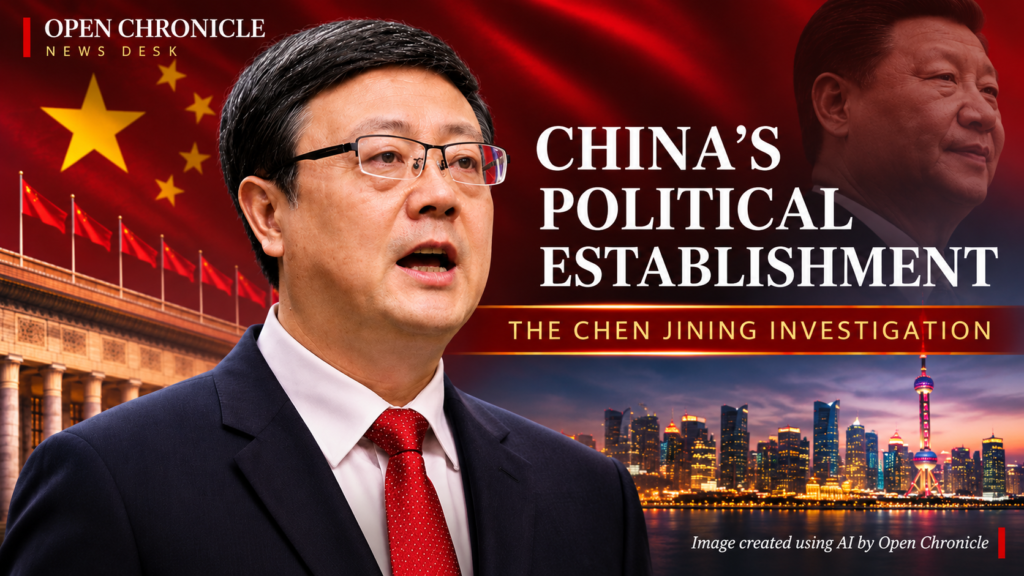
The investigation into one of China’s most prominent civilian leaders raises questions about political accountability, elite stability and the future composition of the country’s leadership ahead of the Communist Party’s 2027 Congress.
By Open Chronicle News Desk
November 25, 2026 | China | Politics and Geopolitics
China’s political establishment is confronting another significant development in President Xi Jinping’s extensive campaign against corruption, following the announcement of an investigation into Chen Jining, the Communist Party secretary of Shanghai and a member of the powerful Politburo.
On November 24, Chinese disciplinary authorities announced that Chen was suspected of serious breaches of party discipline and national law. The announcement, distributed by the official Xinhua News Agency, provided no specific details concerning the alleged offences.
The investigation is particularly significant because Chen was not merely a regional administrator. An internationally educated environmental scientist, former university president, government minister and mayor of Beijing, he embodied the combination of scientific expertise and political experience that has characterised several senior appointments under Xi.
His case also extends a series of investigations involving senior civilian and military figures at the highest levels of China’s political system.
Chen is the fourth member of the Politburo formed in 2022 to face an investigation since 2025, according to Reuters.
With the Communist Party preparing for its next national congress in 2027, the investigation introduces another element of uncertainty into the future composition of China’s leadership.
|
62
Age of Chen Jining
|
2022
Joined the Politburo
|
|
4th
Politburo member investigated since 2025
|
2027
Next Communist Party Congress
|
From environmental science to the centre of Chinese power
 |
Chen Jining
Shanghai Communist Party Secretary | Politburo member
Environmental scientist, academic and senior Chinese political official whose career brought him from scientific research into national government.
|
Chen’s professional background distinguishes him from many traditional political figures within the Communist Party.
He studied environmental engineering at Tsinghua University, one of China’s most prestigious academic institutions, and subsequently pursued scientific research in Britain, obtaining a doctorate at Imperial College London.
Returning to China, he developed an academic career that eventually brought him to the presidency of Tsinghua University in 2012.
His transition into government came during a period when environmental degradation, industrial pollution and urban air quality were becoming increasingly important political concerns.
As minister of environmental protection between 2015 and 2017, Chen was involved in addressing some of the environmental consequences of China’s rapid industrialisation.
His subsequent appointment as mayor of Beijing placed him in charge of the administration of the country’s capital.
In 2022, he assumed the leadership of Shanghai’s Communist Party organisation and entered the Politburo, establishing himself within the senior national leadership.
|
Academic years
Environmental engineering
Scientific education at Tsinghua University and doctoral research at Imperial College London.
|
|
|
2012
President of Tsinghua University
Assumes leadership of a major Chinese academic institution.
|
|
|
2015–2017
Minister of Environmental Protection
Moves into national government during a period of growing environmental policy challenges.
|
|
|
2018
Mayor of Beijing
Takes responsibility for the municipal administration of China’s capital.
|
|
|
2022
Shanghai Party Secretary
Enters the Politburo and assumes leadership of China’s principal financial centre.
|
|
|
November 24, 2026
Disciplinary investigation announced
Chinese authorities disclose an investigation into suspected violations of discipline and law.
|
Why Shanghai matters in Chinese politics
To understand the political significance of Chen’s investigation, it is necessary to understand Shanghai’s position within the Chinese system.
Shanghai is not simply one of China’s largest cities. It is a major international financial centre, an industrial and technological hub, and an essential connection between the Chinese economy and global markets.
Its municipal leadership oversees an economic environment that includes international financial institutions, advanced manufacturing, semiconductor development, shipping infrastructure and emerging technology industries.
The position of Communist Party secretary is particularly important because the party leadership exercises political authority over the municipal administration.
Historically, Shanghai has also provided a route into China’s national leadership.
Several prominent figures have occupied the position before assuming greater responsibilities in Beijing.
 |
Jiang Zemin
Shanghai Party Secretary, 1987–1989
Subsequently became China’s president and Communist Party general secretary.
|
 |
Xi Jinping
Shanghai Party Secretary, 2007
Subsequently entered the Politburo Standing Committee and assumed China’s senior leadership.
|
 |
Li Qiang
Shanghai Party Secretary, 2017–2022
Subsequently became China’s premier.
|
 |
Chen Jining
Appointed Shanghai Party Secretary in 2022
Subject of a disciplinary investigation announced in November 2026.
|
The historical importance of the position helps explain why political observers had closely followed Chen’s career.
However, occupying a prestigious municipal position does not guarantee promotion, nor does it provide immunity from disciplinary scrutiny.
Understanding China’s political hierarchy
China’s political system differs fundamentally from political systems in which competing parties seek governmental authority through national elections.
The Chinese Communist Party occupies the central position within the country’s governing structure, exercising leadership over state institutions and the armed forces.
Within the party, authority is organised through several interconnected leadership bodies.
The Politburo is among its most influential institutions, while the smaller Politburo Standing Committee occupies the highest level of collective party leadership.
Inside China’s Communist Party leadership
Simplified representation of senior party leadership levels. This diagram does not reproduce formal election procedures or every institutional relationship.
An investigation involving a Politburo member therefore carries implications beyond the administration of an individual province or municipality.
It affects the composition of an institution directly involved in determining China’s strategic priorities, domestic policies and international direction.
What exactly is Chen accused of?
The terminology used by Chinese authorities deserves careful attention.
The announcement referred to suspected serious violations of discipline and law, a formulation frequently employed when disciplinary investigations are initiated against senior officials.
Such wording can encompass corruption, abuse of authority, violations of party regulations and other forms of alleged misconduct.
However, the expression does not establish which specific offences Chen is suspected of committing.
China’s Central Commission for Discipline Inspection, together with the National Commission of Supervision, is responsible for investigating misconduct within the relevant party and public administration structures.
Depending on the findings, disciplinary proceedings may result in internal sanctions, expulsion from the party or referral to criminal justice authorities.
|
✓
|
PUBLICLY CONFIRMED
|
|
?
|
NOT PUBLICLY ESTABLISHED
|
Reuters reported that Chen had not been reachable for comment and that his access to legal representation remained unclear.
Until additional information becomes available, conclusions about his individual conduct or the political motivations behind the investigation would be premature.
Xi Jinping’s anticorruption campaign
Since assuming the leadership of the Communist Party in 2012, Xi Jinping has made internal discipline and the fight against corruption central elements of his political programme.
The campaign has reached across China’s governmental institutions, provincial administrations, state enterprises and military establishment.
From the perspective of the Chinese leadership, corruption threatens institutional effectiveness, public confidence and the Communist Party’s ability to govern.
Official statements present strict disciplinary enforcement as necessary to preserve the party’s integrity and ensure that national policies are implemented consistently.
Political analysts, however, have also examined the campaign in the context of the concentration of authority, elite competition and the enforcement of political loyalty.
These interpretations are not necessarily mutually exclusive.
Investigations may address genuine misconduct while simultaneously producing significant consequences for political relationships and institutional power.
The difficulty for outside observers is determining how these factors interact in individual cases, particularly when disciplinary proceedings are conducted with limited public disclosure.
|
⚖︎
|
Institutional accountability
Investigating corruption, abuse of authority and violations of official responsibilities.
|
|
✓
|
Party discipline
Enforcing internal regulations, organisational cohesion and compliance with central directives.
|
|
|
Political authority
Potential consequences for leadership networks, elite relationships and the distribution of influence.
|
Open Chronicle analytical framework. These dimensions are not findings concerning Chen Jining’s individual case.
Four Politburo figures under scrutiny
Chen’s investigation follows several other cases involving officials who occupied positions within the Communist Party’s senior leadership.
The developments demonstrate that disciplinary action has extended across both civilian and military institutions.
 |
OCTOBER 2025
He Weidong
Former Central Military Commission vice chairman
Expelled following allegations of serious disciplinary misconduct and financial offences.
EXPELLED |
 |
JANUARY 2026
Zhang Youxia
Former senior Central Military Commission vice chairman
Investigation announced in January, followed by subsequent removal and expulsion.
EXPELLED |
 |
APRIL 2026
Ma Xingrui
Former Xinjiang Party Secretary
Investigated in April, expelled in July and subsequently indicted on bribery charges in November.
CRIMINALLY CHARGED |
 |
NOVEMBER 2026
Chen Jining
Shanghai Party Secretary
Disciplinary investigation announced on November 24. Specific allegations remain undisclosed.
UNDER INVESTIGATION |
The military dimension of China’s disciplinary campaign
Although Chen’s career has been predominantly civilian, his investigation comes against the background of extensive changes within China’s military leadership.
The Central Military Commission, chaired by Xi Jinping, occupies a central position in the political supervision and command of China’s armed forces.
Investigations involving senior military officials have attracted international attention because they intersect with China’s military modernisation, procurement programmes and strategic ambitions.
The cases involving Zhang Youxia, He Weidong, Liu Zhenli and Miao Hua have affected individuals associated with important military leadership functions.
Analysts have considered several possible institutional objectives behind the broader disciplinary campaign, including improving procurement integrity, strengthening military professionalism and reinforcing political loyalty.
However, the removal of senior officers can also create organisational challenges.
Changes in leadership may affect institutional continuity, professional relationships and the management of long term modernisation programmes.
The extent of those effects remains difficult to establish from publicly available information.
Importantly, no evidence disclosed in Chen’s investigation establishes a direct connection between his case and the military investigations.
The limits of political proximity
One of the most interesting aspects of the Chen Jining case is his association with the type of leadership that Xi Jinping has frequently promoted.
Chen’s scientific background, experience in environmental policy and management of major urban economies made him representative of a broader emphasis on technically qualified administrators.
His professional profile appeared compatible with national priorities involving technological innovation, environmental protection and industrial modernisation.
Yet the investigation illustrates that such qualifications do not necessarily provide lasting political security.
Joseph Torigian, a specialist in Chinese elite politics at American University, has highlighted the difficulty of explaining why officials who initially appear compatible with Xi’s leadership priorities subsequently become vulnerable.
The broader analytical lesson is that political proximity should not automatically be interpreted as evidence of permanent protection.
Nor should the investigation itself be treated as proof that a political alliance has collapsed.
Without detailed evidence, the precise relationship between disciplinary misconduct and elite political dynamics remains uncertain.
Shanghai, technology and China’s economic ambitions
Chen’s investigation also deserves attention from an economic perspective.
Shanghai occupies an important position in China’s efforts to develop advanced manufacturing, artificial intelligence, financial services and strategic industries.
Its leadership must balance national policy objectives with the practical requirements of attracting investment, managing urban infrastructure and supporting technological innovation.
|
🏛︎
Global finance
Banking, capital markets and international financial services.
|
▦
Semiconductors
Advanced electronics and domestic technological capabilities.
|
|
🧠︎
Artificial intelligence
Research, commercial applications and emerging industries.
|
🚢︎
Global trade
Maritime logistics, port infrastructure and international supply chains.
|
|
🏭︎
Advanced manufacturing
Industrial production, electric vehicles and automation.
|
🌐︎
International investment
Commercial relationships with multinational companies.
|
A leadership transition in Shanghai could therefore attract attention from international businesses and financial institutions seeking clarity about administrative continuity.
Nevertheless, China’s economic policy is determined through a wider institutional framework.
An investigation into an individual municipal leader does not automatically imply a reversal of national economic priorities.
There is currently insufficient evidence to establish that Chen’s case will result in substantial changes to Shanghai’s investment environment or technological development programmes.
The road towards the 2027 Communist Party Congress
The timing of the investigation is particularly relevant.
China’s next national Communist Party Congress is expected to take place in the second half of 2027.
These congresses provide an institutional framework for reviewing party priorities, renewing leadership bodies and establishing the political direction of the following period.
The investigation into Chen introduces another variable into discussions surrounding future leadership appointments.
Reuters and other international news organisations have reported that political observers previously regarded Chen as a possible candidate for promotion within the national leadership.
His investigation does not, however, provide sufficient evidence to identify future appointments or determine the eventual composition of the Politburo Standing Committee.
The disciplinary campaign is likely to remain an important subject of international scrutiny as preparations for the congress advance.
|
2012
Xi assumes party leadership
|
|
|
2022
20th Communist Party Congress
|
|
|
2025–2026
Senior leadership investigations
|
|
|
NOVEMBER 2026
Chen Jining investigation
|
|
|
2027
21st Party Congress expected
|
How international observers should interpret the investigation
The investigation is significant for governments, businesses and researchers attempting to understand China’s political trajectory.
However, the interpretation of Chinese elite politics requires caution.
The limited transparency surrounding internal disciplinary proceedings creates an environment in which incomplete information can generate competing explanations.
Several developments deserve particular attention over the coming months.
| Area | What to monitor |
|---|---|
| Disciplinary proceedings | Publication of specific findings concerning Chen. |
| Legal developments | Possible referral to prosecutors or announcement of criminal charges. |
| Shanghai leadership | Official decisions concerning municipal leadership responsibilities. |
| Economic continuity | Changes, if any, to investment and industrial policies. |
| Politburo composition | Formal changes to senior party membership. |
| Military leadership | Further appointments and disciplinary announcements. |
| 2027 Congress | Official preparations, institutional priorities and leadership decisions. |
These indicators offer a more reliable basis for assessing political developments than speculation concerning undisclosed personal rivalries or alleged factional disputes.
Five broader questions raised by the Chen Jining investigation
|
01
⚖︎
|
Institutional accountability
How effectively can internal disciplinary mechanisms investigate misconduct while providing sufficient transparency about their findings?
|
|
02
👥︎
|
Leadership stability
What consequences might repeated investigations have for continuity within senior political institutions?
|
|
03
🎓︎
|
The future of technocratic leadership
How will scientific expertise and administrative experience influence future appointments?
|
|
04
🏛︎
|
Economic governance
Can major economic centres maintain policy continuity during changes in political leadership?
|
|
05
📅︎
|
The 2027 political transition
How will disciplinary proceedings intersect with preparations for the next national party congress?
|
Conclusion: A political system under continuing disciplinary scrutiny
The investigation into Chen Jining represents another significant episode in the evolution of China’s political establishment under Xi Jinping.
Its importance derives not only from Chen’s seniority but also from the institutions he has represented throughout his career.
From environmental research and academic leadership to national government and the administration of Shanghai, Chen’s professional trajectory reflected several of the priorities associated with China’s modernisation.
His investigation now raises questions about the relationship between administrative expertise, political accountability and leadership continuity.
For the Chinese authorities, the case forms part of an ongoing commitment to strict party governance and anticorruption enforcement.
For international analysts, it also provides an opportunity to examine how disciplinary mechanisms interact with the organisation of political power.
As China approaches its 2027 Communist Party Congress, the consequences of the investigation will become clearer only through subsequent official decisions, publicly disclosed findings and institutional developments.
For now, the most important distinction remains between what has been announced, what has been alleged and what has yet to be established.
Understanding China’s political future requires attention to all three.
|
01
|
Al Jazeera | Who is Chen Jining, China’s latest Politburo member under investigation?
November 25, 2026
Biographical background, the disciplinary investigation and related cases involving senior Chinese officials.
|
|
02
|
Reuters | Investigation into Shanghai Party Secretary Chen Jining
November 24 and 25, 2026
Reporting on the announcement and its significance within the Politburo.
|
|
03
|
Associated Press | China investigates Politburo member and Shanghai party chief Chen Jining
November 25, 2026
International reporting and expert commentary on the continuing disciplinary campaign.
|
|
04
|
Reuters | China’s Politburo shrinks as graft crackdown spreads
November 25, 2026
Chronological context and procedural developments concerning other Politburo figures.
|
|
05
|
Xinhua / People’s Daily | Official disciplinary investigation announcement
November 24 and 25, 2026
Chinese language publication of the official announcement concerning Chen Jining.
|
|
06
|
Reuters / ThePrint | Shanghai party pledges loyalty to Beijing
November 25, 2026
Reporting on the response of Shanghai’s municipal party leadership.
|
|
07
|
Financial Times | Shanghai’s powerful Communist Party boss toppled as Xi Jinping escalates purge
November 25, 2026
Additional political and economic context surrounding the investigation.
|