
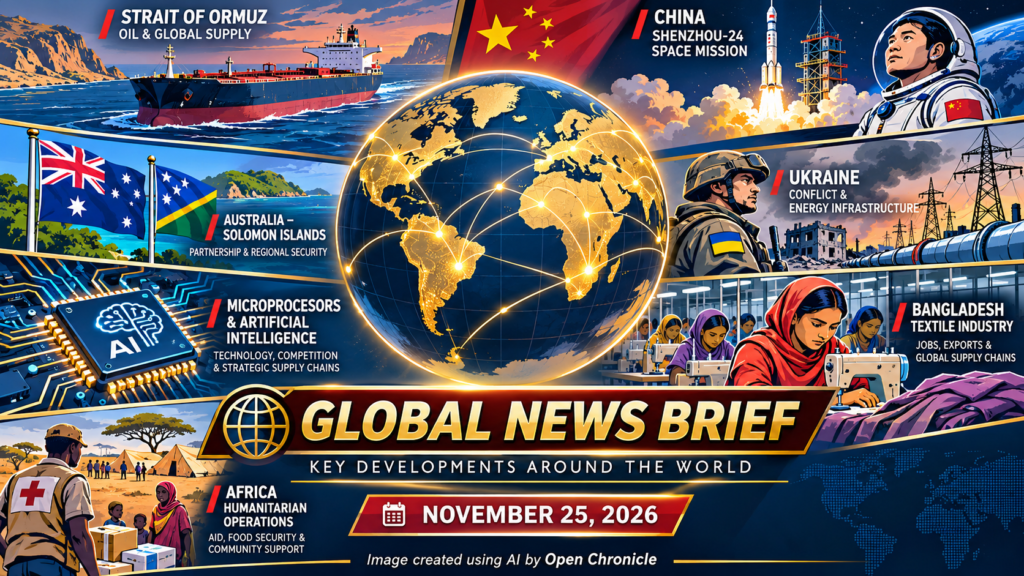
From an escalating confrontation in the Strait of Hormuz and renewed diplomatic manoeuvring over Ukraine to a historic space mission, a changing balance of power in the Pacific and growing concerns over artificial intelligence, today’s developments reveal a world in which military security, technological leadership, economic resilience and humanitarian survival are becoming increasingly interconnected.
By Open Chronicle News Desk
Wednesday, November 25, 2026 | Morning Edition
08 Geographical regions | 06 Global thematic sections |
24H Forward-looking assessment | 09:40 UTC editorial snapshot |
Today’s Global Outlook
The international news agenda on Wednesday is being shaped by several overlapping developments that could have consequences far beyond their immediate geographical boundaries.
In the Middle East, fresh reports of attacks on commercial shipping in the Strait of Hormuz are intensifying concerns over global energy security. Washington is reportedly considering new options in its confrontation with Iran, while renewed hostilities involving Saudi Arabia and Yemen’s Houthis threaten another important maritime corridor.
In Europe, Ukraine’s reported attacks against Russian energy infrastructure coincide with diplomatic discussions about a possible peace settlement, future security guarantees and Europe’s responsibility for supporting Kyiv.
Meanwhile, Australia and Solomon Islands have signed a major treaty that strengthens Canberra’s position in the Pacific, while China has achieved a historic milestone by carrying Pakistan’s first astronaut into orbit.
Economic and technological developments are equally significant. Huawei’s reported conviction in the United States, the political controversy surrounding Nvidia and the compromise of American intelligence systems illustrate how technological competition increasingly intersects with national security.
Beyond these strategic developments, humanitarian emergencies in Sudan, Gaza and Yemen continue to expose the human consequences of prolonged conflict.
The Six Stories Defining Today’s Global Agenda
01 | MIDDLE EAST Hormuz faces renewed maritime insecurity Fresh reports of attacks on commercial vessels raise concerns about energy supplies and international navigation. |
02 | INDO-PACIFIC Australia strengthens its Pacific security position A new treaty with Solomon Islands reshapes regional security relationships. |
03 | EUROPE Ukraine’s military and diplomatic campaigns converge Reported attacks on Russian energy infrastructure accompany negotiations over a possible peace framework. |
04 | SCIENCE & SPACE Pakistan enters a new chapter in space exploration The Shenzhou-24 mission carries the first foreign astronaut to China’s space station. |
05 | TECHNOLOGY & INTELLIGENCE America confronts new digital security challenges Intelligence system breaches, semiconductor disputes and the Huawei case place technology at the centre of national security. |
06 | HUMANITARIAN AFFAIRS Sudan and Gaza face mounting civilian suffering Renewed fighting, disease, displacement and deteriorating medical services deepen humanitarian concerns. |
Part I | The World by Region
1. Europe, Russia and Ukraine
Diplomacy intensifies as the war expands beyond traditional battlefields
Ukraine remains at the centre of European security discussions as military operations continue alongside increasingly complicated diplomatic negotiations.
Ukrainian drones reportedly struck two major oil refineries in Russia’s Samara region. The incidents underline the continuing vulnerability of energy infrastructure and its importance to Russia’s wartime economy.
Russian attacks were also reported in the Kyiv, Odesa, Volyn and Zaporizhzhia regions, with civilian casualties and damage to infrastructure.
At the diplomatic level, Ukrainian President Volodymyr Zelensky reportedly indicated that Washington was seeking progress towards a peace agreement by January. President Donald Trump, however, suggested that he was not committed to a fixed timetable.
Belarusian President Alexander Lukashenko offered to facilitate direct discussions between Zelensky and Vladimir Putin in Moscow, an initiative that received a sceptical response from the Ukrainian leadership.
Europe seeks a stronger role in peace negotiations
European Commission President Ursula von der Leyen reportedly indicated that a substantial European delegation would participate in the next round of Ukraine peace discussions.
The announcement comes amid continuing disagreements over how European governments should finance Ukraine, utilise frozen Russian assets and contribute to future security arrangements.
Germany is reportedly increasing defence expenditure while reducing some development assistance and international contributions. Norway is planning substantial additional support for Ukraine in 2027, particularly in air defence and unmanned systems.
Britain is also continuing its military assistance, while Poland and the United States have reportedly concluded a defence research agreement following years of negotiations.
The war’s international consequences
Reports concerning Ukrainian operations against Russian interests in Libya have raised concerns in Italy, Egypt and other Mediterranean countries.
Separately, allegations of Russian interference with civilian satellite navigation near Britain and accusations by Moscow against Estonia highlight the potential for security tensions to extend beyond Ukraine’s borders.
These claims require further independent verification, particularly where they concern responsibility for specific incidents.
Other European developments
Spain’s election campaign is increasingly focused on housing affordability, construction policies and rent regulation.
Hungary and Ukraine reportedly agreed to expand cooperation in energy and border management.
European governments are discussing additional restrictions affecting Russian passports and former combatants.
The European Union is considering stronger protection of its eastern borders, including rapid response and counter-drone capabilities.
Political debate continues in France over reported military commitments involving Ukraine.
European judicial decisions concerning migration and border enforcement are renewing debates over national security and human rights.
European startup legislation is generating disagreements over administrative and regulatory requirements.
Bosnia and Herzegovina marks Statehood Day amid continuing discussions about political stability and European integration.
Why it matters: Europe is being compelled to consider not only how to support Ukraine, but also how to construct a security architecture capable of functioning during and after the conflict.
2. Middle East and the Persian Gulf
Strait of Hormuz becomes the focus of renewed international concern
Reports of attacks involving commercial vessels in the Strait of Hormuz have intensified fears of further escalation between Iran and the United States.
Iranian accounts concerning damaged tankers and reports attributed to American officials have offered differing descriptions of the incidents.
The precise circumstances, responsibility and operational consequences remain uncertain.
Nevertheless, the strategic importance of the waterway means that even limited disruption can influence shipping insurance, energy prices and international supply chains.
Washington is reportedly considering additional options involving Iran’s senior leadership, while President Trump has indicated that existing funding for the conflict could sustain American operations into January.
These developments are reported policy discussions and statements, rather than confirmation that additional military action has been authorised.
OPEN CHRONICLE | STRATEGIC MARITIME SECURITY
Two maritime corridors under pressure
Strait of Hormuz
Critical passage for Persian Gulf energy exports.
Red Sea and Bab el-Mandeb
Major maritime connection between Asia, Europe and the Mediterranean.
Conceptual geographical illustration. Markers identify strategic waterways, not verified attack locations.
Saudi Arabia and the Houthis
The Saudi-led coalition has reported renewed military operations against Houthi capabilities in Yemen, including activities associated with Hodeidah.
The Houthis have issued claims concerning attacks against Saudi targets and threatened further action against Red Sea ports.
The competing statements raise concerns about the potential reopening of a wider regional confrontation.
Commercial aviation has also reportedly experienced disruption associated with the deteriorating security environment.
Israel’s coalition negotiations
Israeli political developments are being shaped by Gadi Eisenkot’s attempts to construct a governing coalition.
Reports indicate that Eisenkot has reached an initial agreement with Avigdor Lieberman while continuing discussions involving other political parties.
Disagreements within Israel’s opposition underline the difficulty of translating electoral support into a stable parliamentary majority.
Gaza and the West Bank
Reports of further Israeli military operations in Gaza, including a strike involving a Hamas security official and members of his family, are raising renewed questions about the durability of the ceasefire.
In the West Bank, military operations, arrests and restrictions on Palestinian movement continue to generate concern.
Humanitarian organisations are simultaneously warning about disease, inadequate winter shelter, medical shortages and the consequences of separating mothers from newborn children.
Iraq and Lebanon
Iraq has emphasised the independence of its national decision-making following reports of American support for military deployments.
Relations between Baghdad and the Kurdistan Regional Government are also facing renewed tensions over autonomy and central government authority.
In Lebanon, President Joseph Aoun has continued to emphasise diplomacy while defending national sovereignty.
Why it matters: Escalation in the Middle East is no longer solely a regional military issue. It has direct implications for international energy security, commercial transportation, inflation and diplomatic relations.
3. Africa
Sudan’s humanitarian emergency deepens
Renewed fighting in Sudan has prompted fresh warnings concerning deteriorating humanitarian conditions.
Reports of attacks affecting civilians in Blue Nile state and other areas illustrate the continuing dangers faced by displaced communities and families attempting to access essential services.
Ethiopia has offered to host inclusive negotiations intended to advance a political settlement, but Sudanese authorities have reportedly questioned Ethiopia’s neutrality.
The disagreement highlights a fundamental difficulty in resolving the conflict: regional governments may be able to facilitate negotiations, but their perceived political interests can undermine confidence in mediation.
Nigeria confronts digital surveillance and institutional challenges
Reports examining the expansion of digital surveillance in Nigeria are drawing attention to the relationship between technology companies, artificial intelligence and state authority.
Digital systems can improve public administration and security, but their deployment without adequate oversight can create significant privacy and civil liberties concerns.
Nigeria also faces continuing questions about judicial delays, access to legal representation and the treatment of economically disadvantaged citizens.
South Africa’s political institutions
South African President Cyril Ramaphosa has reportedly succeeded in a court challenge seeking to overturn a parliamentary panel report associated with the Farmgate controversy.
The development represents an important moment in the continuing relationship between judicial oversight, parliamentary accountability and executive authority.
Africa’s evolving security environment
Armed groups operating across parts of Africa are increasingly associated with commercially available drone technology.
Meanwhile, reports concerning Türkiye’s military engagement in Somalia point to Ankara’s expanding security relationships across the continent.
Africa’s clothing and manufacturing industries are also receiving attention as governments and businesses explore opportunities to diversify international production networks.
Why it matters: Africa’s emerging challenges increasingly combine traditional security threats with technological transformation, economic opportunity and institutional governance.
4. North Africa and the Mediterranean
Libya becomes an increasingly important strategic crossroads
Eastern Libyan commander Khalifa Haftar’s reported visit to Türkiye represents a potentially significant development in relations between Ankara and Libya’s competing political and military authorities.
Türkiye has historically maintained close relations with authorities in western Libya. Broader engagement with eastern institutions could indicate a more flexible diplomatic approach.
At the same time, reports of Ukrainian operations against Russian interests near Libya are complicating the regional security environment.
Italy and Egypt have substantial interests in Mediterranean security, energy infrastructure and political stability in Libya.
Washington has also reportedly reaffirmed its diplomatic efforts to reduce Libya’s institutional divisions.
Egypt explores regional economic integration
Proposals to ease travel restrictions between Egypt and Iraq are generating discussion about tourism, commercial activity, labour mobility and wider economic cooperation.
Egyptian policymakers must also consider the implications of growing security tensions near Libya and the Red Sea.
Migration and Mediterranean security
New reporting concerning dangerous migration routes through Libya highlights the continued exploitation of vulnerable migrants by criminal networks.
The issue remains closely connected to European border policy, instability in North Africa and the absence of safe migration alternatives.
Why it matters: Libya increasingly sits at the intersection of European security, Russian military interests, Turkish regional influence, African migration and Mediterranean energy networks.
5. East Asia and the Indo-Pacific
Australia and Solomon Islands reshape Pacific security
Australia and Solomon Islands have signed a comprehensive bilateral treaty that establishes Australia as the island nation’s principal security partner and prohibits foreign military or security bases.
The agreement also extends into infrastructure, education and economic development.
Although the treaty represents a significant strengthening of Australia’s regional position, Solomon Islands Prime Minister Matthew Wale declined to publicly confirm the precise future of the country’s earlier security arrangement with China.
Beijing maintains that its cooperation with Pacific island nations is not directed against third countries.
| New Australia–Solomon Islands treaty | |
| Existing Chinese security relationship under review |
China’s political leadership faces another corruption investigation
Chinese authorities are reportedly investigating Shanghai Communist Party chief Chen Jining, a senior figure within the country’s political leadership.
The development has renewed attention on President Xi Jinping’s anti-corruption campaign and its implications for elite political stability.
Official investigations should not be treated as proof of individual guilt before their findings are established.
North Korea confronts Switzerland
North Korea has reportedly ordered the closure of Switzerland’s recently reopened diplomatic office and demanded the departure of its representative.
The dispute follows Swiss sanctions associated with a North Korean youth programme reportedly connected to Russia’s war in Ukraine.
Other developments concerning North Korea’s naval capabilities and nuclear infrastructure continue to attract international security attention.
Japan’s artificial intelligence ambitions
Japan is reportedly seeking to become one of the world’s three leading artificial intelligence powers, behind the United States and China.
Achieving that ambition would require sustained investment in computing infrastructure, semiconductor capabilities, research and skilled personnel.
Japan is also confronting a reported security incident involving an online securities platform, highlighting the risks associated with increasingly digitised financial services.
Other regional developments
Australia’s internet safety legislation is generating disagreement with Washington over freedom of expression and platform regulation. Chinese activities around the disputed Paracel Islands are attracting renewed attention, while debates over the future of the Quad reflect uncertainty about regional strategic cooperation.
Why it matters: The Indo-Pacific is becoming a central arena of competition over security partnerships, technological infrastructure, trade and diplomatic influence.
6. South Asia and Southeast Asia
Pakistan celebrates a historic achievement in space
Pakistan has reached a landmark in its scientific history with the launch of Muhammad Zeeshan Ali aboard China’s Shenzhou-24 spacecraft.
The mission marks the first participation of a foreign astronaut in China’s crewed space programme, strengthening the scientific dimension of the relationship between Beijing and Islamabad.
The mission also demonstrates China’s growing ability to develop international partnerships through its independent space infrastructure.
24 Shenzhou mission | 3 Crew members | 1st Foreign astronaut |
Bangladesh’s garment workers secure a wage increase
Following weeks of industrial unrest, Bangladesh’s wage board approved a 36 per cent increase in the minimum wage for garment workers.
Reuters reported that the new minimum would rise from 12,500 to 17,000 taka per month, with implementation beginning in December.
The decision has not fully satisfied workers’ demands, and further protests have been reported.
The dispute has international significance because Bangladesh is a major supplier to the global fashion industry.
Bangladesh’s political uncertainty
Former Prime Minister Sheikh Hasina has reportedly announced plans to return to Bangladesh on December 16, while authorities in Dhaka continue to seek her extradition.
The announcement comes amid concerns over political polarisation, press freedom and the country’s institutional transition.
Indonesia’s mining emergency
Rescue teams are reportedly searching for workers feared trapped inside a flooded gold mine in Indonesia.
The incident has renewed attention on occupational safety, informal mining and the challenges of regulating mineral extraction in remote areas.
India, Israel and regional strategic partnerships
India’s relationship with Israel continues to attract attention because of cooperation involving defence technology, intelligence, surveillance and industrial development.
Relations between India and Nepal are also under discussion following disagreements over earlier bilateral recommendations.
Other regional developments
Malaysia is reportedly reviewing commercial relationships involving semiconductor companies affected by American export restrictions. Its reported plans concerning the return of Rohingya refugees to Myanmar have also raised humanitarian and legal concerns.
Sri Lanka’s critical mineral resources are receiving growing geopolitical attention, while misinformation involving domestic political developments continues to circulate across South Asian digital platforms.
Why it matters: South Asia illustrates the contrasting dimensions of global development. Historic scientific achievements coexist with labour disputes, political uncertainty, industrial safety concerns and humanitarian challenges.
7. North America
Cyberattacks expose vulnerabilities in American intelligence infrastructure
Reports of cyber intrusions involving the Central Intelligence Agency and the Office of the Director of National Intelligence have raised concerns about the protection of government information systems.
The affected infrastructure reportedly supported the collection and analysis of unclassified information.
Although classified information was not reported to have been compromised, unclassified analytical systems can still contain material of considerable strategic value.
The identity of those responsible and the suspected involvement of a Chinese-developed cybersecurity application remain unresolved.
The incident has added to wider concerns about the resilience of American government technology infrastructure.
Nvidia becomes a political and national security controversy
The return of Jensen Huang to Nvidia’s leadership, as reported in the supplied news coverage, continues to generate political debate in Washington.
Questions surrounding semiconductor export controls, congressional oversight and access to advanced artificial intelligence hardware are placing the company at the centre of competing economic and security priorities.
Republican lawmakers have reportedly expressed concerns over the administration’s intervention, while Democratic figures have questioned whether existing export restrictions were adequately enforced.
The controversy illustrates the increasingly complicated relationship between corporate leadership and national technological strategy.
Washington debates trade restrictions
The United States is reportedly considering additional tariffs affecting countries accused of supporting industrial production through subsidies.
Potential measures could affect China, European economies and other major trading partners.
Such policies could create further uncertainty for manufacturers operating across international supply chains.
Consumer confidence improves
American consumer confidence reportedly increased to its strongest level in nearly two years, reflecting improved perceptions of employment opportunities and economic conditions.
The improvement nevertheless comes against a background of uncertainty surrounding tariffs, energy prices and international conflicts.
Aviation tragedy off Mississippi
Six people, including two children, were reportedly killed when a small aircraft crashed into the sea off the Mississippi coast.
Investigators are expected to examine the circumstances surrounding the accident.
Separately, American aviation authorities are investigating the causes of a recent nationwide air traffic disruption.
Canada and international economic partnerships
Canada and Qatar are exploring opportunities to strengthen bilateral investment and economic cooperation.
The discussions reflect Ottawa’s continuing interest in diversifying its international economic relationships.
Why it matters: American domestic developments increasingly have international consequences, particularly in artificial intelligence, semiconductor exports, cybersecurity, trade and military funding.
8. Latin America and the Caribbean
Colombian authorities respond to hostage crisis
Colombian security forces intervened following a hostage incident at a supermarket in Cartagena.
Subsequent reports indicated that all hostages had been released.
A separate bombing in Villavicencio has raised additional concerns about the spread of violence into urban areas.
The incidents are distinct and should not be interpreted as evidence of a coordinated campaign without further information.
Venezuela confronts debt and social unrest
Venezuela has reportedly disclosed a debt burden of approximately $237.5 billion as part of preparations for a possible restructuring process.
The figure requires clarification regarding the categories of obligations included and the methodology used.
At the same time, protests over minimum wages illustrate the continuing economic pressures experienced by Venezuelan households.
A reported new military agreement with the United States introduces another dimension to Venezuela’s evolving international relationships.
Chile faces education protests
Teachers have reportedly participated in nationwide industrial action against education spending reductions.
The protests highlight disagreements over public expenditure, social priorities and the future of educational services.
Chile is also attracting attention for its strategic mineral resources and regional security capabilities.
Cuba’s energy emergency
The World Health Organization’s leadership has reportedly called for an end to American restrictions affecting Cuba’s access to fuel.
Energy shortages can have significant consequences for hospital operations, refrigeration, emergency transportation and the delivery of essential medical services.
Why it matters: Latin America’s political and economic challenges increasingly intersect with international debt markets, strategic resources, public security and the provision of essential services.
Part II | Global Thematic Developments
9. Global Economy, Trade and Financial Markets
China reportedly places major Boeing aircraft order
China has reportedly placed an order for 50 Boeing aircraft valued at approximately $7.4 billion.
If confirmed on the terms reported, the agreement would represent a significant development in commercial aviation and economic relations between China and the United States.
It would also illustrate the persistence of commercial interdependence despite wider geopolitical tensions.
The reported valuation should not automatically be interpreted as Boeing’s eventual realised revenue, since aircraft agreements may include negotiated discounts and different delivery schedules.
Huawei’s conviction creates another technology dispute
A United States jury convicted Huawei on ten of twelve criminal counts in a case involving its business activities in Iran, financial misconduct and trade secret allegations.
Huawei rejected the findings and indicated that it intended to appeal. Beijing criticised the American government’s treatment of Chinese technology companies.
The verdict represents a significant development in the continuing legal and commercial confrontation surrounding Chinese telecommunications technology.
Artificial intelligence uncertainty weighs on markets
Asian financial markets reportedly experienced renewed pressure amid questions about the sustainability of artificial intelligence investment and valuations.
The political controversy surrounding Nvidia has reinforced concerns about the concentration of global technological expectations around a relatively small number of companies.
European industry confronts new pressures
European developments include reported restrictions affecting hybrid vehicle imports, uncertainty surrounding London’s ability to retain major corporate listings and debates over the future competitiveness of European startups.
Meanwhile, renewed instability in the Middle East is reportedly contributing to a substantial increase in Britain’s household energy price cap.
Global supply chains under pressure
Bangladesh’s garment sector, semiconductor export restrictions in Asia and shipping insecurity in the Middle East demonstrate how disruptions in different regions can affect businesses and consumers thousands of kilometres away.
36% Bangladesh garment wage increase Reported by Reuters | 50 Aircraft in reported Chinese Boeing order Commercial terms require confirmation |
$237.5bn Reported Venezuelan debt burden Scope requires clarification | 103.3 Reported US consumer confidence index Morning news coverage |
10. Defence, Intelligence and International Security
United Nations warns about artificial intelligence in warfare
The United Nations Secretary-General has reportedly renewed calls for international action addressing autonomous weapons and the transformation of warfare through artificial intelligence.
The debate extends beyond the technological capabilities of military systems.
It also concerns human responsibility, compliance with international humanitarian law, accountability and the ability to prevent unintended escalation.
Europe accelerates military modernisation
Germany is reportedly preparing to establish a dedicated drone regiment, while Poland and the United States are expanding defence research cooperation.
Norway’s proposed assistance to Ukraine and continuing British military support reflect the growing importance of air defence, unmanned technology and industrial production.
North Korea’s military modernisation
Reports concerning North Korean naval development and the expansion of nuclear infrastructure are attracting renewed attention from security analysts.
The intended capabilities and operational significance of individual facilities require careful assessment.
Russia’s reported recruitment of foreign workers
Investigations concerning the recruitment of Southeast Asian nationals for Russia’s war in Ukraine raise questions about military manpower, deceptive employment practices and the protection of migrant workers.
The reports also demonstrate how the social consequences of the war can extend far beyond Europe.
The growing international importance of drones
From European battlefields to African conflict zones, unmanned systems are changing the economics and organisation of military operations.
The resulting challenges include civilian protection, airspace security, technological proliferation and the development of effective defensive capabilities.
⛢︎ Conventional defence Military readiness, alliances and industrial capacity. | ▦ Artificial intelligence Automation, analytical capabilities and human oversight. |
🔒︎ Cybersecurity Protection of digital infrastructure and information. | 🛰︎ Space security Communications, navigation and orbital infrastructure. |
11. Cybersecurity, Artificial Intelligence and Digital Governance
The boundaries between technology and national security disappear
Several of today’s most significant developments concern the intersection of digital technology, economic power and national security.
The American intelligence breach, Huawei’s criminal conviction and controversies surrounding Nvidia illustrate different aspects of this transformation.
Governments increasingly regard computing infrastructure, semiconductor production and artificial intelligence systems as strategic assets.
Quantum computing and European security
European discussions about quantum technology are increasingly focused on the long-term security of digital communications and encrypted information.
Quantum computing could eventually undermine some widely used public-key cryptographic systems, making preparation for post-quantum cryptography an important institutional priority.
Digital surveillance in Nigeria
The reported expansion of digital surveillance in Nigeria raises questions about privacy, democratic accountability and the responsibilities of technology providers.
The challenge is not simply whether advanced monitoring technologies should exist, but how their use should be governed.
Australia’s internet regulation
Australia’s efforts to impose stronger obligations on online platforms have reportedly prompted criticism from the United States.
The disagreement reflects competing approaches to online safety, freedom of expression and the responsibilities of technology companies.
Financial data protection in Japan
A reported data leak involving a Japanese online securities company has raised concerns about the protection of financial information.
The supplied coverage refers to information associated with approximately 1.68 million accounts, although the precise scope of exposure requires confirmation.
Misinformation remains a global challenge
Misleading videos associated with political developments in Bangladesh and Sri Lanka, alongside reports of disaster-related misinformation encouraging panic buying, demonstrate the continuing difficulty of protecting the integrity of public information.
12. Humanitarian Affairs, Human Rights and Global Health
Sudan’s civilians face renewed danger
Renewed fighting in Sudan continues to threaten communities already affected by displacement, food insecurity and inadequate access to healthcare.
Reports of civilian deaths and attacks affecting residential areas underline the importance of protecting non-combatants and maintaining humanitarian access.
Gaza’s medical emergency intensifies
Reports of rising meningitis cases, particularly among infants, are adding to concerns about deteriorating public health conditions in Gaza.
Medical services are reportedly experiencing further disruption because of electricity and generator failures.
Winter conditions threaten displaced families living in inadequate shelters, while shortages of basic supplies continue to undermine their ability to protect themselves.
Amnesty International has also reportedly raised concerns about the effects of military operations and restrictions on reproductive healthcare.
Its allegations and calls for international legal investigation should be distinguished from findings established by a competent court.
Yemen’s humanitarian crisis
Rising prices, insecurity and renewed military confrontation are placing additional pressure on Yemeni households.
Families in Hodeidah and other vulnerable communities face uncertainty over access to food, fuel and essential services.
Preventable maternal deaths
International campaigns are calling for greater attention to preventable deaths during pregnancy and childbirth.
Access to clean water, trained medical personnel, emergency transportation and adequately equipped health facilities remains essential to improving maternal survival.
Migration and human rights
European judicial developments concerning border enforcement, reports of dangerous Mediterranean crossings and proposed refugee returns to Myanmar are renewing questions about the balance between migration management and international protection obligations.
♡ | Sudan Renewed fighting, displacement and humanitarian access. |
♡ | Gaza Disease, winter shelter shortages and disrupted medical services. |
♡ | Yemen Rising living costs, food insecurity and renewed hostilities. |
♡ | Myanmar and displaced Rohingya communities Protection, displacement and the consequences of proposed refugee returns. |
13. Science, Space and the Environment
China’s space programme enters a new international phase
The Shenzhou-24 mission represents more than a national achievement for Pakistan.
It demonstrates the emergence of China’s space station as an additional platform for international scientific cooperation.
As governments develop new partnerships in space, scientific diplomacy is becoming increasingly important to international relations.
Planetary defence returns to the spotlight
A spacecraft has reportedly arrived to investigate the consequences of an earlier deliberate asteroid impact, four years after the original planetary defence experiment.
Such missions are important because they allow scientists to evaluate whether controlled interventions could alter the movement of potentially dangerous celestial objects.
The Beaver Supermoon
Observers across different regions have reported impressive views of the Beaver Supermoon.
The astronomical event offers a reminder that scientific curiosity remains one of the few genuinely universal interests shared across national and political boundaries.
Water security and environmental protection
International discussions concerning water security are receiving greater attention as governments confront the relationship between public health, agricultural production, energy systems and climate resilience.
European debates over pesticide regulation and energy cooperation similarly reflect the difficulty of balancing environmental objectives with economic interests.
14. Society, Culture and Sport
Pope Francis’ private writings attract international attention
Reports concerning private diary entries attributed to the late Pope Francis have renewed interest in his personal spirituality, religious experiences and reflections on the responsibilities of the priesthood.
The writings have also generated discussion about the relationship between personal belief, historical documentation and institutional accountability.
Hong Kong remembers a devastating fire
One year after a deadly residential fire, survivors and relatives of victims are reportedly returning to damaged homes and reflecting on their losses.
Questions concerning building safety, responsibility and compensation remain central to the public debate.
Ukrainian cultural heritage
An exhibition in Kyiv celebrating the work of Ukrainian illustrator Vladyslav Yerko is drawing attention to the importance of preserving cultural life during wartime.
The Istanbul Photo Awards have also provided a platform for discussions about photojournalism and its ability to document experiences that might otherwise receive limited public attention.
International sport and institutional accountability
Reports indicate that a sports arbitration decision has restored an Africa Cup title to Senegal following a dispute involving Morocco.
The precise implications of the ruling should be assessed against the official decision.
Remembering cultural figures
Reports concerning the deaths of Nigerian actor Pete Edochie and Martha Ford have generated tributes in the entertainment and automotive communities respectively.
Their reported deaths remain among the items requiring direct confirmation before more extensive obituary coverage.
Part III | Open Chronicle Global Analysis
15. The Global Strategic Assessment
Today’s developments reveal six broader forces shaping the international environment.
01 ◎ | Regional conflicts are acquiring global consequences Developments involving Ukraine, Iran, Libya and Yemen increasingly affect countries and economic networks beyond their immediate geographical boundaries. |
02 ⚓︎ | Maritime security is becoming an economic priority Instability around strategically important waterways threatens international trade, energy supplies and transportation costs. |
03 ▦ | Technology is becoming an instrument of national power Artificial intelligence, semiconductor manufacturing, telecommunications and cybersecurity are central to competition between major economies. |
04 ∞ | International partnerships are being redefined Australia’s Pacific treaty and China’s space cooperation with Pakistan illustrate different approaches to expanding international influence. |
05 ▤ | Economic resilience depends on global interdependence Labour disputes, industrial subsidies, export restrictions and infrastructure disruptions can produce consequences across multiple continents. |
06 ♡ | Humanitarian emergencies remain the greatest human cost Sudan, Gaza, Yemen and displaced communities elsewhere demonstrate the continuing gap between international political ambitions and civilian protection. |
16. What to Watch Over the Next 24 Hours
The following developments could influence the international news agenda between today and tomorrow.
| Area of interest | What to watch |
|---|---|
| Strait of Hormuz | Independent confirmation of vessel incidents and changes to maritime security advisories. |
| Iran and the United States | Washington’s military and diplomatic decisions, including congressional funding discussions. |
| Saudi Arabia and Yemen | Further developments involving the Saudi-led coalition and Houthi responses. |
| Ukraine peace negotiations | European participation, American proposals and Russian territorial demands. |
| Russian energy infrastructure | Confirmation of damage and consequences for refinery operations. |
| Israel | Progress in coalition negotiations involving Gadi Eisenkot. |
| Gaza | Medical conditions, humanitarian access and the consequences of deteriorating weather. |
| Sudan | Responses to Ethiopia’s mediation proposal and developments in civilian protection. |
| Australia and Solomon Islands | Implementation of the new treaty and Beijing’s diplomatic response. |
| Huawei | Corporate and governmental reactions to the American court verdict. |
| Nvidia | Congressional scrutiny and possible changes to semiconductor export policy. |
| US intelligence cybersecurity | Additional information concerning the breach, its scope and attribution. |
| Bangladesh | Workers’ reactions to the minimum wage decision. |
| Indonesia | Progress in rescue operations at the flooded gold mine. |
| Shenzhou-24 | Scientific activities and further updates concerning Pakistan’s historic space mission. |
The World in Perspective
November 25, 2026, offers a revealing picture of an international system undergoing profound transformation.
Australia is strengthening its position in the Pacific through diplomacy. China is expanding its international scientific relationships through space exploration. European governments are reconsidering the foundations of their security. The United States is confronting difficult questions about the relationship between technological leadership and national security.
At the same time, conflicts in Ukraine, Sudan, Gaza and Yemen continue to demonstrate the limits of international diplomacy and the consequences of prolonged instability.
The most important lesson emerging from today’s news is that geopolitical competition can no longer be understood exclusively through military power or diplomatic relationships.
Energy infrastructure, digital networks, semiconductor production, commercial shipping, scientific cooperation and the resilience of civilian institutions have become equally important elements of national and international security.
Understanding the world requires more than knowing what happened. It requires understanding how events are connected, why they matter and what they may mean for tomorrow.
That is the purpose of the Open Chronicle Global News Brief.