
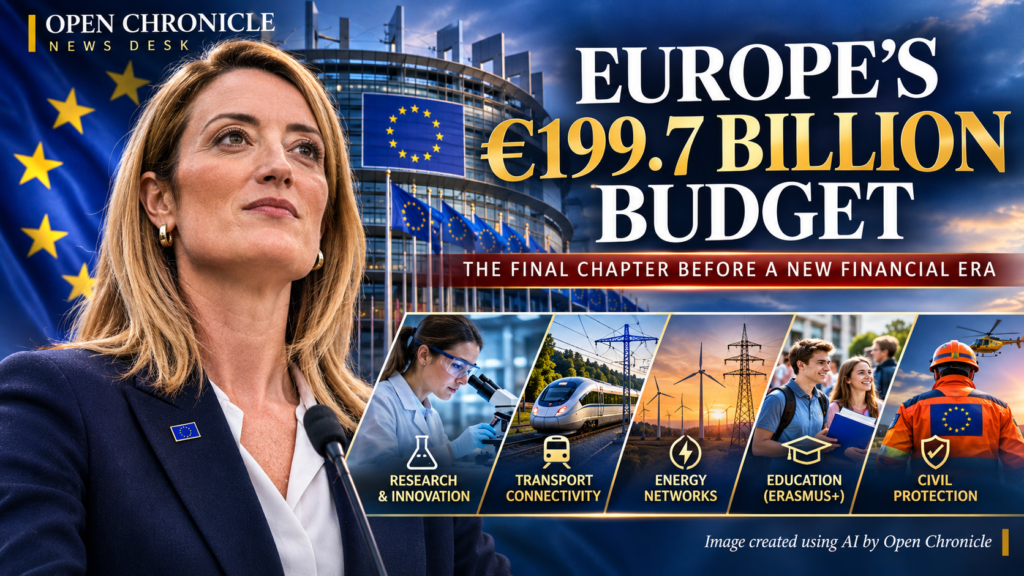
The European Union’s 2027 budget represents more than an annual spending agreement. As the final budget of the current seven year financial framework, it offers an insight into Europe’s evolving priorities, from scientific research and economic competitiveness to infrastructure, civil protection, migration management and international security.
By Open Chronicle News Desk
November 25, 2026 | European Union | Economy & European Affairs
The European Union has completed the adoption of its 2027 annual budget, marking the final chapter of a financial framework originally designed before many of the geopolitical, economic and technological challenges that now confront Europe.
European Parliament President Roberta Metsola signed the budget into law on Wednesday following its approval during a plenary session in Strasbourg.
The financial agreement establishes €199.7 billion in commitment appropriations and €211.5 billion in payment appropriations, providing the financial basis for European Union programmes and obligations during 2027.
Behind these figures lies a broader political question: how can Europe finance its growing strategic ambitions while maintaining its traditional commitments to economic development, social cohesion, scientific progress and international cooperation?
The answer will become increasingly important as the European Union prepares for its next long term financial framework.
€199.7bn Commitment appropriations | €211.5bn Payment appropriations |
€300m+ Additional funding secured by Parliament | 1 JAN Entry into force in 2027 |
A budget that closes an important chapter in European history
The 2027 budget is particularly significant because it represents the final annual spending plan under the European Union’s 2021–2027 Multiannual Financial Framework, commonly known as the MFF.
When that framework was established, Europe was confronting the consequences of the COVID pandemic and preparing for a period of economic recovery, digital transformation and environmental transition.
The international environment has subsequently changed considerably.
Russia’s full scale invasion of Ukraine, energy insecurity, industrial competition, technological rivalry between the United States and China, migration pressures and growing demands for European defence capabilities have reshaped the political debate surrounding public expenditure.
The European Union has increasingly been required to balance long established policy objectives with emerging strategic responsibilities.
The 2027 budget reflects this evolution while continuing to operate within the financial architecture of the existing framework.
It also provides a useful indication of the competing demands that European policymakers will face when establishing spending priorities for the years beyond 2027.
Understanding the numbers: why commitments and payments are different
One of the most frequently misunderstood aspects of European Union finances is the distinction between commitment appropriations and payment appropriations.
The fact that payments in 2027 will exceed new commitments by approximately €11.8 billion does not mean that the European Union has adopted an unbalanced budget.
The two figures represent different stages of the financial process.
Commitments establish the legal authority to finance projects and programmes, including activities that may take several years to complete. Payments represent the actual expenditure authorised for the financial year, including obligations arising from previous budgets.
✓ | COMMITMENTS €199.7 billion |
PAYMENTS €211.5 billion |
This distinction is particularly relevant during the final year of a financial framework, when payments associated with previously approved infrastructure projects, research programmes and regional development initiatives may become due.
According to the European Parliamentary Research Service, commitments increase by 2.2% and payments by 4.6% compared with the adjusted 2026 budget baseline.
Where will Europe’s money go?
Although public attention frequently focuses on new spending announcements, the overall distribution of European resources provides a more comprehensive picture of the Union’s priorities.
Regional development, resilience, agriculture, environmental policies and economic modernisation continue to account for a substantial proportion of European expenditure.
The agreement reached between Parliament and the Council on November 11 provides the following distribution.
| Budget heading | Commitments | Payments |
|---|---|---|
| Cohesion, resilience and values | €75.76bn | €81.85bn |
| Natural resources and environment | €57.11bn | €61.28bn |
| Single market, innovation and digital | €22.01bn | €22.85bn |
| Neighbourhood and the world | €15.54bn | €16.66bn |
| European public administration | €13.87bn | €13.87bn |
| Special instruments | €5.87bn | €8.26bn |
| Migration and border management | €5.81bn | €3.88bn |
| Security and defence | €3.08bn | €2.23bn |
| Ukraine support loan | €0.65bn | €0.65bn |
| Total | €199.71bn | €211.53bn |
Source: Council of the European Union, November 11, 2026. Individual figures have been rounded.
OPEN CHRONICLE | EUROPEAN SPENDING PRIORITIES
Where every €100 of commitments goes
| €0 | €100 |
| Cohesion, resilience and values | €37.94 | |
| Natural resources and environment | €28.60 | |
| Single market, innovation and digital | €11.02 | |
| Neighbourhood and the world | €7.78 | |
| European public administration | €6.94 | |
| Special instruments | €2.94 | |
| Migration and border management | €2.91 | |
| Security and defence | €1.54 | |
| Ukraine support loan | €0.33 |
Together, cohesion, resilience, values, natural resources and environmental expenditure represent approximately 66.5% of total commitments.
This is an important finding.
Despite the growing political emphasis on security and technological competition, the European budget remains heavily rooted in its traditional responsibilities towards regional development, agriculture, economic convergence and environmental management.
The emerging strategic agenda has not replaced these responsibilities. It must coexist with them.
The European Parliament’s €300 million intervention
During negotiations, European lawmakers obtained more than €300 million in additional allocations for selected programmes compared with the European Commission’s proposal.
These increases reveal where Parliament sought to exercise its budgetary influence.
| ♡ | Humanitarian aid | +€30m |
| Border management and visas | +€25m |
| Transport and energy networks | +€22.5m |
| ⚗︎ | Horizon Europe | +€21.5m |
| 🎓︎ | Erasmus+ | +€14m |
✓ | Civil Protection Mechanism | +€13.5m |
| LIFE environmental programme | +€10m |
| 🚚︎ | Military mobility | +€10m |
| Internal Security Fund | +€10m |
| Asylum, Migration and Integration Fund | +€5m |
The increases should not be interpreted as an additional €300 million added uniformly to the overall budget.
They represent targeted adjustments to particular programmes within a wider financial negotiation. Other expenditure lines can be revised or reduced as part of the same process.
Their significance therefore lies not only in their financial value but also in the political priorities they reveal.
Research and innovation: Europe’s battle for technological competitiveness
The additional €21.5 million for Horizon Europe comes at a time when technological leadership has become an increasingly important component of economic and geopolitical influence.
Europe possesses major universities, research institutions, industrial companies and scientific capabilities. Nevertheless, it faces intense international competition in artificial intelligence, semiconductor manufacturing, biotechnology, quantum computing and advanced industrial technologies.
Research funding can help European institutions develop new technologies, establish international scientific partnerships and translate discoveries into commercial applications.
The additional allocation is relatively modest when compared with the entire European budget. Its strategic importance, however, lies in reinforcing a programme that connects scientific research with economic competitiveness.
Europe’s challenge is not simply to produce scientific knowledge.
It is also to ensure that discoveries can be developed, financed, manufactured and commercialised within Europe.
Funding alone cannot achieve this objective. Regulatory conditions, private investment, access to skilled workers and the ability to expand innovative businesses will remain equally important.
Connecting Europe: infrastructure as an instrument of strategic resilience
The additional €22.5 million reported for transport and energy networks highlights another increasingly important dimension of European policy.
Infrastructure is no longer viewed exclusively through the lens of economic efficiency.
Railways, ports, electricity interconnections, energy distribution networks and transport corridors also influence Europe’s ability to respond to emergencies, maintain supply chains and reduce vulnerabilities.
A more interconnected European energy system can facilitate the distribution of electricity between countries facing different supply conditions.
Improved transport connections can strengthen commercial relationships, reduce logistical bottlenecks and support the movement of emergency resources.
The strategic value of these investments extends beyond the countries in which individual projects are located.
Their benefits can emerge across borders, particularly when national infrastructure becomes part of a wider European network.
The additional funding does not, by itself, establish which individual projects will receive support. Those outcomes depend on subsequent programme decisions and implementation.
Erasmus+: investing in Europe’s human capital
The €14 million increase for Erasmus+ provides a reminder that European integration is not solely an institutional or economic project.
Education, academic mobility, vocational training and cultural exchange contribute to the development of relationships between European societies.
For students and young professionals, international educational opportunities can provide access to new skills, languages, professional networks and employment possibilities.
From a wider strategic perspective, these programmes can also help address skills shortages and strengthen cooperation between educational institutions.
The long term benefits of such expenditure are more difficult to measure than the construction of a railway or the acquisition of equipment.
Nevertheless, human capital remains one of the most important foundations of economic resilience and technological development.
Civil protection: preparing Europe for the unexpected
The additional €13.5 million for the EU Civil Protection Mechanism reflects the growing importance of cooperation in responding to emergencies.
Wildfires, floods, earthquakes, extreme weather events and other disasters can place considerable pressure on national emergency services.
European coordination allows participating countries to request and provide assistance when domestic resources are insufficient.
The mechanism also supports collective preparedness and the development of shared response capabilities.
For countries such as Portugal, Greece, Spain and Italy, where major wildfires have repeatedly challenged emergency services, European cooperation can be particularly relevant.
However, the additional budget allocation should not be confused with a direct transfer of €13.5 million to any individual country.
The funding supports the wider European mechanism.
⚗︎ +€21.5m Scientific research Innovation and technological competitiveness. | +€22.5m Connectivity Transport and energy infrastructure. |
+€14m Education Skills, mobility and human capital. | ✓ +€13.5m Civil protection Emergency preparedness and collective resilience. |
Security, defence and the changing European strategic environment
The budget allocates approximately €3.08 billion in commitments under the dedicated security and defence heading.
Parliament also secured additional resources for military mobility and internal security programmes.
These developments illustrate how security considerations have become increasingly integrated into European financial planning.
Military mobility, for example, concerns the ability to move personnel and equipment across European territory efficiently. It can involve infrastructure, transport compatibility and administrative coordination.
Internal security programmes address a different range of challenges, including cooperation against organised crime and threats to public security.
It is essential, however, to distinguish the European Union budget from the combined military expenditure of its member states.
The €3.08 billion allocation is not Europe’s total defence budget.
National military expenditure, NATO commitments, separate European financial instruments and security related expenditure under other budget headings must be considered independently.
Treating these different financial mechanisms as a single budget would create a misleading impression of Europe’s actual security expenditure.
Migration, border management and humanitarian responsibilities
European migration policy continues to involve competing political, legal and humanitarian considerations.
The 2027 agreement increases funding for border management, visa systems, asylum and integration programmes.
These allocations address different aspects of migration governance, from managing external borders to supporting asylum procedures and integration policies.
At the same time, Parliament secured an additional €30 million for humanitarian aid.
The coexistence of these priorities illustrates the complexity of Europe’s international responsibilities.
The Union must manage its external borders while respecting applicable international protection obligations. It must also determine how humanitarian assistance, diplomatic engagement and development cooperation can respond to instability beyond its territory.
Budget allocations indicate the availability of financial resources. They do not automatically establish whether the resulting policies will be effective, proportionate or consistent with their stated objectives.
Those questions require continuing scrutiny.
How the European Union adopted its 2027 budget
The adoption of the European budget is the result of negotiations between three principal European institutions.
The European Commission prepares the initial proposal. The Council represents the governments of the member states, while the European Parliament represents European citizens through their elected representatives.
When Parliament and the Council disagree over spending priorities, a conciliation process provides a mechanism for reaching a common position.
The 2027 agreement emerged from this institutional process.
European Parliament Represents European citizens | 🏛︎ Council of the EU Represents national governments |
The procedure illustrates an important characteristic of European governance. Financial decisions require cooperation between institutions representing different sources of democratic and political authority.
Neither the European Parliament nor national governments can independently determine the entire annual budget.
The Strasbourg vote: a majority, but not a consensus
The final parliamentary vote produced a clear majority in favour of the agreement, although a substantial number of representatives opposed the budget or abstained.
IN FAVOUR 406 61.6% | AGAINST 184 27.9% | ABSTENTIONS 69 10.5% |
✓
BUDGET ADOPTED
The result reflected support from several political groups, including majorities within the European People’s Party, Socialists and Democrats, Renew Europe and the Greens/European Free Alliance.
Opposition was concentrated among several other political groups, while abstention was particularly prominent within the European Conservatives and Reformists.
These voting patterns should not be interpreted as evidence that every member of a particular political group adopted the same position.
The agreement nevertheless demonstrates that a parliamentary majority could be established across different political traditions, despite continuing disagreements over European expenditure and institutional priorities.
From negotiation to implementation
The adoption of the budget concludes the principal legislative process, but it does not mark the completion of the programmes that it finances.
Implementation, monitoring and financial accountability will continue throughout 2027 and, in some cases, beyond it.
FEBRUARY 17, 2026 Council establishes budget guidelines Member states identify financial priorities. | |
JULY 9, 2026 Commission presents draft budget The initial financial proposal is established. | |
NOVEMBER 11, 2026 Political agreement reached Parliament and Council conclude conciliation negotiations. | |
NOVEMBER 23, 2026 Council formally approves the agreement National governments endorse the negotiated text. | |
NOVEMBER 25, 2026 European Parliament adopts the budget Roberta Metsola signs the budget following the parliamentary vote. | |
JANUARY 1, 2027 Budget enters into force The final annual budget of the current financial framework becomes operational. |
€710.1 million: Europe’s financial room for unexpected events
One of the less prominent but potentially significant elements of the agreement is the remaining margin of €710.1 million below the expenditure ceilings of the current financial framework.
This margin preserves a degree of flexibility should unexpected financial requirements emerge.
✓ | €710.1 million Remaining commitment margin |
In an international environment characterised by geopolitical uncertainty, economic disruption and natural disasters, retaining financial flexibility has practical importance.
However, this margin represents only approximately 0.36% of the agreed commitment appropriations.
A major international crisis could therefore require financial responses extending beyond the available margin, potentially involving other instruments or amendments to the annual budget.
The challenge for European policymakers is to maintain sufficient financial discipline without compromising their ability to respond to unforeseen developments.
What does the budget mean for ordinary European citizens?
European budget negotiations can appear distant from everyday life.
Their practical consequences, however, can emerge through projects and programmes that directly affect communities, businesses, universities and public institutions.
🎓︎ | Students and young professionals Educational mobility, training opportunities and international academic cooperation. |
⚗︎ | Researchers and innovative businesses Access to research programmes, scientific partnerships and technological development opportunities. |
🚆︎ | Travellers and businesses Potential improvements to transport connectivity and cross-border infrastructure. |
🚜︎ | Farmers and rural communities Continued support through European agricultural and rural development policies. |
✓ | Communities affected by disasters Coordinated European emergency assistance and preparedness capabilities. |
🏛︎ | Local and regional authorities Investment opportunities through regional development and cohesion programmes. |
For citizens, the ultimate measure of the European budget will not be the size of its headline figures.
It will be the quality of the infrastructure delivered, the opportunities created, the effectiveness of public services and the ability of European institutions to demonstrate that resources have been used responsibly.
The next great European financial debate: 2028 to 2034
The significance of the 2027 budget extends beyond its own financial year.
Europe is preparing for negotiations over the next Multiannual Financial Framework, covering the period from 2028 to 2034.
The next framework will need to address difficult questions about the relationship between Europe’s political ambitions and its financial capabilities.
Should a larger proportion of European resources be directed towards technological competitiveness and industrial development?
How should the Union finance growing security responsibilities without undermining agricultural and regional development programmes?
What role should common European borrowing play?
Should European institutions develop additional sources of revenue, or should financing continue to depend predominantly on existing revenue mechanisms and national contributions?
These questions are likely to expose differences between member states with distinct economic structures, fiscal capacities and strategic priorities.
Countries benefiting substantially from agricultural and cohesion programmes may place particular emphasis on preserving those policies.
Others may favour greater concentration on research, industrial competitiveness, security or cross-border infrastructure.
The challenge will be to establish a financial framework that can accommodate these competing objectives while maintaining political support across the Union.
The 2027 budget does not resolve these debates. It provides the financial and political context in which they will unfold.
Open Chronicle Strategic Assessment
Five challenges that will shape Europe’s financial future
01 ⚖︎ | Balancing traditional and emerging priorities Maintaining agricultural and regional development policies while responding to new technological, economic and security demands. |
02 | Financing technological competitiveness Transforming European scientific capabilities into industrial strength, commercial innovation and sustainable economic growth. |
03 ✓ | Building collective resilience Developing the financial capacity to respond to security threats, infrastructure vulnerabilities and humanitarian emergencies. |
04 € | Establishing sustainable financing Determining how future European ambitions will be funded without creating unsustainable financial obligations. |
05 | Demonstrating measurable results Ensuring that European expenditure produces tangible benefits and remains subject to effective public accountability. |
The financial challenge confronting Europe is not simply a question of increasing or reducing expenditure.
It concerns the ability to direct limited resources towards objectives that generate lasting economic, social and strategic benefits.
The European Union’s financial credibility will increasingly depend on its capacity to demonstrate a clear relationship between political commitments, financial allocations and measurable outcomes.
What should observers monitor during 2027?
| Area | What to monitor |
|---|---|
| Budget implementation | Actual expenditure compared with authorised appropriations. |
| Horizon Europe | Research calls, project selection and innovation outcomes. |
| Transport and energy | Infrastructure financing and cross-border project development. |
| Erasmus+ | Participation opportunities and programme implementation. |
| Civil protection | Preparedness capabilities and emergency response effectiveness. |
| Security and defence | Implementation of funded initiatives and coordination with national policies. |
| Humanitarian aid | Delivery of assistance and access to affected populations. |
| Financial flexibility | Possible mobilisation of available margins and special instruments. |
| Financial accountability | Audits, programme evaluations and expenditure controls. |
| 2028 to 2034 framework | Negotiations over spending ceilings, policy priorities and European revenue sources. |
Conclusion: Europe’s budget is ultimately a statement about its future
The adoption of the European Union’s 2027 budget closes an important chapter in European financial history.
It preserves the Union’s traditional commitments to economic development, agriculture, social cohesion and international cooperation while reinforcing selected priorities associated with research, infrastructure, education, security and collective resilience.
Its €199.7 billion in commitments and €211.5 billion in payments provide the financial architecture for the final year of the current framework.
Yet the most consequential European financial decisions may still lie ahead.
The next financial framework will require European institutions and national governments to determine how far their shared ambitions extend, how those ambitions should be financed and which responsibilities should receive priority.
The debate will ultimately concern more than public expenditure.
It will concern the kind of Europe that its citizens and political institutions intend to build.
A budget does not merely reveal how an institution spends its money. It reveals what that institution considers worth protecting, what it believes deserves investment and how it prepares for an uncertain future.
For the European Union, the 2027 budget represents both the conclusion of one financial era and the beginning of the debate over the next.