
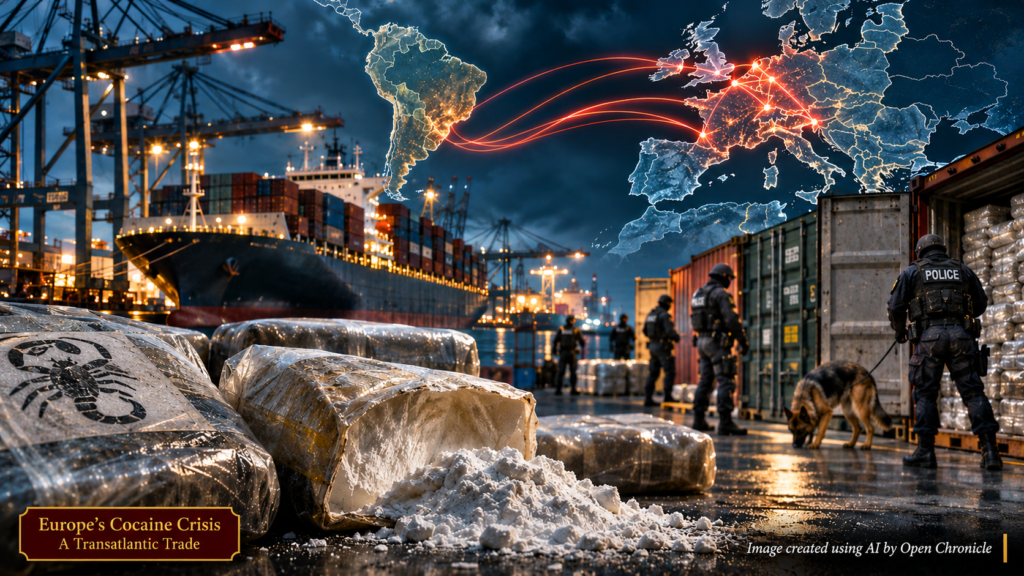
The expansion of maritime cocaine trafficking is placing unprecedented pressure on European law enforcement. Spain and Portugal are confronting an increasingly complex security challenge, while rising consumption, organised crime and public health concerns expose the wider consequences of Europe’s lucrative cocaine market.
By Open Chronicle News Desk
November 25, 2026 | European Security | Organised Crime | Public Health
♟ 4.3m Estimated adult cocaine users in Europe | ⛢ 330t Cocaine seized in the EU during 2024 |
⚓︎ 124t Cocaine seized by Spain in 2024 | ♡ 37,000 First-time cocaine treatment entrants in 2024 |
Europe is confronting a growing cocaine crisis that extends far beyond the streets of its major cities. Across the Atlantic and along the southern shores of the continent, international criminal organisations are exploiting maritime commerce and increasingly sophisticated transportation methods to sustain a market serving millions of consumers.
A recent investigation published by The Independent has brought renewed attention to the proliferation of powerful vessels commonly known in Spain as narcolanchas, highlighting the difficulties faced by law enforcement agencies attempting to contain maritime drug trafficking.
The investigation comes at a time when European authorities are reporting significant criminal operations, expanding cocaine availability and growing pressure on public health services.
On November 25, the European Commission published an overview of international operations supported by Europol during 2026, confirming that maritime cocaine trafficking affecting Spain and Portugal remains a significant European security concern.
The challenge is no longer simply one of intercepting illegal shipments. It concerns the ability of European institutions to confront international criminal networks whose activities intersect with legitimate commerce, financial systems, public institutions and vulnerable communities.
The rise of the narcolanchas
The term narcolancha has become increasingly familiar in Spanish reporting on organised crime. It describes vessels associated with maritime drug trafficking, particularly in investigations involving criminal organisations operating across southern Europe.
Their growing prominence reflects a broader transformation in the international cocaine market.
Criminal organisations have demonstrated an ability to adapt their activities in response to police investigations, customs enforcement and international cooperation. Maritime trafficking has consequently become a more demanding challenge for authorities responsible for protecting European waters.
The problem is not confined to the capabilities of individual vessels. Behind them stand international organisations with access to substantial financial resources, logistical support and criminal networks operating across national borders.
The European Union Drugs Agency, known as EUDA, has identified the diversification of trafficking methods as a major concern in its 2026 assessment of Europe’s drug market.
Spain: a country on Europe’s front line
Spain’s geographical position and extensive maritime responsibilities make it a central participant in Europe’s response to international cocaine trafficking.
According to the European Drug Report 2026, Spanish authorities seized approximately 124 tonnes of cocaine during 2024.
That represents around 37.6% of the total quantity confiscated across the European Union that year.
The scale of the seizures illustrates the extraordinary demands placed on Spanish law enforcement, although seizure figures alone cannot establish the total quantity of cocaine entering the country.
The consequences have also been human.
In February 2024, two members of Spain’s Guardia Civil, Miguel González and David Carracedo, lost their lives during an incident involving a suspected drug trafficking vessel in Barbate, in the province of Cádiz.
Their deaths became a powerful reminder of the dangers faced by officers confronting maritime organised crime. The incident has returned to public attention through recent reporting on the expansion of the narcolancha phenomenon.
Portugal is part of the same European security challenge
Portugal cannot be considered separately from developments affecting neighbouring Spain.
The country’s Atlantic coastline, maritime responsibilities and participation in international commerce place Portuguese institutions within the wider European effort against transnational drug trafficking.
EUDA figures indicate that Portugal seized approximately 23 tonnes of cocaine in 2024.
Combined, Spanish and Portuguese seizures amounted to approximately 147 tonnes, equivalent to 44.5% of the total reported by EU Member States during that year.
These figures do not establish that the Iberian Peninsula receives an equivalent proportion of all cocaine entering Europe. They do, however, demonstrate the scale of law enforcement activity in both countries.
🇪🇸 SPAIN 124 tonnes 2024 cocaine seizures 37.6% of EU seizures | 🇵🇹 PORTUGAL 23 tonnes 2024 cocaine seizures 7.0% of EU seizures |
Operation Alpha Lima: the scale of the Atlantic confrontation
One of the most significant examples of international cooperation against maritime cocaine trafficking emerged in April 2026.
Operation Alpha Lima brought together law enforcement authorities from several countries in a coordinated effort against criminal organisations operating across the Atlantic.
On May 8, Portugal’s Polícia Judiciária confirmed the results of the operation, which demonstrated both the magnitude of the trafficking problem and the capacity of European authorities to respond collectively.
✓ 11 tonnes Cocaine seized | □ 8.5 tonnes Hashish seized |
♟ 54 Individuals detained | ⚓ 8 Vessels seized |
The Portuguese contribution involved the Polícia Judiciária, Maritime Police, Air Force and National Republican Guard.
The operation demonstrates why maritime drug trafficking increasingly requires cooperation between criminal investigators, maritime authorities, aviation resources and international intelligence organisations.
Further evidence emerged in July 2026, when Portuguese, Spanish and Italian authorities participated in another international operation resulting in the seizure of more than 2.6 tonnes of cocaine in the Atlantic and the detention of four suspects.
These operations challenge the suggestion that European authorities are incapable of responding effectively. Nevertheless, successful interceptions do not necessarily translate into a sustained reduction in cocaine availability.
The changing geography of Europe’s cocaine market
For many years, Europe’s largest commercial ports have occupied a central position in investigations into international cocaine trafficking.
Belgium, the Netherlands, Germany, France and Spain have all faced considerable pressure from criminal organisations seeking to exploit international trade.
Recent developments suggest that the security challenge is becoming more geographically dispersed.
The European Drug Report 2026 provides an important statistical perspective on this transformation.
🇪🇸 Spain | 124t |
🇫🇷 France | 53.5t |
🇧🇪 Belgium | 44.6t |
🇳🇱 Netherlands | 37.6t |
🇩🇪 Germany | 23.8t |
🇵🇹 Portugal | 23t |
🇮🇹 Italy | 11t |
🇮🇪 Ireland | 3.3t |
The figures also illustrate an important methodological problem. A country reporting fewer seizures is not necessarily experiencing less trafficking. Equally, an increase in seizures may reflect improved enforcement, increased criminal activity or a combination of both.
Understanding the evolution of Europe’s cocaine market therefore requires more than examining the quantities confiscated by police.
Why falling seizures do not necessarily mean that Europe is winning
One of the most revealing findings in the European Drug Report 2026 concerns the relationship between drug seizures and availability.
2023 | 419 tonnes |
2024 | 330 tonnes |
The decline in the total quantity confiscated between 2023 and 2024 occurred alongside continued growth in global cocaine production and persistent availability in Europe.
This combination makes it difficult to interpret falling seizure volumes as evidence of a shrinking criminal market.
European authorities must distinguish between successful individual operations and measurable changes in the overall availability of illicit drugs.
The global production crisis behind Europe’s cocaine problem
Europe’s difficulties cannot be fully understood without examining developments in South America.
The United Nations Office on Drugs and Crime, UNODC, reported in its World Drug Report 2026 that global cocaine production reached a new historical high in 2024.
The expansion of global production provides criminal organisations with an increasingly abundant supply of cocaine.
For Europe, this creates a structural challenge. Even substantial seizures may have a limited lasting effect if global production continues to expand and criminal organisations retain access to profitable consumer markets.
International cooperation with Latin American countries is consequently an essential component of Europe’s response.
Beyond the speedboats: the criminal economy behind cocaine
The vessels attracting public attention represent only one visible component of a much larger criminal economy.
The international cocaine trade also involves financial intermediaries, commercial organisations, corruption, money laundering and distribution networks.
A major investigation announced by Europol and Eurojust in November 2026 illustrates the importance of confronting these wider criminal structures.
Authorities conducted coordinated investigations across five European countries against a network suspected of importing cocaine from Latin America and laundering the proceeds through corporate structures.
The investigation involved more than 100 searches and the confiscation of substantial financial assets. Investigators believe that several tonnes of previously intercepted cocaine may be connected to the organisation.
One documented seizure in Antwerp during August 2026 involved more than 750 kilograms of cocaine.
The significance of the investigation extends beyond the confiscated drugs. It demonstrates how international criminal organisations can intersect with apparently legitimate economic activity.
Transnational organised crime Criminal organisations operating across multiple national jurisdictions. |
| ⚓ | Maritime trafficking Illicit exploitation of international maritime transport and commerce. |
| € | Criminal finance The movement, concealment and laundering of illegal profits. |
| ! | Corruption and intimidation Threats to institutional integrity, public safety and legitimate businesses. |
| ♟ | Consumer demand A substantial illicit market that sustains the economic incentives behind trafficking. |
When organised crime becomes a threat to institutional security
The expansion of the cocaine market raises concerns that extend beyond conventional criminal investigations.
Criminal organisations with substantial financial resources can threaten the integrity of commercial institutions, undermine confidence in public authorities and contribute to violence within communities.
Ports and transport companies are particularly exposed to the consequences of criminal infiltration.
The potential consequences include corruption, intimidation of employees, threats against law enforcement personnel and the reinvestment of criminal proceeds into legitimate economic activities.
This creates a security problem that cannot be addressed exclusively through maritime patrols.
Financial investigations, judicial cooperation, institutional integrity and the protection of vulnerable workers are equally important elements of the European response.
Europe’s other cocaine crisis: the consumers
While maritime operations attract considerable media attention, the expansion of cocaine consumption represents another dimension of the crisis.
Millions of Europeans consume cocaine, creating a substantial market that sustains international criminal activity.
The consequences are increasingly visible in treatment centres, hospital emergency departments and communities experiencing drug related social problems.
👥︎ 4.3m Estimated adult users Reported cocaine use during the preceding year. | ♟ 2.5m Young adult users Estimated EU users aged 15 to 34. |
♡ 37,000 First-time treatment entrants People seeking specialist cocaine treatment in 2024. | ↗ +39% Treatment demand Increase in first-time cocaine treatment entrants between 2018 and 2024. |
! 27% Drug-induced deaths Proportion involving cocaine in available 2024 data from 20 countries. | + 26% Emergency presentations Proportion mentioning cocaine in monitored hospital emergency services. |
Cocaine consumption is associated with dependence, cardiovascular complications and other serious physical and psychological consequences.
The increasing visibility of crack cocaine use also raises particular concerns regarding vulnerable and socially marginalised populations.
An effective European response must therefore consider people experiencing drug dependence as individuals requiring appropriate healthcare and social support, rather than treating the entire problem exclusively as a criminal justice issue.
What Europe’s wastewater reveals
Population surveys are valuable, but they depend partly on individuals accurately reporting their behaviour.
Wastewater analysis provides an additional scientific instrument for monitoring changes in drug consumption.
The European Drug Report 2026 examined comparable cocaine residue measurements from 85 cities for 2024 and 2025.
85 Cities |
|
The European Union Drugs Agency (EUDA)
Wastewater analysis does not establish precisely how many individuals consume cocaine, nor does it provide a complete national picture.
Nevertheless, the fact that increases were detected in more than half of the participating cities provides important evidence of the geographical expansion of cocaine consumption.
Is Europe fighting a battle it cannot win?
The headline of The Independent’s investigation reflects a particularly pessimistic assessment of the difficulties confronting law enforcement.
There are legitimate reasons for concern. The international cocaine market has demonstrated considerable resilience, while growing production and consumer demand continue to sustain criminal activity.
However, the evidence does not support a simple conclusion that European authorities have already lost the confrontation.
Operation Alpha Lima, the July Atlantic interception involving Portugal and the November investigations into international criminal finance demonstrate that European institutions retain significant investigative and operational capabilities.
The more difficult question is whether these successes can produce lasting reductions in drug availability, criminal profits, violence and public health harms.
The distinction is fundamental.
Intercepting a shipment is an operational achievement. Reducing the long term influence of organised crime is a strategic objective.
Europe’s institutional response
The European Union has increasingly recognised that drug trafficking requires a coordinated response extending beyond individual national jurisdictions.
In March 2026, the Council of the European Union endorsed a strategic framework addressing drug policy and trafficking.
The European Union Drugs Agency (EUDA)
Several European institutions contribute to this wider response.
🏛︎ | European Commission European policy development, strategic coordination and legislative initiatives. |
| ✓ | Europol Criminal intelligence, analytical assistance and coordination between police authorities. |
⚖︎ | Eurojust Cross-border judicial cooperation and coordination of criminal investigations. |
| ▥ | European Union Drugs Agency Scientific monitoring, risk assessment and evidence supporting drug policy. |
⚓︎ | National authorities Criminal investigations, customs enforcement, maritime security and prosecution. |
| ♡ | Public health institutions Prevention, treatment, harm reduction and support for affected communities. |
The effectiveness of this institutional architecture depends on the ability of participating authorities to exchange information, coordinate investigations and translate evidence into judicial outcomes.
A year of growing concern
FEBRUARY 2024 The Barbate tragedy Two Guardia Civil officers lose their lives in an incident involving a suspected drug trafficking vessel. | |
MARCH 2026 European strategic framework The Council endorses a framework addressing European drug policy and trafficking. | |
APRIL 2026 Operation Alpha Lima International authorities conduct a major operation against maritime drug trafficking. | |
MAY 8, 2026 Operation results announced Portuguese authorities confirm the seizure of 11 tonnes of cocaine across the international operation. | |
JUNE 9, 2026 European Drug Report EUDA publishes its annual assessment of drug availability, consumption and associated harms. | |
JULY 27, 2026 Another major Atlantic seizure International cooperation results in the reported confiscation of more than 2.6 tonnes of cocaine. | |
NOVEMBER 12 AND 13, 2026 International criminal network investigation Eurojust and Europol announce coordinated action against suspected cocaine trafficking and money laundering. | |
NOVEMBER 21, 2026 The narcolancha investigation The Independent publishes its investigation into Europe’s changing maritime cocaine trade. | |
NOVEMBER 25, 2026 European Commission assessment The Commission highlights international operations supported by Europol during 2026. |
Open Chronicle Strategic Assessment
Six challenges shaping Europe’s response
The available evidence suggests that Europe’s cocaine problem should be understood as a multidimensional challenge involving security, economics, international relations, criminal justice and public health.
01 | ⚓︎ Maritime security Maintaining effective law enforcement capabilities across extensive maritime jurisdictions. |
02 | International cooperation Strengthening coordination between European institutions and international partners. |
03 | € Criminal finance Identifying and confiscating illegal proceeds while disrupting money laundering networks. |
04 | ✓ Institutional resilience Protecting public institutions, commercial infrastructure and personnel against corruption and intimidation. |
05 | ♡ Public health Expanding effective prevention, treatment and support for people experiencing cocaine dependence. |
06 | ▥ Measuring effectiveness Evaluating progress through availability, criminal violence, financial disruption and health outcomes, rather than seizure volumes alone. |
What should Europe monitor during 2027?
| Area of concern | Indicators to monitor |
|---|---|
| Global cocaine production | Updated UNODC production and cultivation estimates. |
| Maritime security | Results of coordinated investigations and interceptions. |
| Spain and Portugal | National enforcement statistics and international cooperation. |
| Criminal finance | Confiscated assets, financial investigations and judicial outcomes. |
| Institutional integrity | Documented corruption and intimidation cases. |
| Cocaine availability | EUDA market indicators and long term availability trends. |
| Consumption | Population surveys and wastewater analysis. |
| Public health | Treatment demand, hospital presentations and mortality. |
| Organised crime | Criminal violence and the dismantling of international networks. |
| European drug policy | Implementation and evaluation of the European strategic framework. |
Conclusion: Europe cannot measure success in tonnes alone
The powerful vessels confronting European maritime authorities have become a visible symbol of a much larger international problem.
Behind them lies an expanding global cocaine economy, sustained by consumer demand, international criminal networks and substantial financial incentives.
Spain and Portugal occupy an important position in Europe’s confrontation with maritime drug trafficking. Their experiences demonstrate both the seriousness of the challenge and the importance of international cooperation.
Yet the ultimate measure of success cannot simply be the number of vessels intercepted or the quantity of cocaine confiscated.
It must also include reductions in criminal violence, the disruption of illicit financial networks, stronger institutional integrity, lower levels of harmful consumption and improved public health outcomes.
The evidence available in November 2026 does not establish that Europe’s battle against cocaine trafficking is unwinnable. It establishes that the battle is considerably more complex than a confrontation between police vessels and criminal speedboats.
Europe is confronting not merely a maritime trafficking problem, but an international criminal economy whose consequences reach from the Atlantic Ocean to the heart of European society.