
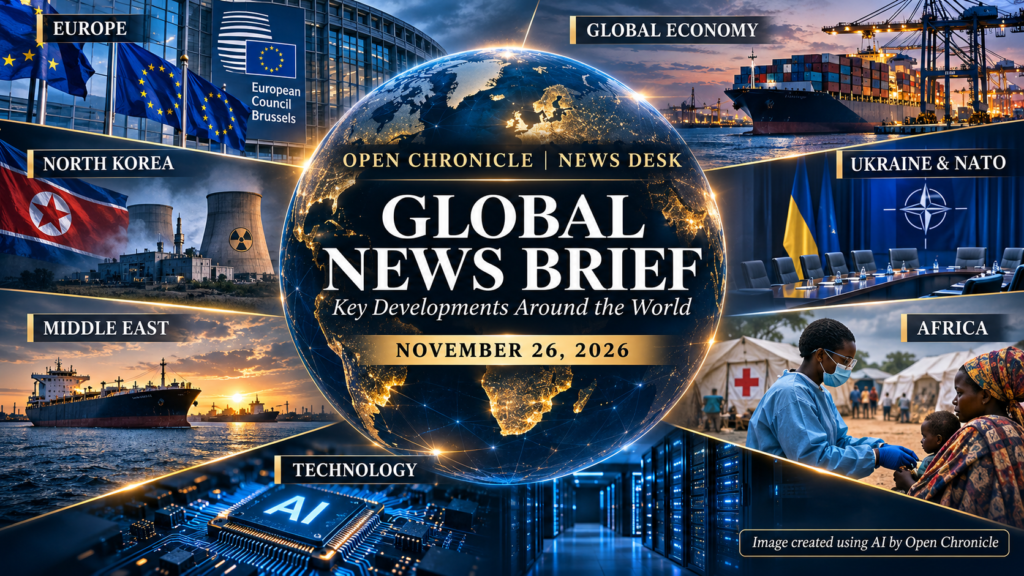
Global trade tensions intensify as Washington prepares new tariffs, European leaders confront difficult financial negotiations, North Korea signals further nuclear expansion and diplomatic efforts to end the war in Ukraine face renewed uncertainty. Meanwhile, humanitarian emergencies, technological competition and environmental disasters expose the growing complexity of an interconnected world.
By Open Chronicle News Desk
Thursday, November 26, 2026 | Morning Edition
INFORMATION • CONTEXT • UNDERSTANDING
The World This Morning
|
🌐︎
08
World regions
|
▤
06
Global themes
|
|
🕑︎
24H
International news cycle
|
📰︎
08:20
UTC editorial cutoff
|
Today’s Global Outlook
The international agenda this Thursday is dominated by the intersection of economic nationalism, military deterrence and political uncertainty.
Washington’s proposed new tariffs are generating opposition among major trading partners, while European governments face difficult negotiations over the European Union’s future financial framework and continued assistance to Ukraine.
In Asia, North Korea’s declared ambition to expand its nuclear capabilities adds another dimension to regional security concerns. China’s investigation into Shanghai Communist Party chief Chen Jining continues to raise questions about political stability within the country’s senior leadership.
The Middle East remains particularly vulnerable to escalation, with reports of renewed Houthi attacks against Saudi Arabia, continuing violence in Gaza and persistent tensions involving Iran.
Beyond these geopolitical developments, humanitarian emergencies in Sudan, the Democratic Republic of the Congo and Southeast Asia underline the importance of international cooperation at a time when governments are increasingly focused on national security and economic competition.
The defining question of the morning is whether international institutions can contain these overlapping pressures before they develop into deeper economic, military and humanitarian crises.
03 | The Six Stories Defining Today’s Global Agenda
|
01
📈︎
|
GLOBAL ECONOMY
Washington opens a new tariff confrontationProposed tariffs targeting 14 trading partners threaten to intensify global economic fragmentation.
|
|
02
🏛︎
|
EUROPEAN UNION
Europe confronts its financial futureLeaders gather in Brussels to negotiate the next European budget and additional financing for Ukraine.
|
|
03
☢︎
|
ASIA PACIFIC SECURITY
North Korea signals further nuclear expansionKim Jong Un’s latest statements renew concerns over nuclear proliferation and regional deterrence.
|
|
04
🌐︎
|
INTERNATIONAL SECURITY
Ukraine diplomacy faces renewed uncertaintyWashington and NATO pursue negotiations while military operations and European support continue.
|
|
05
⚓︎
|
MIDDLE EAST
Regional escalation threatens maritime securityReported Houthi attacks against Saudi Arabia and maritime incidents raise concerns about regional stability.
|
|
06
♥︎
|
HUMANITARIAN AFFAIRS
Humanitarian emergencies demand international attentionSudan’s displacement crisis, Congo’s reported Ebola emergency and disasters in Egypt and Indonesia expose growing vulnerabilities.
|
04 | The World by Region
Europe
Brussels prepares for a decisive budget confrontation
European Union leaders are gathering in Brussels for a special European Council meeting on November 26 and 27, with negotiations expected to focus on the bloc’s long term financial priorities and continued support for Ukraine.
European Council President António Costa is seeking a compromise over the Multiannual Financial Framework covering 2028 to 2034, a financial programme that will shape European investment, agricultural policy, industrial competitiveness, security and international engagement for the next decade.
The European Commission’s proposal for up to €45 billion in additional financial assistance for Ukraine in 2027 represents another major item on the agenda. It would build upon the existing €90 billion Ukraine Support Loan covering 2026 and 2027.
The renewal of the European Central Bank’s senior leadership is also scheduled for discussion.
Europe’s financial crossroads
|
🏛︎
€1.7tn
Approximate budget compromise proposed by António Costa
|
💶︎
€45bn
Proposed additional Ukraine financing for 2027
|
|
🛡︎
€90bn
Existing Ukraine Support Loan for 2026 and 2027
|
📅︎
2028–2034
Next European financial framework
|
The negotiations follow the adoption of the European Union’s annual budget for 2027, previously examined by Open Chronicle. The current summit concerns a separate and considerably broader financial framework.
Ukraine: diplomacy continues amid military pressure
The morning’s international reporting describes discussions between US President Donald Trump and NATO Secretary General Mark Rutte concerning Ukraine, Iran and allied defence expenditure.
Both leaders reportedly warned Russia against expanding the conflict while continuing to explore opportunities for negotiations.
Reports of a potentially significant exchange of prisoners between Russia and Ukraine provide a limited indication that humanitarian agreements may remain possible despite disagreements over territory and the conditions for a ceasefire.
The proposed exchange has not yet taken place.
Ukraine’s military requirements remain substantial. The morning news feed also reports American approval of an approximately $622 million package supporting Ukrainian F-16 aircraft, alongside continuing concerns over the availability of air defence systems.
Spain enters a politically sensitive period
Spain’s forthcoming election is attracting international attention as Prime Minister Pedro Sánchez faces questions over whether economic growth has translated into meaningful improvements in household living standards.
Housing affordability, purchasing power, migration and political fragmentation remain important issues.
The outcome could also influence the ideological balance within the European Council and the direction of European policy.
Britain and the European Union
Reports that the British government is preparing to publish new agreements negotiated with the European Union suggest that relations between London and Brussels remain an important area of political development.
The wider European agenda also includes military readiness, economic cooperation and the future relationship between Britain and European security institutions.
Migration and maritime security
The supplied morning reports describe unusually high migrant arrivals in Spain’s Canary Islands, investigations into suspected suppliers of equipment to migrant smuggling networks and a diesel tanker sinking near Ibiza.
French naval authorities have also reportedly intercepted a vessel suspected of involvement in drug trafficking.
Why it matters: Europe is confronting simultaneous demands for financial solidarity, military preparedness, economic competitiveness and stronger border security. Its ability to reconcile these priorities will influence the credibility of European institutions over the coming years.
North America
Trump launches another global tariff initiative
The United States is preparing a new round of tariffs targeting 14 trading partners, including China, the European Union, Japan, India and South Korea.
The Trump administration argues that excessive industrial capacity and government support for manufacturing in competing economies create unfair conditions for American businesses.
The proposals envisage maximum potential tariff rates ranging from 20% to 40%, although negotiated trade agreements could result in lower applicable duties.
The initiative follows an investigation conducted under Section 301 of American trade legislation and represents another attempt by the administration to reshape international trade following earlier legal challenges to its tariff policies.
Washington’s new tariff offensive
|
🌐︎
14
Trading partners targeted
|
📈︎
20–40%
Proposed maximum tariff rates
|
| 🇨🇳 China | 🇪🇺 European Union |
| 🇯🇵 Japan | 🇰🇷 South Korea |
| 🇮🇳 India | 🇻🇳 Vietnam |
| 🇧🇩 Bangladesh | 🇰🇭 Cambodia |
| 🇮🇩 Indonesia | 🇲🇾 Malaysia |
| 🇸🇬 Singapore | 🇨🇭 Switzerland |
| 🇹🇼 Taiwan | 🇹🇭 Thailand |
International reactions reported in the morning news feed suggest that the measures could provoke another period of difficult trade negotiations.
China disputes Washington’s justification for the proposals, while European and Asian governments are assessing the potential consequences for their exporters.
Nvidia and the intersection of technology and national security
Controversy surrounding Jensen Huang’s reported return to Nvidia’s leadership continues to attract attention in Washington.
Media reports describe differences between American intelligence and law enforcement officials concerning allegations of possible Chinese intelligence involvement in Huang’s personal and professional environment.
The available reporting does not establish that espionage occurred. Differences between intelligence assessments, unresolved suspicions and evidence of criminal conduct must not be treated as equivalent.
The controversy nevertheless illustrates how semiconductor companies have become increasingly entangled with national security policy.
American cybersecurity and institutional security
The supplied news feed reports that the White House has unveiled a cybersecurity initiative intended to strengthen American digital defences.
The announcement comes amid growing concerns over the protection of government networks, critical infrastructure and sensitive information.
The precise scope, funding and implementation timetable of the initiative require further examination of official documentation.
Thanksgiving disrupted by severe weather
New York’s traditional Macy’s Thanksgiving Day Parade has reportedly been postponed until Saturday because of severe weather conditions.
The disruption to its centenary edition comes as weather warnings and coastal flooding concerns affect parts of the United States.
Separately, a FedEx cargo aircraft reportedly left a runway at Miami International Airport, temporarily disrupting flight operations.
Canada confronts competing immigration and research priorities
Canada’s restrictions on international students are generating concerns about the country’s ability to attract researchers, highly qualified graduates and international academic talent.
The debate reflects a difficult balance between immigration management, housing pressures, university finances and long term economic competitiveness.
Why it matters: North America’s economic and technological decisions increasingly have consequences far beyond its borders. Trade restrictions, semiconductor policy and cybersecurity regulation are becoming central instruments of international influence.
Latin America and the Caribbean
Brazil challenges Washington’s trade direction
Brazilian criticism of Washington’s new tariff proposals reflects broader concern over the future of international trade and the growing use of economic restrictions as instruments of foreign policy.
Brazil is not among the 14 economies identified in the latest Reuters reporting as direct targets of the new proposals. Its reported opposition should therefore be distinguished from the immediate exposure of the economies included in the initiative.
For Latin American governments, the wider concern is the potential disruption of export markets, investment decisions and international supply chains.
Colombia responds to security challenges
Colombia’s government has reportedly announced financial assistance intended to support Villavicencio following a recent bombing.
The development highlights the continuing challenges associated with organised violence, public security and economic recovery in affected communities.
Other reports concerning hostage incidents and criminal activity reinforce the importance of effective policing and institutional resilience.
Regional diplomacy and political divisions
Brazil’s preparations for the next presidential inauguration are reportedly generating discussion about diplomatic representation from neighbouring Argentina.
Relations between governments with contrasting political and economic approaches remain an important feature of South American diplomacy.
Organised crime and international security cooperation
The morning’s regional commentary also highlights concerns about border security in Guatemala and the expansion of international military and security technology partnerships across Latin America.
These subjects deserve attention because the region’s security challenges increasingly involve transnational criminal organisations, technological surveillance, financial networks and international cooperation.
Why it matters: Latin America remains exposed to changes in global trade while confronting domestic security and institutional challenges. Its natural resources, agricultural exports and growing technological partnerships make the region increasingly relevant to international strategic competition.
Middle East and North Africa
Saudi Arabia faces renewed regional security threats
Reports of Houthi missile and drone attacks targeting Saudi Arabia have renewed concerns over the possibility of a wider regional confrontation.
Saudi authorities reportedly intercepted incoming threats following developments involving Yemeni ports.
Türkiye has also reportedly condemned attacks against Riyadh.
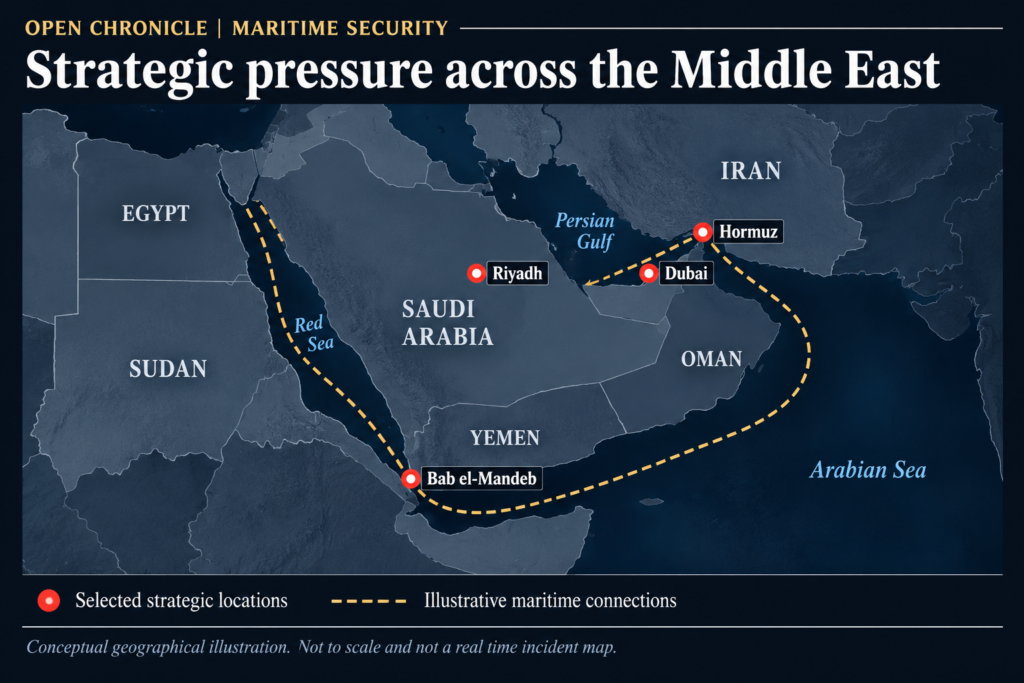
Separately, the United Kingdom Maritime Trade Operations organisation was cited in the morning news feed concerning an explosion near a tanker west of Dubai.
The available information does not establish a direct connection between all these incidents. Nevertheless, their geographical distribution illustrates the vulnerability of regional energy infrastructure and international maritime commerce.
Gaza’s humanitarian emergency continues
The morning news feed contains further reports of Palestinian deaths following Israeli military operations in Gaza.
Concerns are also growing over the deterioration of public health infrastructure, including reported increases in meningitis cases.
The destruction of housing, interruptions to medical services and difficulties accessing essential supplies continue to expose civilians to severe humanitarian risks.
Individual casualty reports remain subject to verification and revision.
Israel’s domestic political and judicial challenges
Israeli Prime Minister Benjamin Netanyahu faces continuing political and legal scrutiny.
Reports suggest that judges involved in his corruption trial have questioned aspects of one bribery case and recommended that prosecutors reconsider part of the proceedings.
Such recommendations should not be interpreted as the termination of the entire trial or a final judicial determination.
Meanwhile, Israeli lawmakers have reportedly advanced legislation concerning an inquiry into the October 7 attacks, reopening disagreements over institutional accountability.
Iran: human rights and diplomatic uncertainty
Reports concerning women facing capital punishment following protests have renewed international concern about human rights in Iran.
At the same time, diplomatic tensions involving Iran, Israel and the United States remain unresolved.
French statements supporting continued diplomatic engagement suggest that European governments remain interested in preventing further military escalation.
Iraq seeks to manage internal tensions and economic development
Iraqi authorities have reportedly denied preparations for military deployments towards the Kurdistan Region.
Discussions between Baghdad and Erbil continue to involve financial arrangements, political authority and security responsibilities.
Iraq and Türkiye are also reportedly seeking to begin construction of the Development Road infrastructure project in 2027.
The initiative could strengthen commercial connections between the Gulf, Türkiye and European markets, although its implementation will depend on financing, political stability and infrastructure development.
Egypt suffers a major road disaster
At least 31 people were killed and 21 injured after a fuel tanker crash triggered a major fire in Greater Cairo on Wednesday, according to Egyptian health authorities cited by the Associated Press.
The incident has renewed attention on road safety, hazardous materials transportation and emergency response capabilities.
Egyptian prosecutors have begun investigating the disaster.
Why it matters: The Middle East remains a central source of international geopolitical and economic risk. Military escalation, humanitarian emergencies and threats to maritime commerce can rapidly affect energy markets, shipping costs and diplomatic relations worldwide.
Sub-Saharan Africa
Sudan: returning home does not mean returning to normality
Sudanese families returning to Khartoum are reportedly discovering that many of their homes have become uninhabitable following prolonged fighting.
Damaged buildings, disrupted electricity and water supplies, limited medical services and the loss of personal possessions complicate efforts to rebuild communities.
The return of displaced populations should not automatically be interpreted as evidence that humanitarian conditions have improved sufficiently.
Meanwhile, the Sudanese military claims to have intercepted a drone in South Kordofan. Fighting, drought and agricultural disruption continue to threaten rural livelihoods and food security.
Democratic Republic of the Congo confronts a major Ebola emergency
Confirmed Ebola infections have exceeded 12,000, according to government figures reported by Reuters on Thursday.
The outbreak represents the second largest recorded Ebola epidemic, placing extraordinary pressure on medical personnel, humanitarian organisations and public health authorities.
The emergency also highlights the difficulties of containing infectious diseases in areas affected by insecurity, population displacement and inadequate healthcare infrastructure.
Somalia faces uncertainty over its future security architecture
The withdrawal of foreign military personnel from Somalia is generating renewed concern about the country’s capacity to contain al-Shabaab.
The transition towards greater national responsibility for security remains dependent on military readiness, institutional stability and sustained international assistance.
Sierra Leone records encouraging maternal health progress
Not all developments across Africa are negative.
The morning news feed highlights a substantial decline in maternal mortality in Sierra Leone, although geographical, financial and institutional barriers continue to restrict access to healthcare.
The development illustrates the potential benefits of sustained public health investment, while demonstrating that national improvements do not necessarily eliminate inequalities between communities.
Guinea confronts urban environmental challenges
Authorities in Guinea have reportedly ordered residents of Conakry to participate in efforts to address accumulated waste.
The initiative follows concerns about urban sanitation and the consequences of inadequate waste management infrastructure.
Why it matters: Africa’s humanitarian and security challenges cannot be understood exclusively through military developments. Public health, agricultural resilience, infrastructure, governance and economic opportunity remain fundamental to long term stability.
East Asia
North Korea declares its nuclear expansion irreversible
North Korean leader Kim Jong Un has inspected nuclear material production and research facilities, calling for the continued expansion of the country’s nuclear arsenal and a broader role for tactical nuclear weapons.
According to North Korean state media, Kim considers the country’s nuclear status irreversible.
The statements follow renewed expressions of interest from President Trump in establishing contact with the North Korean leadership.
Reuters, Associated Press and Yonhap independently reported the statements, although North Korea’s claims concerning its production capabilities cannot be fully verified through the available reporting.
The Korean Peninsula’s strategic dilemma
North Korea
|
🇰🇷
South Korea
|
🇯🇵
Japan
|
🇺🇸
United States
|
|
🇨🇳 |
🇷🇺 |
China: the Chen Jining investigation continues to reverberate
The investigation into Shanghai Communist Party chief Chen Jining remains one of the most significant developments within China’s political establishment.
Shanghai has traditionally served as an important platform for senior political careers, making the investigation particularly relevant to observers of Chinese leadership dynamics.
The case also raises questions about the relationship between Xi Jinping’s anticorruption campaign, institutional discipline and future leadership appointments.
However, an investigation does not establish guilt, and conclusions concerning China’s eventual leadership succession remain speculative.
Open Chronicle examined the investigation in greater detail in its previous coverage.
South Korea raises interest rates as semiconductor exports strengthen
The Bank of Korea increased its benchmark interest rate by 25 basis points to 3.25% on Thursday.
The central bank also upgraded its economic growth forecasts amid strong demand for semiconductors associated with artificial intelligence.
Inflation, household indebtedness and housing affordability nevertheless remain important economic concerns.
Japan confronts resistance to data centre expansion
Japan’s expanding data centre industry is reportedly facing opposition from residents concerned about the construction of large technological facilities in urban neighbourhoods.
The debate reflects a wider international challenge associated with artificial intelligence infrastructure.
Electricity consumption, cooling requirements, noise, land availability and the impact on local communities are increasingly important considerations in technological development.
Hong Kong remembers a devastating residential fire
Hong Kong is marking the anniversary of a major residential fire that claimed 168 lives, according to the supplied news feed.
Commemorations have reportedly taken place amid official warnings against public disorder.
The anniversary renews questions about construction safety, regulatory oversight, public accountability and the rights of affected families.
Taiwan prepares for politically significant local elections
Taiwan’s forthcoming local elections are attracting attention because of their potential implications for domestic political priorities and relations with Beijing.
Local elections are not direct votes on Taiwan’s international status, but their results may provide indications of changing public attitudes towards political parties and national leadership.
Why it matters: East Asia is simultaneously a centre of global economic growth, technological innovation and military competition. Developments on the Korean Peninsula, in China and across the Taiwan Strait have consequences extending throughout the international system.
South Asia
India assesses the consequences of American tariffs
India is among the economies included in Washington’s latest trade proposals.
Official documentation from the United States Trade Representative identifies potential duties of up to 25%, with a possible adjustment to 17% under a qualifying reciprocal trade agreement.
The outcome remains dependent on negotiations and the final implementation of the proposed measures.
The developments could have important implications for Indian manufacturing, textiles, exports and international investment.
Bangladesh faces renewed labour unrest
Reports of fresh demonstrations involving garment workers indicate that tensions surrounding wages and working conditions remain unresolved.
The clothing industry occupies a central position in Bangladesh’s export economy, making labour relations particularly significant for both domestic stability and international supply chains.
Potential American tariffs add another layer of uncertainty for manufacturers and workers.
Nepal confronts the continuing consequences of flash floods
Nepal is reportedly moving towards formally declaring missing Indian nationals dead following destructive flash floods in August.
The development highlights the long term humanitarian consequences of natural disasters, particularly when victims remain missing across international borders.
Sri Lanka confronts unresolved historical grievances
The discovery and investigation of a mass grave have reportedly renewed demands for accountability concerning historical violence against Muslim communities.
Questions surrounding historical memory, missing persons and transitional justice remain important to Sri Lanka’s reconciliation efforts.
Why it matters: South Asia’s economic prospects remain closely connected to international trade, employment and demographic change. Labour rights, disaster preparedness and historical reconciliation are equally important components of regional stability.
Southeast Asia
Indonesia: rescue operations continue following mine flooding
Rescue workers are continuing efforts to locate missing miners following the flooding of an unauthorised gold mine in West Java.
Early morning reports confirmed 13 deaths and 13 missing workers. A subsequent Associated Press report placed the number of confirmed deaths at 16, with 10 people still missing.
The changing figures reflect an ongoing recovery operation.
The disaster has renewed attention on the dangers associated with unregulated mining and inadequate occupational safety protections.
Myanmar challenges international judicial authority
Myanmar’s leadership has reportedly indicated that it will not fully comply with elements of the International Court of Justice’s genocide ruling.
The development is particularly significant for Rohingya communities and refugees who continue to seek justice, protection and conditions permitting a safe return.
The precise scope of the court’s ruling and Myanmar’s formal legal obligations require separate examination of the original judicial documents.
The government’s reported response should not be interpreted as altering the binding nature of applicable international legal obligations.
Vietnam seeks to protect its export economy
Vietnam is reportedly accelerating efforts to reach an agreement with Washington following the announcement of new American tariff proposals.
The country’s clothing, footwear, electronics and manufacturing industries are particularly dependent on international demand.
Vietnam’s position illustrates the difficult choices facing economies that have benefited from the geographical diversification of global manufacturing.
Malaysia confronts digital regulation and cybersecurity concerns
The morning news feed reports that Malaysia has initiated legal action against Google concerning allegedly harmful online content.
Separately, a reported cybersecurity incident involving a Malaysian bank’s website has generated misleading messages concerning cash withdrawals.
Both developments demonstrate the importance of distinguishing legitimate cybersecurity warnings from misinformation capable of undermining public confidence.
Cambodia strengthens military cooperation with China
Cambodia is reportedly hosting an expanded edition of the Golden Dragon military exercise with China.
The development adds to discussions about China’s regional security relationships and Southeast Asian governments’ efforts to balance competing international partnerships.
Why it matters: Southeast Asia occupies an increasingly important position in global manufacturing, international trade and strategic competition. Its governments must balance economic opportunity with security relationships, domestic governance and humanitarian responsibilities.
Oceania and the Pacific
Australia and the Solomon Islands deepen their partnership
Australia and the Solomon Islands signed a bilateral treaty in Canberra on November 25.
According to Australia’s Department of Foreign Affairs and Trade, the agreement establishes a broader foundation for cooperation involving security, economic development, mobility and cultural relations.
The treaty represents an important development in Pacific diplomacy, particularly in the context of Australia’s longstanding regional relationships and China’s growing engagement with Pacific island nations.
The agreement should nevertheless be understood as a bilateral partnership between sovereign countries rather than exclusively through the perspective of competition between major powers.
Australia expands online safety regulation
Australia has reportedly adopted further online safety legislation that could expose major technology companies to substantial financial penalties.
The development reflects increasing international pressure on digital platforms to address harmful content, user protection and regulatory accountability.
The legislation’s detailed requirements and penalty mechanisms remain subject to examination of the official text.
Wildfires threaten communities and wildlife
Reports of destructive wildfires on an Australian island highlight the continuing vulnerability of communities and ecosystems to extreme environmental conditions.
Emergency preparedness, evacuation capacity, wildlife protection and rebuilding efforts remain important priorities.
Why it matters: The Pacific is becoming increasingly significant to international diplomacy, maritime security and environmental policy. Regional governments are also playing a growing role in shaping international approaches to digital regulation.
05 | Global Thematic Developments
Theme 01 | Politics, Geopolitics and International Relations
Diplomacy operates alongside strategic competition
The international political environment is increasingly characterised by simultaneous negotiation and confrontation.
Washington continues to pursue discussions concerning Ukraine while advancing policies that may intensify economic tensions with important allies.
European governments are attempting to preserve political unity while negotiating competing financial priorities.
China’s domestic leadership investigation and North Korea’s nuclear declarations demonstrate how internal political decisions can influence international strategic calculations.
The Australia and Solomon Islands treaty provides another example of regional diplomacy taking place within a wider environment of geopolitical competition.
The central challenge is not simply the existence of disagreements, but the increasing difficulty of separating economic, political and security relationships.
Theme 02 | Military Affairs, Defence and International Security
Deterrence and diplomacy remain closely connected
The meeting between President Trump and NATO Secretary General Mark Rutte addressed Ukraine, Iran and investment in allied defence capabilities.
Their joint statement called for Russia to avoid widening the conflict and supported efforts towards a peaceful resolution.
However, the wider international security environment remains unstable.
North Korea’s nuclear expansion, continuing Russian military operations, reported Houthi attacks and insecurity in parts of Africa demonstrate that diplomatic engagement has not eliminated the perceived need for military preparedness.
Four dimensions of global security pressure
|
☢︎
|
Nuclear deterrenceNorth Korea’s declared nuclear expansion and regional security concerns.
|
|
🛡︎
|
Conventional military conflictContinuing hostilities in Ukraine, Sudan and the Middle East.
|
|
⚓︎
|
Maritime securityThreats to commercial shipping, energy infrastructure and strategic waterways.
|
|
⚙︎
|
Technological securityCybersecurity, semiconductor access and emerging defence technologies.
|
Theme 03 | Global Economy, Trade and Finance
Economic nationalism challenges international integration
The latest American tariff proposals represent one of the most significant economic developments of the morning.
Governments and businesses face renewed uncertainty concerning market access, production costs and international competitiveness.
An important distinction emerges from the official United States Trade Representative documentation: the proposed applicable rates vary between economies and account for existing tariffs, exemptions and negotiated commitments.
The headline maximum figures reported by international media should therefore not be interpreted as uniform additional duties.
Selected US tariff proposals
| 🇮🇳 India | 25% |
| 🇨🇳 China | 20% |
| 🇸🇬 Singapore | 20% |
| 🇧🇩 Bangladesh | 18% |
| 🇰🇭 Cambodia | 18% |
| 🇮🇩 Indonesia | 18% |
| 🇹🇭 Thailand | 18% |
| 🇪🇺 European Union | 15% |
| 🇯🇵 Japan | 15% |
| 🇰🇷 South Korea | 15% |
| 🇨🇭 Switzerland | 15% |
| 🇹🇼 Taiwan | 15% |
Europe’s budget negotiations and South Korea’s monetary policy decision demonstrate two additional dimensions of the global economic environment.
Governments must simultaneously support investment, manage inflation, finance security requirements and maintain public confidence.
Global economic indicators
The numbers shaping today’s economy
|
14
Economies targeted by new US tariff proposals
|
€1.7tn
Approximate European budget compromise proposal
|
|
€45bn
Proposed additional EU financing for Ukraine
|
3.25%
South Korean benchmark interest rate
|
|
4.1%
South Korean GDP growth forecast for 2027
|
2.8%
South Korean inflation in October 2026
|
Theme 04 | Technology, Artificial Intelligence and Cybersecurity
The strategic competition for computing power
Artificial intelligence is increasingly influencing international economic and security policy.
Reports concerning Chinese access to advanced Nvidia semiconductors despite American export restrictions illustrate the difficulties associated with controlling internationally traded technologies.
Meanwhile, the controversy surrounding Nvidia’s leadership demonstrates how corporate governance can become entangled with intelligence assessments and political decision making.
Japan’s reported resistance to urban data centre development highlights another dimension of the AI economy: its physical infrastructure requirements.
Australia’s online safety legislation and Malaysia’s reported legal action against Google illustrate the growing willingness of national governments to regulate international technology companies.
The five layers of technological competition
|
01
|
▣
|
SemiconductorsAccess to advanced processors and manufacturing capabilities.
|
|
02
|
☰
|
Computing infrastructureData centres, electricity, cooling and physical infrastructure.
|
|
03
|
⚛︎
|
Artificial intelligenceResearch, commercial applications and strategic capabilities.
|
|
04
|
🛡︎
|
CybersecurityProtection of government, corporate and critical infrastructure systems.
|
|
05
|
⚖︎
|
Regulation and sovereigntyExport controls, platform accountability and national technology policy.
|
Space infrastructure attracts growing attention
The morning news feed also includes reports concerning a Russian humanoid robot intended to support astronauts aboard the International Space Station and an ambitious SpaceX satellite infrastructure proposal.
These developments illustrate the growing importance of automation, commercial space infrastructure and orbital computing.
However, regulatory approval, proposed deployment and actual operational capability must be distinguished. The reported scale of the SpaceX proposal requires confirmation from original regulatory documentation.
Theme 05 | Humanitarian Affairs, Public Health and Human Rights
Humanitarian emergencies risk losing international attention
While geopolitical competition dominates many international headlines, humanitarian emergencies continue to affect vulnerable populations across several continents.
Sudanese families face the consequences of displacement and damaged infrastructure.
The Democratic Republic of the Congo confronts an extraordinary Ebola emergency.
Palestinian communities in Gaza remain exposed to military violence and deteriorating healthcare conditions.
Rohingya refugees continue to face uncertainty concerning justice, protection and their long term future.
Four humanitarian emergencies demanding attention
|
🇸🇩
SudanDisplacement and reconstruction
Families returning to damaged homes amid continuing insecurity.
|
🇨🇩
DR CongoEbola emergency
More than 12,000 confirmed infections reported by authorities.
|
|
🇵🇸
GazaCivilian protection
Continuing violence and deteriorating healthcare infrastructure.
|
🇲🇲
Myanmar and RohingyaJustice and displacement
Unresolved refugee protection and international legal accountability.
|
Violence against women remains a global concern
Developments following the International Day for the Elimination of Violence Against Women, observed on November 25, have highlighted continuing concerns over gender based violence, political repression and access to justice.
Reports concerning Iranian women facing capital punishment and the suffering of women in conflict zones underline the importance of sustained international attention beyond annual commemorations.
Theme 06 | Environment, Climate, Society and Culture
Environmental emergencies expose infrastructure vulnerabilities
Several developments in the morning news cycle illustrate the relationship between environmental conditions, infrastructure and public safety.
Environmental and infrastructure emergencies
|
🇮🇩
⛰︎
|
IndonesiaFlooding at an unauthorised gold mine prompts continuing rescue operations.
|
|
🇪🇬
🚚︎
|
EgyptA major fuel tanker fire raises concerns over road and transport safety.
|
|
🇦🇺
🔥︎
|
AustraliaWildfires threaten residential communities and wildlife.
|
|
🇺🇸
🌧︎
|
United StatesSevere weather disrupts Thanksgiving celebrations and threatens coastal communities.
|
|
🇪🇸
≋
|
SpainA tanker sinking near Ibiza prompts reported pollution response measures.
|
Climate diplomacy faces renewed disagreements
The supplied news feed includes accusations from OPEC concerning the European Union’s role in the reported breakdown of COP31 climate negotiations.
The allegations highlight continuing disagreements over energy policy, economic development and international climate commitments.
Responsibility for the reported negotiating difficulties cannot be established solely from statements issued by one participant.
Culture: reports of the death of Andy Taylor
Several headlines in the morning news feed report the death of Andy Taylor, the guitarist and songwriter associated with Duran Duran.
Taylor’s musical contributions helped define the sound of one of the most internationally recognised British bands of the 1980s.
Independent confirmation from his family, representatives or the band’s official channels should be obtained before publishing a definitive obituary.
Thanksgiving in a period of international uncertainty
Millions of Americans are observing Thanksgiving today, providing a moment of cultural continuity amid political divisions, economic uncertainty and international tensions.
The reported postponement of New York’s traditional parade illustrates how even longstanding cultural institutions remain vulnerable to environmental disruption.
06 | Open Chronicle Global Strategic Assessment
Six forces reshaping the international environment
Today’s developments reveal several interconnected forces that extend beyond individual national headlines.
Six forces reshaping the world
|
01
⇅
|
Economic fragmentationTariffs, industrial subsidies and competing trade policies are challenging established patterns of international economic integration.
|
|
02
☢︎
|
Renewed nuclear competitionNorth Korea’s declarations illustrate the continuing difficulties facing international nonproliferation efforts.
|
|
03
⚖︎
|
Institutional resilienceEuropean budget negotiations demonstrate the challenge of maintaining collective action amid competing national priorities.
|
|
04
⚙︎
|
Technological sovereigntySemiconductors, artificial intelligence, computing infrastructure and cybersecurity are becoming central instruments of national power.
|
|
05
⚓︎
|
Maritime vulnerabilityRegional conflicts and shipping incidents expose the dependence of international commerce on secure maritime connections.
|
|
06
♡
|
Humanitarian vulnerabilityConflict, infectious disease, displacement and inadequate infrastructure continue to threaten vulnerable populations.
|
Economic security is becoming national security
Washington’s tariff proposals and Europe’s financial negotiations demonstrate how economic policy is increasingly influenced by strategic considerations.
Governments are attempting to protect industrial capabilities, secure access to critical technologies and reduce perceived external dependencies.
The resulting policies may strengthen selected domestic industries while introducing additional costs and uncertainty elsewhere in the global economy.
Diplomacy remains essential but increasingly difficult
The discussions between Washington and NATO demonstrate that diplomatic engagement remains possible even amid substantial political disagreements.
However, diplomatic statements must eventually translate into practical agreements, credible security arrangements and measurable humanitarian improvements.
A commitment to negotiations is not equivalent to a successful peace process.
Technological progress creates new dependencies
Artificial intelligence and advanced semiconductors offer considerable economic opportunities.
Their development also creates new dependencies on electricity, computing infrastructure, specialised manufacturing, international supply chains and cybersecurity.
Technological leadership will increasingly depend not only on innovation but also on the resilience of the systems supporting it.
Humanitarian resilience must remain a strategic priority
The humanitarian situations in Sudan, Gaza, Myanmar and the Democratic Republic of the Congo demonstrate that international security cannot be measured exclusively through military capabilities or economic indicators.
Public health, civilian protection, functioning infrastructure and access to essential services remain fundamental elements of stable societies.
07 | What to Watch Over the Next 24 Hours
| Development | What to monitor |
|---|---|
| European Council summit | Progress towards a compromise on the next financial framework. |
| Ukraine financing | Political support for the proposed additional €45 billion package. |
| ECB leadership | Developments concerning senior appointments. |
| US tariff proposals | Official responses, negotiations and proposed implementation arrangements. |
| Ukraine peace diplomacy | Further statements from Washington, Kyiv, Moscow and European governments. |
| Prisoner exchange | Official confirmation of any agreed humanitarian arrangements. |
| North Korea | Diplomatic reactions from Seoul, Tokyo and Washington. |
| Middle East | Further developments involving Saudi Arabia, Yemen, Iran and maritime security. |
| Gaza | Humanitarian access, civilian protection and public health conditions. |
| Sudan | Security conditions and assistance for returning displaced populations. |
| Congo Ebola outbreak | Updated epidemiological figures and international medical assistance. |
| Indonesia mine disaster | Rescue operations and revised official casualty figures. |
| Myanmar | Formal responses to international judicial decisions. |
| Technology regulation | Further details concerning online safety legislation and semiconductor controls. |
| Global financial markets | Reactions to tariff uncertainty and South Korean monetary policy. |
| United States weather | Emergency warnings, transport disruption and coastal flooding. |
08 | The World in Perspective
An international system under simultaneous pressure
The events of November 26, 2026, reveal a world in which economic decisions, technological developments, military competition and humanitarian emergencies are becoming increasingly interconnected.
A tariff announcement in Washington can influence employment in Bangladesh, industrial investment in Vietnam and economic policy in Europe.
A nuclear declaration in Pyongyang can affect security calculations in Seoul, Tokyo and Washington.
A regional confrontation in the Middle East can influence international shipping, energy prices and household expenditure thousands of kilometres away.
An infectious disease emergency in Central Africa can expose weaknesses in international humanitarian coordination and public health preparedness.
These connections demonstrate why international affairs cannot be understood through isolated headlines alone.
The ability of governments and international institutions to respond effectively will depend on their capacity to recognise these relationships, manage competing priorities and preserve opportunities for cooperation.
The world is not facing a single crisis. It is confronting multiple pressures that increasingly influence one another.
Understanding the world requires more than knowing what happened. It requires understanding how events are connected, why they matter and what they may mean for tomorrow.
That is the purpose of the Open Chronicle Global News Brief.
09 | Sources and Editorial Transparency