
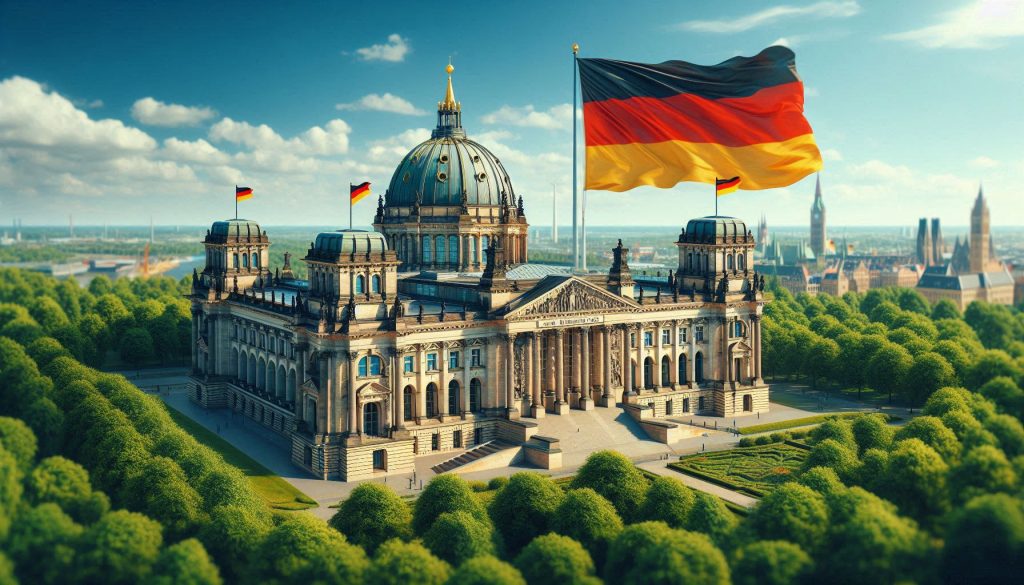
Image Credentials: Image Title: Trump Exempts Key Tech Products from China Tariffs, Easing Tensions with US Firms Source: AI-Generated Image (Microsoft.Disegner) Date: April 2025 Attribution: Created by AI-generated imagery (Microsoft.Disegner), and it does not depict a real-world scene.
By Staff Writer with Agencies
Berlin — Germany is on the brink of a major political transition as the coalition agreement between the Conservative Christian Democratic Union (CDU), the Bavarian sister party CSU, and the Social Democrats (SPD) nears final approval. The historic deal, which marks a shift in power after months of negotiations, is set to bring about significant changes in the country’s leadership, with a particular focus on the key government positions to be filled by the new coalition.
Following the snap elections in February, where the CDU/CSU alliance secured 28.5% of the vote, Chancellor-in-waiting Friedrich Merz is poised to take office. Although the CDU fell short of a majority, they have successfully brokered a coalition with the SPD, giving the two parties a combined 328 seats in the Bundestag, comfortably surpassing the 316-seat threshold for a governing majority.
Under the terms of the agreement, the CDU/CSU will hold control of six key ministries, including the pivotal Foreign Ministry, marking the first time in nearly 60 years that the Christian Democrats will take charge of Germany’s foreign affairs. With this shift, senior CDU figures Johann Wadephul and Armin Laschet have emerged as leading candidates for the position. Both figures are well-regarded within the party, with Laschet having previously served as the party’s leader and Wadephul being a senior member of the Bundestag.
The CSU, the CDU’s Bavarian sister party, will control three ministries, including the Interior Ministry, where they are expected to implement stricter migration and internal security policies. CSU parliamentary leader Alexander Dobrindt is widely tipped to be appointed as interior minister, with the coalition agreement detailing tough measures on irregular migration, including enhanced border controls and a stricter approach to migrant returns at entry points.
In contrast, the Social Democrats (SPD) will hold seven ministries, including the crucial Finance, Defense, and Labor portfolios. Boris Pistorius, the current defense minister, is expected to retain his position due to his popularity among the electorate. Meanwhile, Lars Klingbeil, co-chair of the SPD, is set to take on dual responsibilities as vice chancellor and finance minister, a move that strengthens his role as a key figure in the new government.
The coalition agreement, while promising a solid majority, still needs to pass internal approval processes. The SPD will conduct a membership-wide vote from April 15 to 29, while the CDU will make its decision at a smaller party conference on April 28. The CSU, however, has already approved the deal during a video conference meeting of its executive committee and parliamentary groups earlier this week.
If all three parties approve the agreement, Friedrich Merz is expected to be elected as the new chancellor in early May, replacing Olaf Scholz, whose term will officially end with the new government formation. The signing ceremony for the coalition agreement is set for May 5, with the parliamentary vote scheduled for May 6.
As the coalition moves closer to finalization, all eyes are on the cabinet lineup and the policies the new government will implement, particularly in the areas of migration, security, and economic reform. The shift in power marks a turning point in Germany’s political landscape, with the CDU now poised to return to a position of influence after years in opposition, while the SPD’s diminished share of the vote highlights the ongoing challenges facing the Social Democrats.
This new coalition government will have significant implications not only for Germany’s domestic policies but also for its role on the global stage, especially in light of the leadership change in the Foreign Ministry. With both domestic and international challenges ahead, the incoming administration will have its work cut out as it navigates the complex political landscape of post-Scholz Germany.