
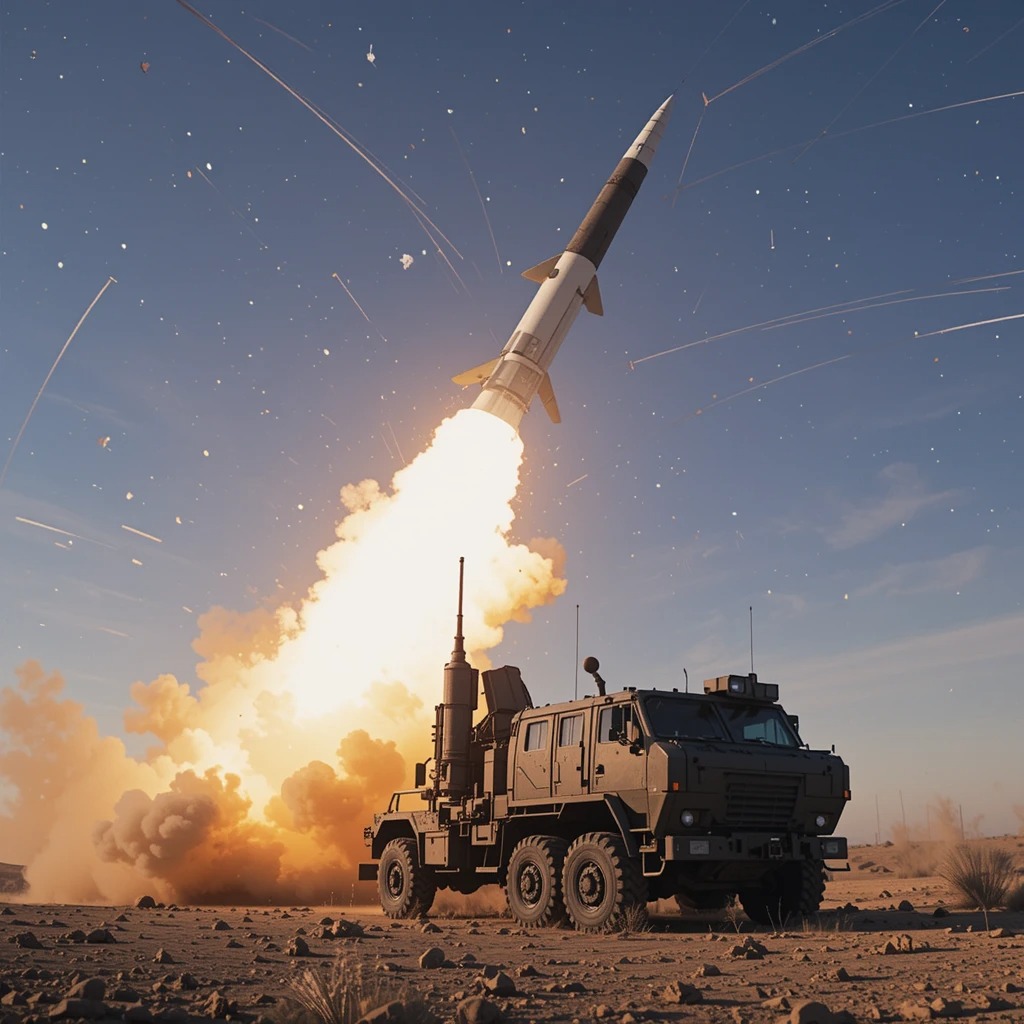
Image Credentials: Image Title: IDF Announces New Advance Alert System for Long-Range Missile Threats Source: AI-Generated Image (Aiease.ai) Date: April 2025 Attribution: Created by AI-generated imagery (Aiease.ai), and it does not depict a real-world scene.
By Staff Writer with Agencies
Tel Aviv, Israel — April 19, 2025 — In response to escalating missile threats from Iran and its regional proxy, the Houthi rebels of Yemen, the Israel Defense Forces (IDF) has unveiled a new advanced alert system aimed at enhancing public safety and readiness. The IDF’s Home Front Command announced on Thursday that the system, integrated into a new mobile app, will provide a critical early warning to citizens, allowing them to take shelter in anticipation of incoming missile fire.
The app, which is now available to the public, will issue alerts 3 to 5 minutes before the activation of traditional sirens, providing a crucial window of time for Israeli citizens to seek cover. This new system is designed to give civilians an early warning about missile launches, particularly those coming from Yemen, where the Iran-backed Houthi militia has been increasingly active in the conflict.
A statement from the IDF spokesperson accompanying the announcement explained: “Missile fire from Yemen toward the State of Israel may occur in the coming minutes.” The primary purpose of the new alert system is to improve public preparedness and bolster the security of the civilian population against long-range missile threats.
Missile Threats from Yemen and Houthi Aggression
The Houthi militia, which has launched hundreds of missiles and drones against Israel since the outbreak of the Israel-Hamas conflict in October 2023, has become one of the most significant threats facing Israel from the Iranian-backed proxies in the region. Though the Houthis initially played a smaller role in the broader Iranian campaign, their involvement escalated significantly after Israeli military actions weakened other groups like Hamas and Hezbollah in 2024.
One of the most notable incidents occurred in December 2024, when a Houthi missile struck southern Tel Aviv, injuring 16 Israelis. The strike occurred despite Israel’s existing alert system, which had failed. Following the attack, the Israeli Air Force responded with extensive aerial strikes targeting key Houthi infrastructure, including Sana’a International Airport in Yemen.
The Role of U.S. Military Intervention
The growing missile threat from Yemen has also prompted international involvement. In March 2025, U.S. President Donald Trump ordered large-scale military strikes against the Houthis, marking a more forceful American approach to the situation. Trump, on his Truth Social platform, warned the Houthis directly, saying, “To all Houthi terrorists, YOUR TIME IS UP, AND YOUR ATTACKS MUST STOP, STARTING TODAY… HELL WILL RAIN DOWN UPON YOU LIKE NOTHING YOU HAVE EVER SEEN BEFORE!”
Despite these U.S. actions, Houthi missile attacks on Israel continued, with a missile launched on Friday landing in central Israel. Fortunately, the missile was intercepted by Israel’s defense systems, and no casualties or damage were reported.
U.S. Strategy and Israeli Support
The United States has advocated for Israeli forces to focus more on the threats from Hezbollah and Hamas, leaving the management of the Houthi situation to U.S. military assets in the region. Washington believes that U.S. military capabilities—specifically the ability to launch sustained air strikes from naval assets—are better suited to handle the long-range missile threats posed by the Houthis.
Israeli officials have expressed their appreciation for U.S. involvement, with Prime Minister Benjamin Netanyahu publicly praising Trump’s actions. “I greatly appreciate the actions of our ally, the U.S.,” Netanyahu said in a statement. “They are dealing with them very forcefully. Of course, we are acting to defend ourselves, as has happened recently. But the fact that the U.S. has gone in there vigorously is a major change.”
Future of the Houthi Threat
In recent reports, Israeli officials estimated that the Houthi militia is now down to a “few dozen” ballistic missiles in their arsenal. However, the ongoing missile launches demonstrate that the group remains a viable threat, underscoring the need for the new early alert system to provide more advanced notice to protect civilians.
The combination of the new alert system, the continued efforts of the Israeli Air Force, and the U.S. military intervention represents a multi-faceted approach to dealing with the growing missile threat from the Iranian-backed Houthis. The situation remains fluid, with Israel and its allies continuing to adjust their strategies in response to the evolving threat landscape.