
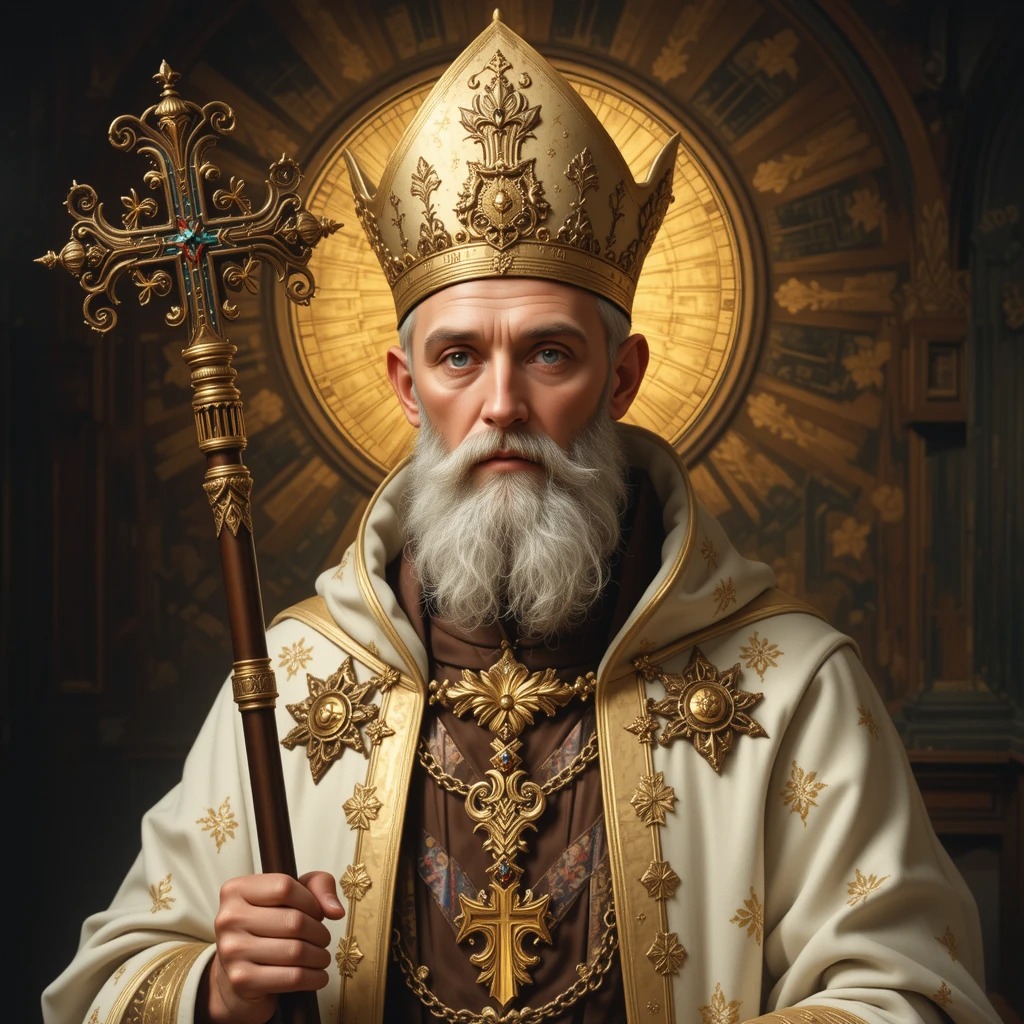
Image Credentials: Image Title: 12th-century Irish bishop Saint Malachy Ancient Prophecy Resurfaces After Pope Francis’ Death, Sparks End-of-Days Speculation Source: AI-Generated Image (Aiease.ai) Date: April 2025 Attribution: Created by AI-generated imagery (Aiease.ai), and it does not depict a real-world scene.
By Staff Writer
VATICAN CITY — April 21, 2025
The death of Pope Francis on Easter Monday has reignited global curiosity and unease surrounding a 900-year-old prophecy that many believe foretells the end of the world. According to a mysterious medieval manuscript long held in the Vatican’s secret archives, the pontiff who follows Francis may preside over the final days of humanity.
The document in question is “Prophetia Sancti Malachiae Archiepiscopi, de Summis Pontificibus” — more commonly known as The Prophecy of the Popes. Attributed to 12th-century Irish bishop Saint Malachy, the text contains a cryptic list of 112 Latin mottos, each corresponding to successive popes from Celestine II (elected in 1143) to the last leader of the Catholic Church.
With Pope Francis now deceased at the age of 88 after a prolonged battle with double pneumonia, attention has turned to the final passage in Malachy’s prophecy. The chilling entry reads:
“In the final persecution of the Holy Roman Church, there will reign Peter the Roman, who will feed his flock amid many tribulations, after which the seven-hilled city will be destroyed, and the dreadful Judge will judge the people. The End.”
Many believers interpret this to mean that Pope Francis — the 266th pontiff — was the last traditional pope before the rise of “Peter the Roman,” a symbolic or literal figure who will lead the Church through unprecedented trials leading up to the Judgment Day, possibly as early as 2027.
The timeline speculation stems in part from a section of the prophecy associated with Pope Sixtus V, who began his papacy 442 years after the first pope. Some theorists claim that this marks the midpoint of the papal lineage, predicting a symmetrical end 442 years later, placing the supposed “end of the world” just two years from now.
The book was discovered in 1590 by Benedictine monk Arnold Wion, but it has always walked a fine line between revered scripture and controversial forgery. Many modern historians and theologians argue that the prophecy was a politically motivated hoax, crafted to influence 16th-century papal elections.
Despite this, the prophecy has permeated popular culture and conspiracy theories alike. It has been featured in thrillers like The Third Secret by Steve Berry and The Doomsday Key by James Rollins, lending it a mystique that continues to captivate audiences.
Skeptics also point to Scripture as a direct contradiction to doomsday predictions. The Bible, specifically Matthew 24:36, cautions:
“But about that day or hour no one knows, not even the angels in heaven, nor the Son, but only the Father.”
For now, the Catholic Church prepares to lay Pope Francis to rest and convene a conclave to elect his successor. But in the shadow of ancient prophecy and modern uncertainty, questions about the future of the Church — and the world — continue to swirl.
As one Vatican insider put it, “The legacy of Pope Francis is one of inclusion, peace, and humility. Whether or not he was the last pope, he was certainly a shepherd for our times.”