
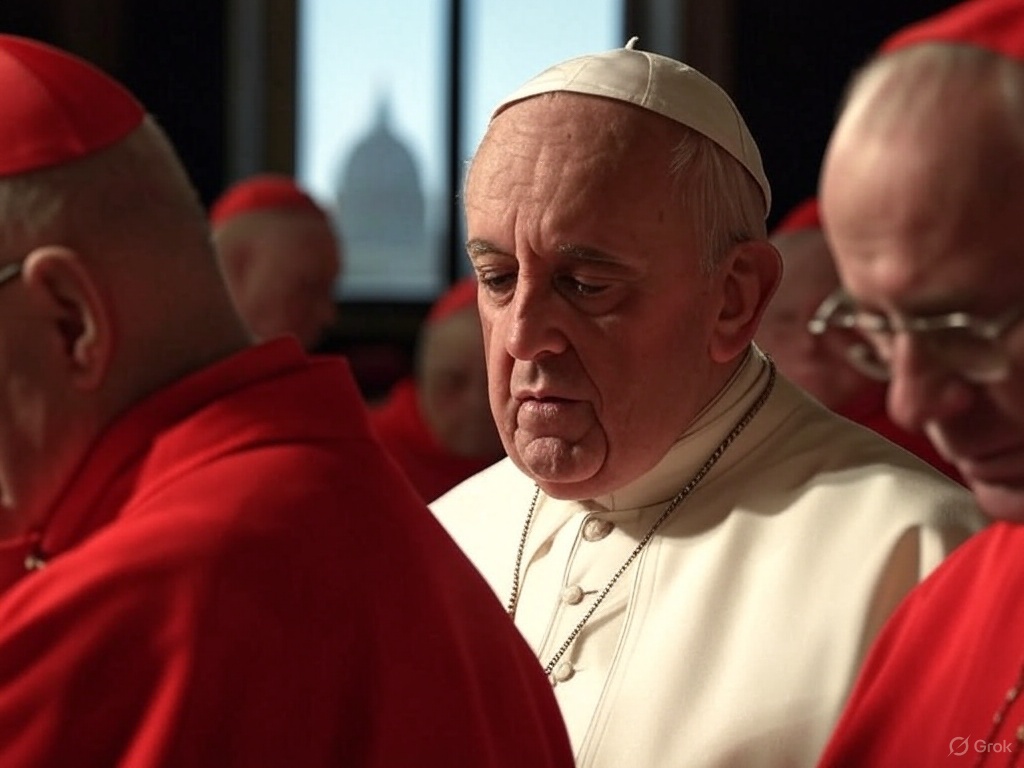
Image Credentials: Image Title: Pope Francis Dies at 88: A Global Mourning and the Path to a New Pope Source: AI-Generated Image (Grok, xAI) Date: April 2025 Attribution: Created by AI-generated imagery (Grok, xAI), and it does not depict a real-world scene.
Vatican City, 21 April 2024 – Pope Francis, the first Latin American pontiff in history, passed away on Easter Monday at the age of 88, marking the end of over 12 years of leadership for the Catholic Church. His death, confirmed by Cardinal Kevin Farrell, the Vatican camerlengo, sets in motion the intricate process of mourning, funeral arrangements, and the election of his successor.
A Final Farewell on Easter Sunday
Pope Francis made his final public appearance just a day before his death. On Easter Sunday, despite his declining health, he blessed the crowds gathered in St. Peter’s Square from the loggia of St. Peter’s Basilica, offering the traditional Easter greeting: “Brothers and sisters, Happy Easter.” The appearance, marked by a ride in his popemobile, drew wild cheers and applause from the faithful.
In a poignant moment, Francis met with U.S. Vice President JD Vance before the mass. Vance, who had converted to Catholicism in 2019, remarked on the pope’s evident illness, but also on the warmth and dedication Francis showed despite his fragile health.
Reactions and Global Mourning
As the bells of St. Peter’s Basilica tolled to mark Francis’ passing, tributes began pouring in from around the globe. Leaders from all walks of life, Catholic and non-Catholic alike, mourned the loss of a spiritual leader whose compassion and advocacy for the marginalized left an indelible mark on the world.
European Council President António Costa praised Francis for caring about the world’s pressing challenges, such as migration, climate change, and inequality. German Chancellor Olaf Scholz described the pontiff as an advocate for the weak and a warm-hearted reconciler.
Religious leaders also honored him for his commitment to fostering interfaith dialogue. The head of the Church of England and Rome’s chief rabbi both celebrated Francis’ efforts to improve relations between religions, particularly between Judaism and Catholicism.
Pope Francis’ Final Months and Last Day
Pope Francis had struggled with chronic lung disease, a condition that led to the removal of part of his lung during his youth. In February 2024, he was hospitalized for double pneumonia, marking the longest hospital stay of his papacy. The period of hospitalization raised fears that Francis’ health was deteriorating rapidly, and there was speculation that, like Pope Benedict XVI, he might resign. However, after 38 days in the hospital, he returned to the Vatican on March 23, providing brief relief to the faithful.
Despite these struggles, Francis remained dedicated to his role as leader of the Catholic Church. His death on Easter Monday came after a final public blessing, offering a serene and fitting conclusion to his pontificate.
The Mourning Process, Funeral, and Conclave
The death of Pope Francis triggers a series of rituals and ceremonies, including a formal mourning period for the faithful to pay their respects. Initially, the Vatican will allow Vatican officials to pay their respects at the Santa Marta Chapel, where Francis had lived. Afterward, his body will be transferred to St. Peter’s Basilica for public viewing.
A funeral Mass will be held, followed by burial. While the exact date of the funeral has not yet been announced, the burial will occur between the fourth and sixth day after his death, following tradition. After the funeral, the Vatican will observe nine days of official mourning known as the novemdiales.
During this period, cardinals will begin to gather in Rome for the conclave to elect a new pope. The conclave will begin 15 to 20 days after the declaration of the sede vacante (vacant see), although it could begin sooner if the cardinals agree. The election process will be held in secret sessions, with ballots burned in a stove. Black smoke will indicate no pope has been elected, while white smoke will signal the election of a new head of the Catholic Church.
The Legacy of Pope Francis
Pope Francis will be remembered for his compassion, his advocacy for the poor, and his efforts to bring the Catholic Church closer to the people. His pontificate was defined by his humility and deep focus on social justice, emphasizing the care for the environment and his calls for peace, equality, and dialogue among faiths.
Though he has passed, his legacy will undoubtedly continue to inspire and shape the direction of the Church and the broader world for years to come.
For updates on the papal funeral rites, conclave proceedings, and the election of the next pope, stay tuned to our ongoing coverage.