
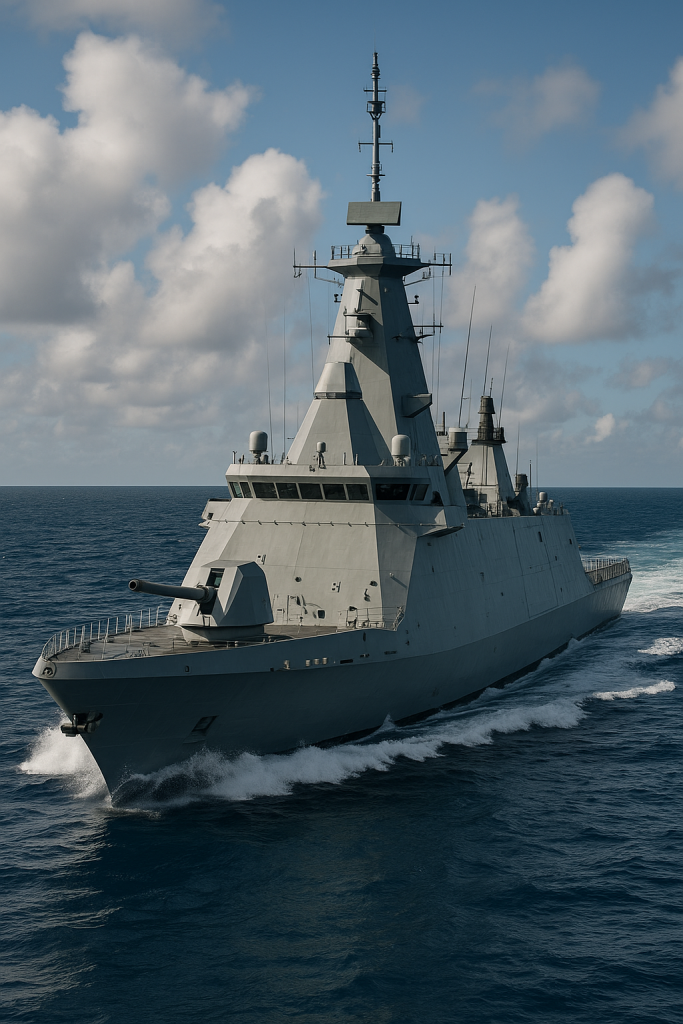
Image Credentials: Image Title: Singapore Showcases Futuristic Multirole Combat Vessels at IMDEX Asia 2025 Source: (sora.chatgpt) Date: May 2025 Attribution: Created by AI-generated imagery (sora.chatgpt), and it does not depict a real-world scene.
By Staff Writer with Agencies
Singapore, May 15, 2025 — In a major step toward reshaping the Republic of Singapore Navy (RSN), Singapore has publicly revealed scale models of its future Multirole Combat Vessels (MRCVs) for the first time. The unveiling occurred at IMDEX Asia 2025, a premier naval exhibition hosted from May 6–8, showcasing the next evolution in maritime warfare design.
Built by ST Engineering and designed in collaboration with Sweden’s Saab and Denmark’s Odense Maritime Technology (OMT), the MRCVs represent a significant technological leap for the RSN. These vessels are set to replace the aging Victory-class missile corvettes and position Singapore at the forefront of naval innovation in Southeast Asia and beyond.
Twin-Tower Design and Future-Ready Systems
The sleek models on display revealed a futuristic hull design featuring dual superstructures, a raised midsection deck, and an integrated forward mast made of carbon fibre composite. Supplied by Saab Kockums, the mast houses four active electronically scanned array (AESA) radar panels and is engineered to be up to 50% lighter than steel, enhancing stealth, corrosion resistance, and thermal insulation. Despite its lightweight properties, each mast weighs approximately 60 tonnes and will be shipped in modular form from Sweden for final assembly in Singapore.
Lars Kaddik of Saab confirmed the design echoes previous mast technologies deployed in the RSN’s Littoral Mission Vessels (LMVs), blending proven systems with new capabilities.
For the first time, accurate scale models of Singapore’s new Multirole Combat Vessel #MRCV have been shown. Both ST Engineering, which is building the MRCV, and Saab, which designed the vessel, exhibited respective scale models at IMDEX 2025 🇸🇬https://t.co/rcwT0K8OCn
— Naval News (@navalnewscom) May 14, 2025
Heavy Firepower and Modular Flexibility
At the bow, a 76mm Leonardo naval gun in STRALES configuration is positioned ahead of 32 vertical launch system (VLS) cells capable of firing MBDA’s Aster and VL MICA NG surface-to-air missiles. Though absent from the models, Blue Spear anti-ship missiles are also expected to be part of the vessel’s armament.
A bulbous bow suggests onboard sonar capability, while two diagonally mounted remote-controlled weapon stations sit above the hangar. The ship’s non-lethal defence systems include Sitep Italia’s multi-role acoustic stabilised systems. Additional sensors and countermeasures are provided by Safran (electro-optical suite and decoy launchers) and Thales, whose SeaFire multifunction radar is already proven on France’s FDI frigates.
The stern features a large flight deck and hangar capable of supporting a helicopter the size of an Airbus Super Puma. A dual stern ramp allows deployment and recovery of unmanned surface vessels (USVs) and rigid-hulled inflatable boats (RHIBs), an enhanced system derived from those used on LMVs.
Unmanned Warfare and Integrated Command
As “motherships” for unmanned systems, MRCVs will support operations across air, surface, and sub-sea domains. This aligns with Singapore’s ongoing push into autonomous warfare, already seen with the deployment of MARSEC USVs.
Measuring 150 meters in length with a beam of 21.04 meters and a draught of 5.7 meters, each MRCV will displace 8,400 tonnes at full load. Propulsion will be provided by an integrated full electric propulsion (IFEP) system combining GE Vernova electric motors with M.A.N. diesel engines, designed to accommodate future technologies such as directed energy weapons.
Each vessel will support a crew of up to 160, though the actual number will be significantly leaner due to automation and AI systems. The vessels will feature an integrated command centre that merges bridge, combat, and engineering controls, mirroring lessons learned from the LMV programme.
Construction Underway
Construction is already progressing at pace. The first steel was cut on March 8, 2024, with the keel laid in October. The second vessel began construction on April 24, and the lead ship’s launch is expected by the end of this year. Commissioning is targeted for 2028.
The Ministry of Defence awarded the design and build contract to ST Engineering on March 27, with Saab and OMT providing the baseline design, differing from ST Engineering’s in-house Vanguard-class concept.
RSN’s Vision for the Future
According to ST Engineering, the MRCV programme will serve as a force multiplier through the integration of digital and autonomous technologies, enabling faster, smarter, and more efficient operations at sea. These ships will not only enhance the RSN’s maritime domain awareness but also form the backbone of its future combat capability.
With this ambitious project, Singapore cements its position as a leader in maritime innovation, fielding a new generation of warships ready for the digital and unmanned age.
Tags: Singapore Navy, MRCV, IMDEX Asia 2025, ST Engineering, Saab, unmanned systems, naval technology, Southeast Asia defence, Republic of Singapore Navy, carbon fibre mast, SeaFire radar, VL MICA, Aster missiles, GE Vernova, AI in defence, modern naval warfare, Victory-class replacement, autonomous vessels