
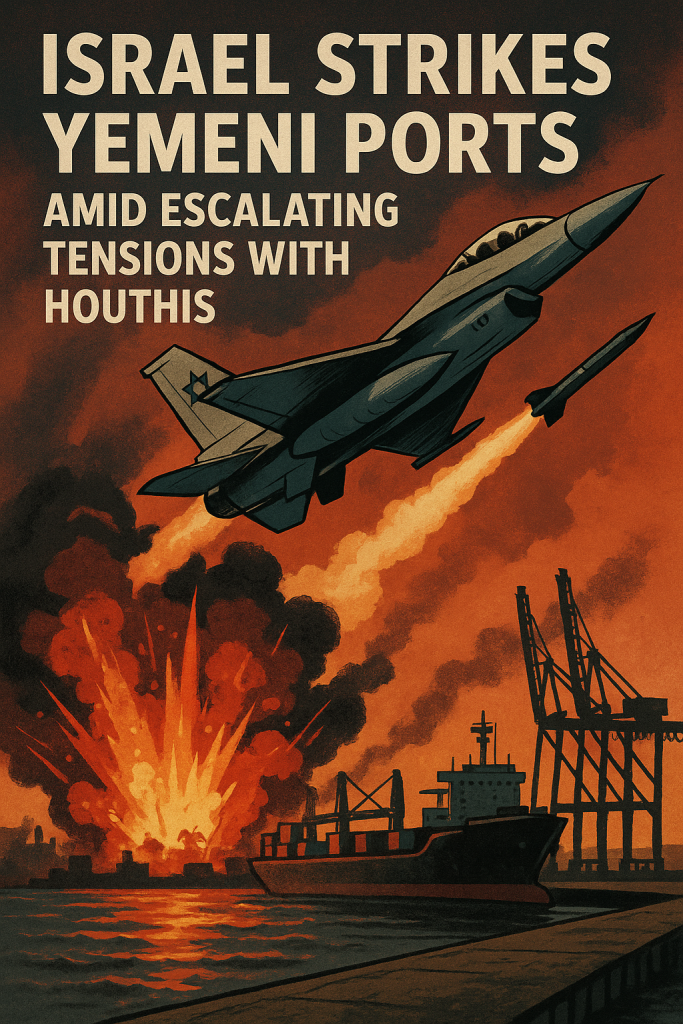
Image Credentials: Image Title: ISRAEL STRIKES YEMENI PORTS AMID ESCALATING TENSIONS WITH HOUTHIS Source: (sora.chatgpt) Date: May 2025 Attribution: Created by AI-generated imagery (sora.chatgpt), and it does not depict a real-world scene.
Netanyahu warns of further retaliation as conflict spreads beyond Gaza
By Staff Writer | Open Chronicle with Agencies
Tel Aviv/Amman – May 16, 2025 — Israel has launched airstrikes on two key ports in Yemen — Hodeidah and as-Salif — in what it calls a direct response to ongoing missile attacks from the Iran-backed Houthi rebel group. The strikes mark a significant escalation, coming just days after the Houthis agreed to a U.S.-brokered truce that excluded Israel.
The Israeli military confirmed the attacks early Friday, stating that the targeted facilities were being used to transfer weapons by what it described as a “terrorist organization.” The Houthis, who control large swaths of northern Yemen, including the capital Sanaa, acknowledged the strikes via their affiliated Al Masirah television channel.
No immediate casualties have been reported, and the extent of damage to the ports remains unclear.
Prime Minister Benjamin Netanyahu issued a stern warning following the strikes, vowing that Israel would continue its offensive campaign if Houthi missile launches persist.
“These attacks are just the beginning,” Netanyahu said in a statement posted on the Israeli government’s official social media channels. “We will not stand idly by. We will strike them with greater force, including at their leadership and infrastructure.”
Israeli Defence Minister Yoav Gallant echoed this stance, stating that Houthi leader Abdel-Malik al-Houthi would be targeted directly if attacks on Israeli territory do not cease.
“We will hunt him down,” Gallant said, referencing previous Israeli operations that eliminated key regional adversaries, including Hamas commanders and Hezbollah leaders.
Widening Front
The Houthi attacks on Israel are part of what the group calls a campaign of solidarity with Palestinians, as Israel continues its assault on Gaza. Since October 2023, the conflict has claimed thousands of lives. According to Gaza’s Health Ministry, nearly 3,000 Palestinians have been killed since Israel broke a ceasefire with Hamas in March.
Al Jazeera’s Hamdah Salhut, reporting from Amman, Jordan, noted that the Houthis have launched at least 34 projectiles toward Israel since that ceasefire ended.
“Israel’s policy moving forward appears to be simple: for every missile fired, there will be an airstrike in response,” she said.
Geopolitical Implications
Friday’s strikes are the first by Israel since the United States and the Houthis reached a limited ceasefire agreement earlier this month, with the Houthis agreeing to stop attacks on Red Sea shipping routes and the U.S. halting its own strikes in Yemen. Israel was not party to that deal, and officials in Tel Aviv insist that the Houthis remain a direct and immediate threat.
Netanyahu accused Iran of orchestrating Houthi operations, describing the rebel group as “just a tool” in Tehran’s regional strategy.
The growing confrontation threatens to further destabilize an already volatile Middle East, as regional powers watch closely to see whether the war in Gaza will spiral into a broader conflict involving multiple fronts, including Lebanon and now Yemen.
International Response
There has been no immediate reaction from Washington or the United Nations regarding the Israeli strikes. However, analysts suggest that the widening conflict could complicate U.S. efforts to maintain its own ceasefire agreement with the Houthis and de-escalate tensions in the Red Sea.
As of now, the Houthis have not signaled a formal end to their truce with the U.S., but Friday’s Israeli airstrikes may test the limits of that agreement.