
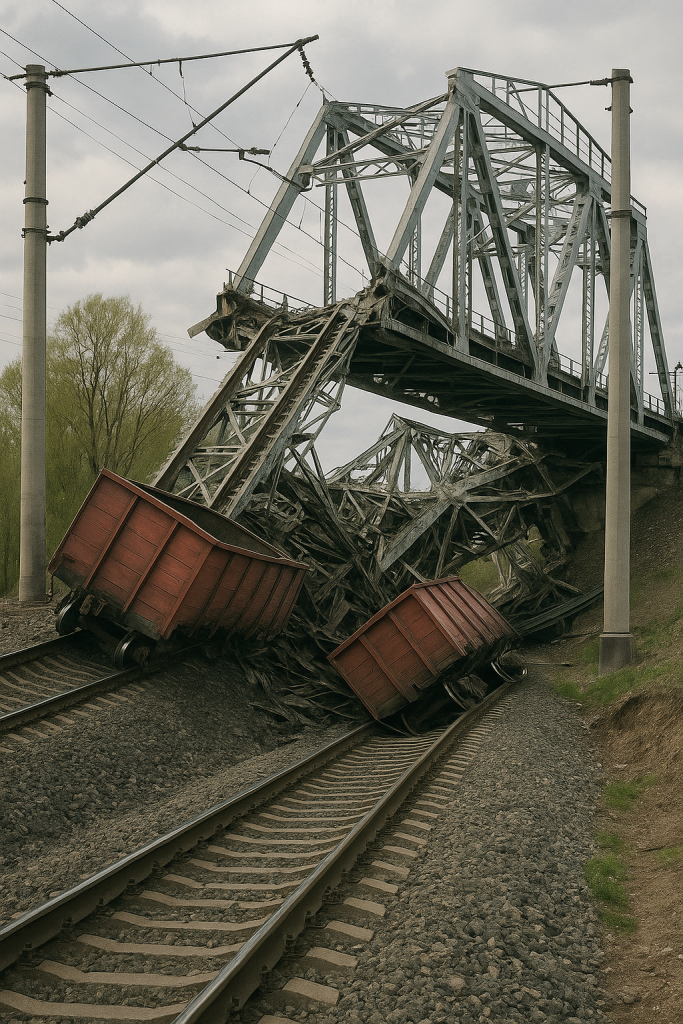
Image Credentials: Image Title: Railway Chaos in Russia: Bridge Collapses in Bryansk and Kursk Leave Seven Dead and Dozens Injured Source: (sora.chatgpt) Date: May 2025 Attribution: Created by AI-generated imagery (sora.chatgpt), it does not depict a real-world scene.
Officials blame sabotage; Ukraine denies involvement amid peace talks in Istanbul.
By Staff Writer with Agencies | International Desk
LONDON — Two railway bridges collapsed overnight in Russia’s western border regions of Bryansk and Kursk, causing the derailment of both a passenger and a freight train, according to Russian officials. At least seven people were killed and 66 injured in the more serious of the two incidents, which occurred in Bryansk.
Authorities in Bryansk said the disaster was caused by an explosion on a bridge as a passenger train carrying 388 people was traveling from the border town of Klimov to Moscow.
“There was an explosion on the bridge on the highway while the Klimov-Moscow train was moving,” Bryansk Governor Aleksandr Bogomaz told Rossiya-24, Russia’s state television channel. Moscow Railway, the train operator, later confirmed that the derailment was a result of “illegal interference in transport operations.”
Of the 66 injured, 47 were hospitalized, Governor Bogomaz said on his official Telegram channel.
In the neighboring Kursk region, a second bridge collapse occurred around the same time, this time involving a freight train. According to acting regional governor Alexander Khinshtein, part of the train fell onto a road underneath the bridge, injuring at least one rail worker.
Ukraine Accused, Denies Involvement
The dual incidents have heightened tensions along Russia’s western frontier, with some Russian officials accusing Ukraine of orchestrating the attacks.
Andrei Klishas, chairman of the Russian Federation Council’s Committee on State Construction, claimed the explosions were acts of terrorism by Ukraine. “The blowing up of the bridge and the derailment of the passenger train in the Bryansk region indicate that Ukraine is controlled by a terrorist group,” he wrote on Telegram.
The Kremlin said President Vladimir Putin was immediately briefed on the situation, receiving updates from the Federal Security Service (FSB) and the Emergencies Ministry.
In response, Andriy Kovalenko, head of Ukraine’s Counter-Disinformation Center, denied any Ukrainian role in the Bryansk incident. Writing on Telegram, he linked the allegations to a possible Russian attempt to undermine peace talks scheduled in Istanbul.
“Ukraine has no motive to disrupt the Istanbul summit. On the contrary, Ukraine agreed to a ceasefire long ago,” he stated. “A rail war in the style of World War II is an argument for Russian propaganda, not an instrument of our policy.”
Railways: A Tactical Target
While Kyiv denied involvement in the recent bridge collapses, Ukrainian military intelligence (GUR) has in the past claimed responsibility for operations aimed at disrupting Russian military logistics, especially in occupied territories.
Just last weekend, the GUR reported a sabotage operation in southern Ukraine, where an explosion derailed a freight train bound for Crimea. “The fight against the military logistics of the Russian occupiers continues,” the agency stated.
Attacks and sabotage efforts targeting railway infrastructure in Russia’s border regions of Bryansk, Kursk, and Belgorod have become increasingly common throughout Moscow’s full-scale invasion of Ukraine, now in its third year. These have included missile strikes, cross-border raids, and targeted infrastructure damage.
Fallout and Uncertainty
With peace negotiations set to resume in Turkey, the timing of the incidents has raised questions about their political and strategic implications. Russia continues to tighten security in its border regions, while Ukraine accuses Moscow of staging or exaggerating incidents to derail diplomatic efforts.
As investigators assess the damage and responsibility, the human cost is already clear: lives lost, dozens injured, and the specter of escalating cross-border sabotage casting a shadow over fragile diplomatic ground.