
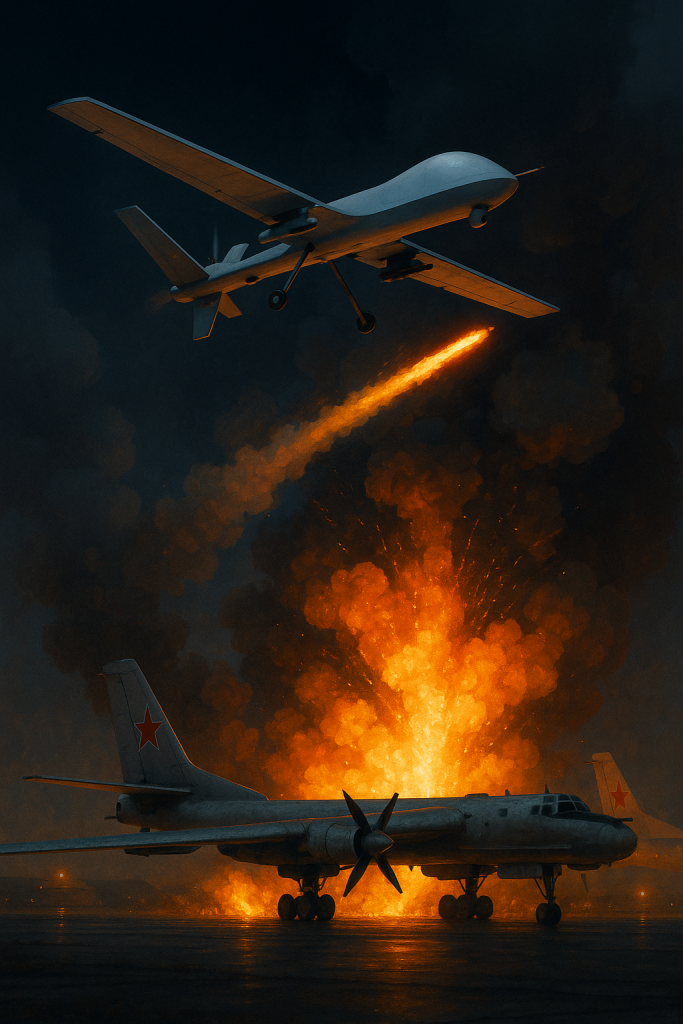
Image Credentials: Image Title: Ukraine Launches Largest Long-Range Drone Strike of War, Targets Russian Strategic Bombers Source: (sora.chatgpt) Date: June 2025 Attribution: Created by AI-generated imagery (sora.chatgpt), it does not depict a real-world scene.
By Staff Writer of International Affairs Correspondent | June 1, 2025
Kyiv, Ukraine — In what Ukrainian officials are calling the largest long-range strike since the beginning of Russia’s full-scale invasion, Ukraine launched a coordinated drone assault targeting four key Russian military airbases, damaging a significant number of strategic bombers. The operation, dubbed Spider’s Web, involved 117 smuggled drones in a complex, year-and-a-half-long covert effort orchestrated by Ukraine’s Security Service (SBU).
President Volodymyr Zelensky confirmed the scale and sophistication of the strike on Sunday, stating that 34% of Russia’s strategic cruise missile carriers were hit in the unprecedented operation. He praised SBU head Vasyl Maliuk for what he called an “absolutely brilliant result,” and emphasized that each drone was piloted individually.
BREAKING: Ukraine appears to have hit much of Russia’s strategic bombing fleet today in one of the most audacious and successful operations of the entire war. Live footage of the apparent drone attacks is being beamed live back to Ukraine. Slava Ukraini! pic.twitter.com/1GRdHA4CPT
— Business Ukraine mag (@Biz_Ukraine_Mag) June 1, 2025
Covert Operation Inside Russian Territory
According to details released by SBU sources to the BBC, the drones were hidden in wooden cabins mounted on trucks, with remotely operated roofs. These mobile launch platforms were smuggled deep into Russian territory and parked near airbases. At the chosen time, the cabin roofs opened, and the drones launched toward their targets.
“This operation was extremely complex logistically,” the SBU stated. “It required the smuggling of FPV drones into Russia, followed by the transport and concealment of launch platforms disguised as cargo vehicles.”
Zelensky later revealed that the command center for the operation had been located near a local branch of the FSB, Russia’s domestic intelligence agency, underscoring the audacity and deep penetration of the Ukrainian effort. He also confirmed that all operatives involved had been successfully extracted from Russia before the strikes began.
Targets and Damage
The Ukrainian drones struck four key airbases:
-
Belaya (Irkutsk oblast, Siberia)
-
Olenya (Murmansk oblast, far northwest Russia)
-
Dyagilevo (Ryazan oblast, central Russia)
-
Ivanovo (Ivanovo oblast, central Russia)
Among the aircraft reportedly hit were nuclear-capable Tu-95 and Tu-22M3 strategic bombers, along with A-50 early warning planes. These bombers have been central to Russia’s long-range airstrike capabilities.
Russia confirmed drone attacks in five regions, calling them a “terrorist act.” The Russian defense ministry claimed that airbases in Ivanovo, Ryazan, and Amur were “protected” and that all attacks were “repelled,” though it did admit that in Murmansk and Irkutsk “several aircraft caught fire.”
Irkutsk Governor Igor Kobzev confirmed drones were launched from a truck near the Belaya base, noting the site had been secured. Russian social media also showed videos of drones flying out of trucks, including one reportedly near a petrol station.
The SBU has estimated damage from the operation to be in the range of $7 billion USD, though the claims have not yet been independently verified.
Russia Responds with Massive Counterattack
In retaliation, Russia launched one of the largest overnight drone and missile assaults on Ukrainian territory since the war began. According to Kyiv, 472 drones and seven ballistic/cruise missiles targeted cities and infrastructure across the country. Ukraine claims it neutralized 385 aerial targets, but confirmed 12 soldiers were killed and over 60 injured in a missile strike on a training center.
Maj. Gen. Mykhailo Drapatyi, Ukraine’s head of land forces, resigned following the tragedy, citing a personal sense of responsibility for the incident.
Diplomatic Efforts in Istanbul
Despite the dramatic escalation, peace talks between Ukraine and Russia are set to resume in Istanbul on Monday. Expectations remain low. Both sides continue to stand far apart on key issues, with Russia still controlling approximately 20% of Ukrainian territory, including Crimea, annexed in 2014.
Zelensky reiterated Ukraine’s position that its nuclear and strategic deterrence capabilities are necessary in the face of continued Russian aggression. His government has increasingly relied on innovative asymmetric warfare tactics to disrupt Russia’s deep rear capabilities.
Global Reactions and Implications
While international observers have yet to confirm the full extent of the damage inflicted by Ukraine’s drone assault, military analysts note the operation demonstrates Kyiv’s evolving technical sophistication and intelligence-gathering capabilities inside Russia. It also marks a major psychological blow to Russia’s airpower, raising questions about the security of its strategic assets far from the frontlines.
With both sides escalating and diplomatic resolutions remaining elusive, the conflict continues to push the limits of conventional and unconventional warfare, with broader implications for regional and global stability.