
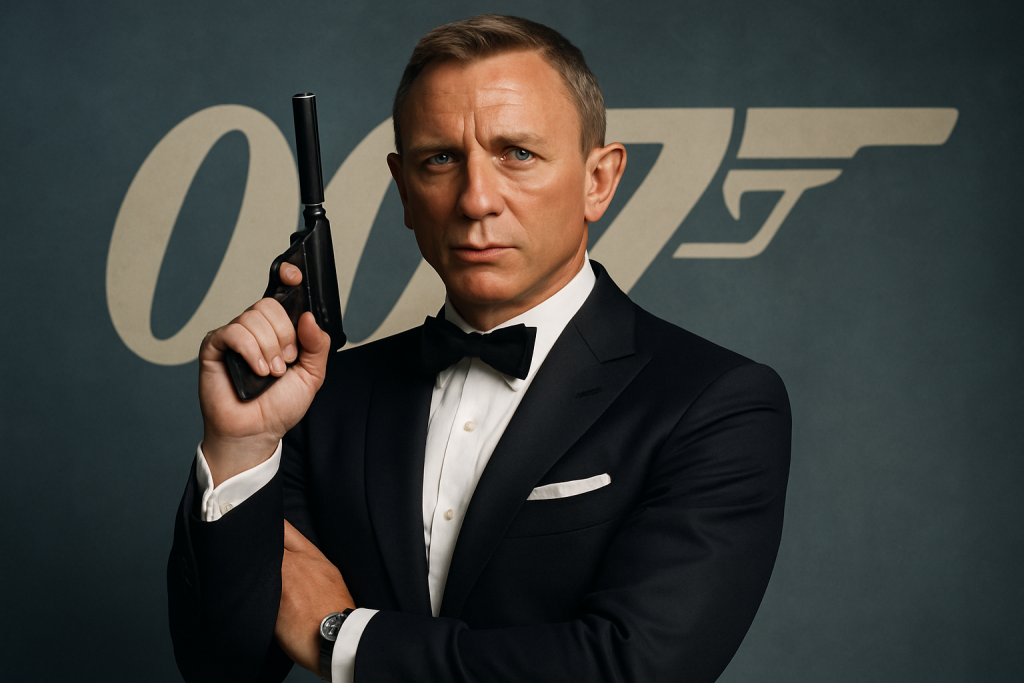
Image Credentials: Image Title: Casting the Impossible: The Search for James Bond Source: (sora.chatgpt) Date: May 2025 Attribution: Created by AI-generated imagery (sora.chatgpt), it does not depict a real-world scene.
By Open Chronicle Staff, History Desk
The cinematic legacy of James Bond is so deeply etched into global pop culture that it’s hard to imagine a world in which Sean Connery wasn’t the first man to sip a martini, shoot a silencer, and introduce himself as “Bond… James Bond.” Yet, the journey to cast the original 007 was anything but straightforward. Long before Connery’s iconic debut in Dr. No (1962), the wheels were already in motion to bring Ian Fleming’s fictional spy to the big screen, with some fascinating detours along the way.
A 1950s Bond? Hitchcock and Burton
The very first plans to adapt Fleming’s novels date back to 1959. By then, Fleming had spent years unsuccessfully pitching his stories to both British and American studios. Disillusioned but not defeated, he entered into collaboration with Kevin McClory, a daring young Irish filmmaker. Together, they worked on a storyline that revolved around nuclear terrorism—an idea that would eventually morph into Thunderball.
During these early development stages, Fleming confided in a letter to his friend Ivar Bryce that he and screenwriter Paul Dehn had the ideal Bond in mind: Richard Burton. “Both Dehn and I think that Richard Burton would be by far the best James Bond!” Fleming wrote on August 11, 1959. The casting suggestion is revealing—not only for its timing but for its departure from what Bond would eventually become. Burton, known for his intensity and brooding Welsh charisma, would have made a very different kind of 007: raw, cerebral, and likely far more tragic.
Years later, Fleming would pivot toward the suave David Niven, a more quintessential English gentleman. The contrast between Burton and Niven shows the creative fluidity surrounding Bond’s early image—he was not yet the tuxedoed archetype we know today but a blank canvas for projection and reinvention.
Alternate Bond Universes
The fascinating alternate realities in the Bond franchise are chronicled in The Search for Bond by film journalist Robert Sellers. The book reads like a cinematic multiverse of missed opportunities and tantalising what-ifs. Imagine Patrick McGoohan, later of The Prisoner, playing opposite Eunice Gayson in Dr. No. Or Burt Reynolds—complete with his Southern drawl—trading quips with Sheriff J. W. Pepper while driving an underwater Lotus Esprit. One could even picture Lewis Collins, best known for The Professionals, kicking a villain’s car off a cliff.
Ultimately, the Bond producers’ instincts prevailed. Each actor chosen, from Connery and Moore to Dalton, Brosnan, and Craig, reflected and defined the cultural tone of his era. While fan debates rage on about “the best Bond,” each casting was a product of calculated timing, charisma, and changing audience expectations.
A New Era, Same Dilemma
With Daniel Craig’s departure following No Time to Die (2021), the familiar storm of speculation returned. Names flooded the press, Idris Elba, Tom Hardy, Aaron Taylor-Johnson, Tom Hiddleston, and more. The producers faced the same challenge as they did post-Brosnan: to find a man who could carry the mystique, ruthlessness, and emotional complexity of Bond into a new decade.
As actor Neil Dickson wryly observed, more people have walked on the moon than have played James Bond. It’s a fitting metaphor for the enormity of the task. Whoever dons the tuxedo next won’t just inherit a role, they’ll become part of a mythos spanning over six decades.
Conclusion
The history of casting James Bond is as much a story of near-misses as it is of perfect hits. It is a testament to how the right choice at the right time can shape cultural history. And while the face of Bond may change, the allure of the search remains eternal. As long as there are actors with the right blend of grit and glamour, the legend of 007 will continue, shaken, not stirred.
References
Fleming, I. (1959, August 11). Letter to Ivar Bryce. Private correspondence, quoted in Sellers, R. (2023).
Sellers, R. (2023). The Search for Bond: Casting 007 from Connery to Craig. The History Press.
Lycett, A. (1995). Ian Fleming. Phoenix Press.
Chapman, J. (2000). Licence to Thrill: A Cultural History of the James Bond Films. I.B. Tauris.
Cork, J., & Scivally, B. (2002). James Bond: The Legacy. Boxtree.
Rubin, S. J. (1990). The James Bond Films: A Behind the Scenes History. Arlington House.