
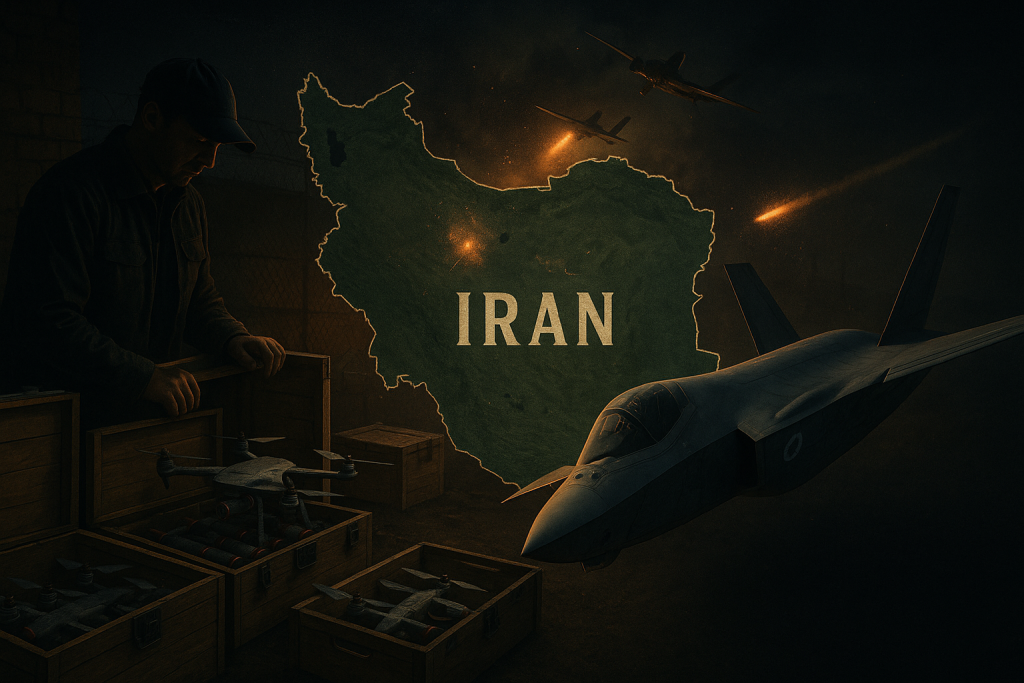
Image Credentials: Image Title: Mossad’s Shadow War: How Israel Struck Iran from Within Source: (sora.chatgpt) Date: June 2025 Attribution: Created by AI-generated imagery (sora.chatgpt), it does not depict a real-world scene.
By Staff Writer with Agencies | International Desk | June 18, 2025
In a stunning exposé, The Wall Street Journal has revealed the scale and sophistication of an Israeli intelligence operation that neutralized critical Iranian missile and air defense systems ahead of a major Israeli Air Force strike, demonstrating how espionage, drones, and elite covert teams were deployed deep inside Iranian territory in what analysts call a “shadow war turned kinetic.”

According to the report, Israel’s Mossad spent years meticulously infiltrating Iran, smuggling in hundreds of explosive-laden drones and positioning operatives near strategic targets. These operations, the Journal claims, enabled Israel’s advanced F-35 fighter jets to penetrate Iranian airspace with near impunity during a surprise overnight strike that targeted nuclear and military infrastructure.
Multi-Year Infiltration
Sources say that beginning years before the April operation, Mossad agents began covertly transporting commercial quadcopters rigged with explosives into Iran. Using a complex web of logistics involving suitcases, shipping containers, and commercial trucking, the drones were smuggled into the country under the guise of regular commerce.
Once inside, operational cells, trained in undisclosed third countries, assembled and deployed these systems near Iranian air defense sites and ballistic missile storage facilities. Mossad teams reportedly tracked and struck dozens of mobile launchers and transporter vehicles before they reached launch readiness, exploiting Iran’s limited supply of missile transporters compared to its overall missile inventory.
“By eliminating those trucks, they paralyzed Iran’s ability to respond effectively,” said a senior Israeli defense official familiar with the operation. “It wasn’t just sabotage—it was operational paralysis.”
Clearing the Skies for the IAF
With Iranian missile defenses already compromised on the ground, the Israeli Air Force launched one of its deepest strikes in modern history. On Friday night into Saturday morning, 70 F-35 fighter jets entered Iranian airspace, striking military installations in and around Tehran for over two hours. The Israeli Defense Forces (IDF) described the action as their “deepest operational penetration to date.”
“This represents the deepest operational distance we have achieved so far in Iran,” said IDF Spokesperson Brig. Gen. Effie Defrin. “We established aerial freedom of action.”
Iran responded with four missile salvos totaling approximately 200 projectiles, but the intensity was far lower than Israeli military analysts expected. Sima Shine, a former senior Mossad officer, suggested that the early neutralization of Iran’s launch capabilities explains the muted retaliation.
“We expected much more,” said Shine. “But that doesn’t mean we won’t receive much more today or tomorrow.”
A New Era of Covert Drone Warfare
The use of consumer-grade drones modified for explosive delivery highlights a broader shift in modern espionage and warfare. Commercial off-the-shelf (COTS) technology is increasingly being adapted for military and intelligence purposes, posing new threats to national defense systems.
Israel has previously used similar tactics. In 2022, Mossad agents employed drones to strike a drone production facility in Kermanshah. In 2023, a similar attack targeted an ammunition plant in Isfahan. These operations served as dry runs for the recent full-scale infiltration, according to regional intelligence sources.
Iranian state media on Saturday warned citizens to watch for drones launched from pickup trucks or cargo vehicles—evidence that Israeli field teams may still be operating inside Iranian territory.
The Psychological Front
The impact of the Mossad operation was not only tactical but psychological. As Shine noted, the sense of vulnerability now permeating Iran’s senior leadership could have long-lasting effects.
“No one in Iran’s senior leadership can be certain they are not known to Israeli intelligence and will not become a target,” Shine said. “It’s not merely the damage inflicted but the psychological anxiety it generates.”
Indeed, Israel’s intelligence reach was previously underscored when Mossad allegedly assassinated senior Hamas figure Ismail Haniyeh with a concealed explosive device during a high-level event in Tehran last year. That operation, like the latest, showcased Israel’s ability to penetrate even the most secure environments.
Implications for Regional Security
Experts say the success of the Mossad’s operation underscores a growing reliance on hybrid warfare—merging traditional military might with cyber capabilities, espionage, and technological infiltration. The fact that such an operation could unfold undetected for years raises serious questions about Iranian counterintelligence capabilities and the stability of an already volatile region.
As both sides prepare for potential escalations, this operation marks a defining moment in Israel’s evolving strategy to neutralize threats far beyond its borders, before they ever reach them.