
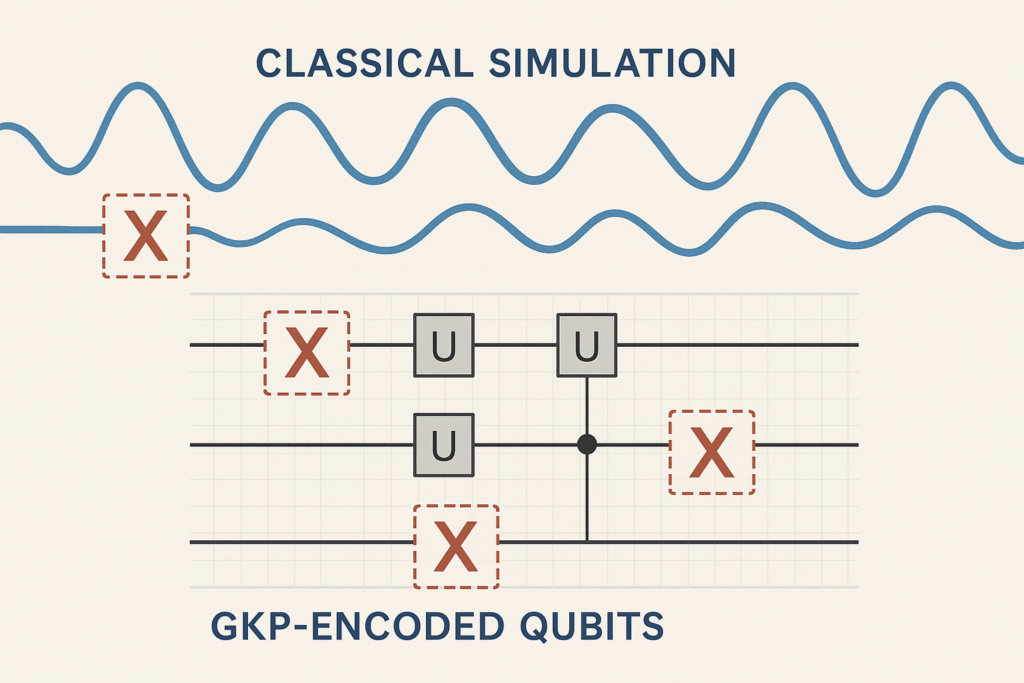
Image Credentials: Image Title: Breakthrough in Quantum Error Correction: New Algorithm Simulates Fault-Tolerant Quantum Circuits Source: (sora.chatgpt) Date: June 2025 Attribution: Created by AI-generated imagery (sora.chatgpt), it does not depict a real-world scene.
July 3, 2025 | Chalmers University of Technology
A multinational research team has achieved a major milestone in quantum computing by developing an algorithm that allows classical computers to accurately simulate fault-tolerant quantum circuits based on the Gottesman-Kitaev-Preskill (GKP) bosonic code—a significant step toward reliable quantum computation.
The study, published in Physical Review Letters, addresses one of quantum computing’s biggest challenges: error correction. Quantum computers, while promising unprecedented computational power, are highly susceptible to noise and disturbances. The new method provides a way to verify quantum computations using classical computers, paving the way for more robust quantum hardware.
The Quantum Error Correction Challenge
Quantum computers leverage qubits, which can exist in superpositions of states (both 0 and 1 simultaneously). However, these qubits are extremely fragile—even minor environmental noise (vibrations, temperature fluctuations, or electromagnetic interference) can disrupt calculations.
Unlike classical computers, which use well-established error-correction techniques, quantum systems require fault-tolerant codes to detect and fix errors without collapsing the quantum state. The GKP bosonic code is one such method, encoding quantum information across multiple energy levels of a vibrating quantum system.
Yet, simulating GKP-based computations on classical computers has been nearly impossible—until now.
The Breakthrough: A Classical Algorithm for Quantum Verification
The research team—comprising scientists from Chalmers University of Technology (Sweden), the University of Milan (Italy), the University of Granada (Spain), and the University of Tokyo (Japan)—developed an algorithm that efficiently simulates GKP-based quantum circuits.
Key Innovations:
✅ New Mathematical Tool – The algorithm simplifies the simulation of GKP states, previously considered too complex for classical computation.
✅ Wave-Pattern Simulation – The method tracks quantum state interactions using wave-like patterns, enabling accurate error-correction testing.
✅ Scalability – Unlike brute-force quantum simulations, this approach scales efficiently, even for large systems.
“We’ve found a way to simulate quantum computations with an error-correction code that was previously too difficult to model,” says Cameron Calcluth, lead author and PhD in Applied Quantum Physics at Chalmers. “This is crucial for building stable, large-scale quantum computers.”
Why This Matters
-
Validating Quantum Hardware – Researchers can now test quantum computations before running them on real quantum processors.
-
Faster Development of Fault-Tolerant Systems – The algorithm helps optimize error-correction methods, accelerating progress toward practical quantum advantage.
-
Applications in Medicine, AI, and Cryptography – Reliable quantum computers could revolutionize drug discovery, optimization problems, and unbreakable encryption.
“This opens entirely new ways to simulate quantum computations that were previously untestable,” says Giulia Ferrini, co-author and Associate Professor at Chalmers.
Next Steps
The team plans to extend their method to other quantum error-correction codes and collaborate with quantum hardware developers to integrate their findings into real-world systems.
Story Source:
Materials provided by Chalmers University of Technology. Note: Content may be edited for style and length.
Journal Reference:
- Cameron Calcluth, Oliver Hahn, Juani Bermejo-Vega, Alessandro Ferraro, Giulia Ferrini. Classical Simulation of Circuits with Realistic Odd-Dimensional Gottesman-Kitaev-Preskill States. Physical Review Letters, 2025; 135 (1) DOI: 10.1103/xmtw-g54f