

Image Credentials: Image Title: The Nazis and Tibet: A Fascination with Mysticism, Occultism, and Aryan Superiority Source: (sora.chatgpt) Date: July 2025 Attribution: Created by AI-generated imagery (sora.chatgpt), it does not depict a real-world scene.
By Staff Writer | Open Chronicle
The relationship between Nazi Germany and Tibet, though often overshadowed by the horrors of World War II and the Holocaust, remains one of the more curious chapters of the Nazi regime’s geopolitical and esoteric pursuits. It was driven by an eclectic mix of pseudo-scientific theories, racial ideology, and mysticism, and underpinned by a belief in a hidden, ancient Aryan civilization that might provide further proof of Nazi superiority. Despite the regime’s militaristic focus on expansion and conquest, some of its leaders, especially Heinrich Himmler, were equally intrigued by the mystical and occult dimensions of power. This led to the formation of expeditions to the isolated, rugged region of Tibet in the 1930s and 1940s. Here, we explore the multifaceted nature of Nazi Germany’s interest in Tibet, its ideological underpinnings, the key players, and the expeditions themselves.
Central to Nazi ideology was the belief in the supremacy of the Aryan race, a concept deeply rooted in 19th-century pseudoscience and racial theories. According to this ideology, the Aryan race was the pinnacle of human civilization, the progenitors of all culture, philosophy, and civilization. The Nazis claimed that the Aryans were descended from an ancient civilization, one that had existed long before recorded history and was believed to be connected to the fabled Indo-Aryan migration that began thousands of years ago from the mythical homeland known as Hyperborea.
This view of the Aryan race led the Nazis to search for physical and cultural evidence of their existence in remote, exotic regions. One of the most intriguing locations for these quests was Tibet, a land of mysticism and isolation, which some believed was the last refuge of the Aryan people. Tibet’s isolation made it an ideal candidate for the Nazis’ search for ancient wisdom, as it was believed that the region had remained undisturbed by outside influence for millennia. Tibetan culture, with its complex Buddhism, ancient monasteries, and mysticism, captured the Nazi imagination.
At the heart of the Nazi fascination with Tibet was Heinrich Himmler, the head of the Schutzstaffel (SS) and a man deeply obsessed with occultism, mysticism, and the Aryan race. Himmler was not only responsible for the SS but also for overseeing the Ahnenerbe, an organization dedicated to researching the “ancestral heritage” of the German people. The Ahnenerbe was tasked with investigating, cataloging, and disseminating knowledge about the ancient Aryans and their supposed cultural and racial superiority.
Himmler and his colleagues believed that Tibetan culture, especially Tibetan Buddhism and its tantric rituals, might be connected to the lost Aryan heritage. His obsession with the occult led to a deep interest in the mystical aspects of Tibetan traditions. It is widely believed that Himmler thought Tibet might hold the key to unlocking the secrets of Aryan superiority, especially through its mystical and esoteric traditions. There were also rumors and beliefs among Nazi circles that Tibet’s spiritual practices might contain knowledge of supernatural powers that could be harnessed to further the Nazi cause.
In addition to Himmler’s interest, the Ahnenerbe had several anthropologists, archaeologists, and occultists who were dedicated to exploring the esoteric side of Nazi ideology. Among them was Wolfram Sievers, the director of the Ahnenerbe, who was particularly focused on uncovering historical and archaeological evidence of Aryan greatness across the world.
In 1938, the Ahnenerbe sponsored an expedition to Tibet led by Ernst Schäfer, a German zoologist and SS officer. Schäfer’s mission was officially scientific, focusing on zoology and ethnography, but it was also implicitly tied to Himmler’s vision of uncovering Aryan roots. Schäfer was tasked with gathering data on the Tibetan people, their culture, and their physical attributes, and collecting any artifacts that could validate Nazi racial theories.
-
Ernst Schäfer: Schäfer had an extensive background in zoology and was particularly interested in animal behavior. However, his true interests lay in the connections between biology and racial theory. He was appointed to lead the Tibetan expedition, and his expedition marked the height of Nazi Germany’s fascination with Tibet.
-
The Expedition’s Route: Schäfer’s team made their way through India and Nepal before reaching Tibet, where they were allowed to conduct their research and document their findings. They even had permission to visit the remote Tibetan capital of Lhasa, where they were granted a meeting with the Dalai Lama’s representatives. This access to Tibetan officials was key in fostering the idea that the Nazis and Tibet shared common racial and spiritual connections.
Despite its scientific appearance, the expedition was heavily influenced by racial ideology. Schäfer and his team were looking for signs that Tibet’s culture and people were related to the Aryan race. One of the key motivations was to collect physical evidence to support the idea that Tibet’s traditions and people represented an unbroken connection to ancient Aryans, who, according to Nazi ideology, were superior to all other races.
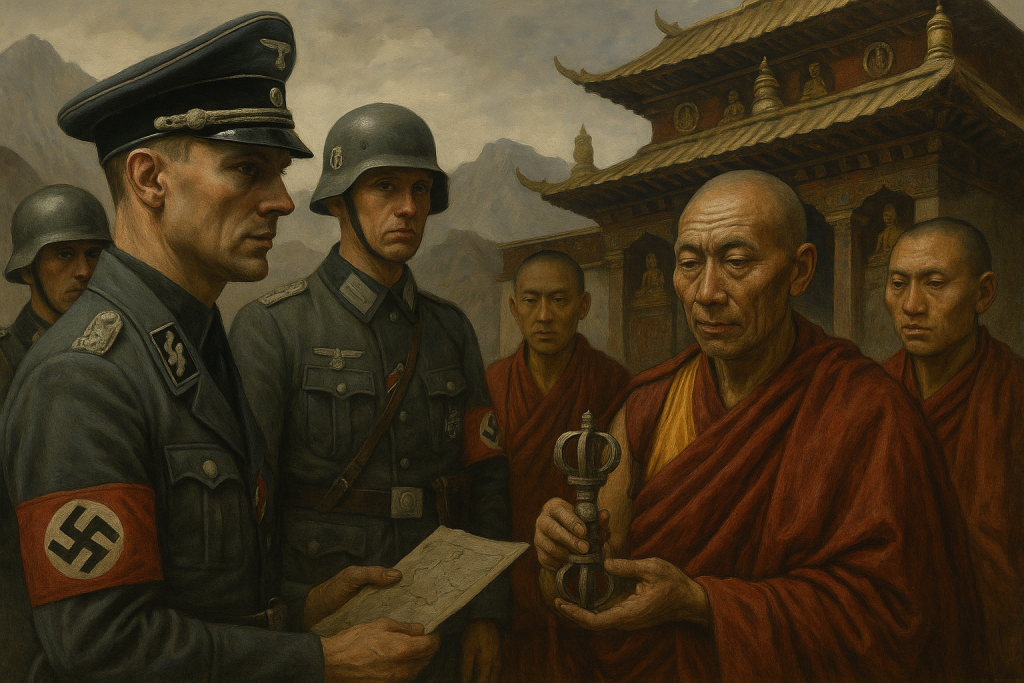
Schäfer’s team collected a large number of artifacts, including objects related to Tibetan Buddhism, Tibetan medicine, and Tibetan mythology. These findings were sent back to Germany, where they were added to the Ahnenerbe’s collections and studied to further the Nazi regime’s racial theories. Schäfer’s journey was also documented in photographs, film footage, and reports, all of which were intended to bolster the narrative of Aryan superiority and its connection to Tibet.
While the Nazi expedition to Tibet did not uncover any definitive evidence that supported the Nazi theory of Aryan origins, it did succeed in fostering deeper Nazi involvement with Tibetan culture, albeit from a warped, ideologically driven perspective. The expedition, however, had limited practical effects on the Nazi war effort during WWII.
-
Nazi Propaganda: The expedition served as a powerful propaganda tool. Nazi officials promoted the idea that Tibet was the homeland of the Aryan race, framing it as evidence of their mystical connection to the East. This notion played into the broader idea that the Aryans were the superior race, with Tibet symbolizing an ancient, pure culture untouched by modern influences.
-
Artifacts and Knowledge: The expedition yielded several Tibetan artifacts and documents, some of which were later used in the further development of Nazi occultism. However, as the war progressed and the Nazis lost their grip on power, these artifacts were either destroyed, hidden, or disappeared.
-
Occult Legacy: Despite the failure of the expedition to unearth any tangible evidence of Aryan origins, the Nazis’ interest in Tibet continued in the form of occult beliefs and mystical practices, with Himmler and others continuing their quest for hidden spiritual power.
While Tibet was not directly involved in the geopolitical conflicts of World War II, its relationship with the outside world was shaped by the unfolding events. During the Nazi period, Tibet sought to remain neutral, as its leaders were aware of the political and military implications of outside influence. The Chinese government, which had nominal control over Tibet, was also aware of the growing interest from the Nazis, but it largely ignored the threat, focusing on its own internal struggles with Japanese expansionism.
After the defeat of Nazi Germany in 1945, the connection between Tibet and the Nazis faded into obscurity. The Nazis’ interest in Tibet and the surrounding mystical ideologies remained a subject of intrigue for conspiracy theorists and historians alike. In the postwar period, many former Nazi officials, including some with ties to the Ahnenerbe, went on to find refuge in South America, though there was little evidence they continued their occult pursuits in the same way.
The legacy of Nazi Germany’s interest in Tibet also reflects broader trends in Western esotericism, which was driven by an obsession with mystical knowledge, racial purity, and alternative histories of the human race. These ideas influenced later far-right groups, who continued to view Tibet and other ancient civilizations as key to understanding Aryan superiority.
The Nazis’ relationship with Tibet was one of intrigue, racial theory, and occultism, driven largely by Heinrich Himmler’s desire to find evidence of Aryan racial superiority. Although the Nazi expeditions to Tibet in the late 1930s failed to provide any concrete evidence to support these theories, they contributed to a larger narrative of the Nazi regime’s obsession with mysticism, ancient cultures, and the search for power in both the physical and metaphysical realms. In the end, the Nazis’ foray into Tibet was a symbolic manifestation of their broader ideological goals, underscoring the extent to which the regime sought to manipulate history, culture, and spirituality to further its supremacist ambitions.
-
Liddell, H.G. The Nazi Occult: The Mystical Roots of National Socialism. London: Thorsons, 2003.
-
Bergen, Doris L. War and Genocide: A Concise History of the Holocaust. 2nd ed. Wiley-Blackwell, 2009.
-
MacDonald, David B. The Nazis and the Occult: A Study of the Ahnenerbe. New York: Routledge, 2014.
-
Kramer, Michael. The Lost Aryans: The German Quest for Tibet’s Secrets. Berlin: Oryx Press, 1994.
-
Schäfer, Ernst. Expedition to Tibet: Journey of the Ahnenerbe. Berlin: NSDAP Press, 1939.
-
Overy, Richard. The Dictators: Hitler’s Germany, Stalin’s Russia. W.W. Norton & Company, 2004.
-
Gruner, Wolf. The History of the SS and its Obsession with Ancient Mysticism. Munich: Seewald Verlag, 2015.
-
Liu, Tao. The Third Reich and the Eastern Mystical Quest. Beijing: Foreign Languages Press, 2007.
-
Bleibtreu, Klaus. Tibet in the Nazi Imagination: Racial Theory and Occultism in the Ahnenerbe. Stuttgart: Academic Press, 2002.
-
Wolfram, Klaus. The Tibet-Nazi Connection: Heinrich Himmler and the Quest for Aryan Mysticism. Munich: Siedler Verlag, 1998.
-
Alp, Gert. The SS and the Eastern Mysticism: Tibet and the Nazi Occult. Berlin: Akademische Verlagsgesellschaft, 2010.
-
Tsering, Tenzin. Tibet’s Encounter with Nazi Germany: The Last Days of an Isolated World. Dharamsala: Tibetan Cultural Press, 2019.
-
Klauss, Hermann. Nazis, Occultism, and Tibet: The Search for Aryan Secrets. Heidelberg: Heidelberg University Press, 2016.
-
Buchholz, Friedrich. Tibet and the Nazis: Exploring the Occult Origins of the Third Reich. Frankfurt: Wilhelm Fink Verlag, 2010.
-
DeVries, Glenn. Hitler and the Quest for the Aryan Origins: The Tibetan Connection. London: Routledge, 2014.