
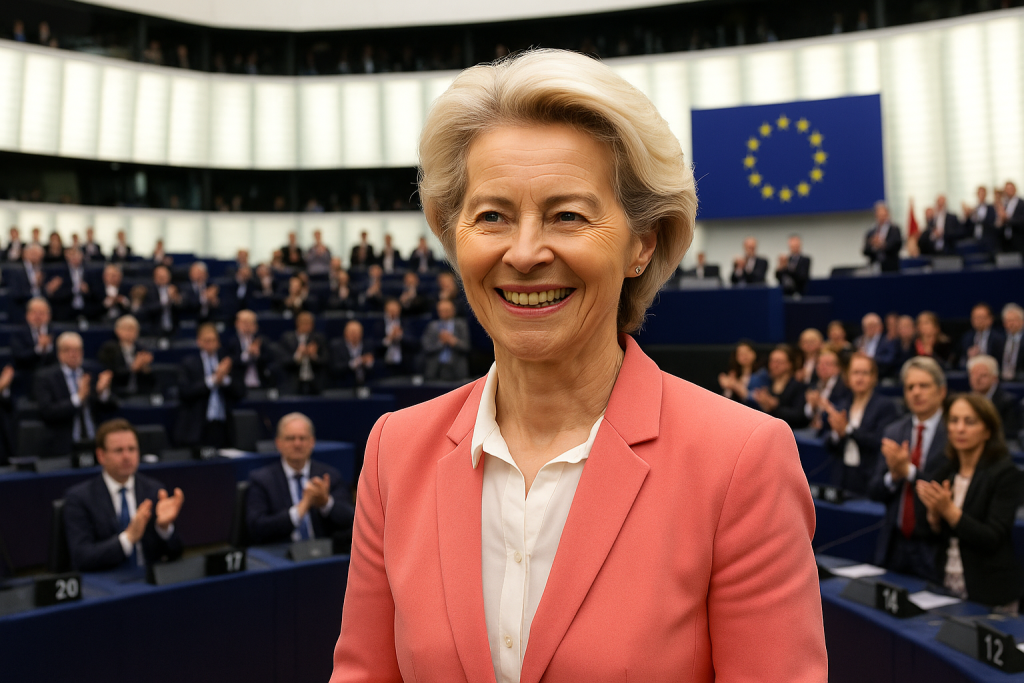
Image Credentials: Image Title: Caught in Translation: EU Interpreter Fired for Alleged Russian Spying Source: (sora.chatgpt) Date: July 2025 Attribution: Created by AI-generated imagery (sora.chatgpt), it does not depict a real-world scene.
By Staff Writer | Open Chronicle with Agencies
Brussels, Belgium — European Commission President Ursula von der Leyen has successfully survived a rare confidence vote in the European Parliament initiated by a far-right faction, though the motion’s very existence highlighted deepening discontent with her leadership. The motion, which sought to oust her from office, was tabled by Romanian far-right MEP Gheorghe Piperea and centered around accusations of a lack of transparency during the negotiations to secure COVID-19 vaccines. Although von der Leyen ultimately prevailed, the vote’s occurrence signals growing political tensions within the European Union.
Confidence votes of this nature are extremely rare in EU politics. The last time such a motion was tabled was over a decade ago, against former European Commission President Jean-Claude Juncker. For the motion to pass, two-thirds of the 720 Members of the European Parliament (MEPs), or 480 votes, were required in favor. However, the motion garnered only 175 votes in favor, with 360 votes against, and 18 abstentions. The remaining MEPs chose not to vote.
The motion was based on allegations that von der Leyen had been secretive about text messages exchanged with the head of Pfizer during the EU’s efforts to secure vaccine deals at the height of the COVID-19 pandemic. Piperea and others accused von der Leyen of undermining the principles of transparency, accountability, and good governance, all of which are considered fundamental to the functioning of the European Union.
The debate surrounding the vote was heated, with von der Leyen fiercely defending herself against what she described as a conspiracy theory. Speaking to the European Parliament, she dismissed the allegations of misconduct as a “lie” and sharply criticized her accuser, Gheorghe Piperea, calling him an “extremist” and labeling him and his supporters as anti-vaxxers and Putin apologists.
“This is a world of conspiracies and alleged sinister plots,” von der Leyen told MEPs. “It is a world that does not belong to the European Union or its values.” She dismissed the accusations over Pfizer text messages, calling them groundless and part of a political smear campaign.
Despite the vocal criticism from Piperea and others, von der Leyen maintained that the EU‘s handling of vaccine negotiations was in line with proper procedures and that transparency had been upheld throughout.
The vote also exposed rifts within the European Parliament. Although von der Leyen ultimately secured the votes she needed, her centre-right European People’s Party (EPP), the largest political group in the parliament, was not fully united in its support. Several liberal and left-wing groups, including the Socialists & Democrats (S&D) and the Greens, expressed concerns over von der Leyen’s increasing willingness to align with the far-right on certain policy issues, especially concerning migration and environmental policies.
Valérie Hayer, President of the Renew Europe group, said that her group’s support for von der Leyen was not guaranteed in the future, urging her to reassert control over her political alliances. “We urge you to end your alliances with the far-right,” Hayer said, reflecting growing unease about von der Leyen’s political positioning.
The motion against von der Leyen found backing from far-right groups, notably Hungarian Prime Minister Viktor Orbán, who posted a photo of von der Leyen on social media with the caption “Time to go”. However, this support was not universal among the far-right factions in the European Parliament. The vote revealed a split within the European Conservatives and Reformists (ECR) group, many of whose members, notably from Italy’s Brothers of Italy (FdI), continue to foster a positive relationship with von der Leyen and voted against the motion. This division within the far-right bloc made it difficult for von der Leyen’s opponents to rally the full support needed for her ouster.
While von der Leyen survived the vote, the criticism surrounding her leadership remains significant. In the lead-up to the vote, Iratxe García, the leader of the Socialists & Democrats (S&D) group, said that dismantling the European Commission amid geopolitical crises, including Russia’s invasion of Ukraine, would be “irresponsible”. However, García also acknowledged concerns about von der Leyen’s political alliances, particularly her shifts toward far-right policies.
Although von der Leyen’s EPP group remained her strongest supporter, the support was conditional, with some groups expressing frustration at her compromises with the far-right and migration policies. The Socialist group eventually voted to back her, but only after she reportedly ruled out budget cuts to social programs in the upcoming EU budget, an issue of great concern to left-wing parties.
Amidst the turmoil, von der Leyen addressed the Ukraine Recovery Conference in Rome, making a speech to highlight the EU’s commitment to Ukraine’s reconstruction. Just moments after the confidence vote, she took to X (formerly Twitter) to deliver a defiant message, stating, “As external forces seek to destabilize and divide us, we must respond in line with our values.”
“Thank you, and long live Europe,” she added, signaling her resolve to continue leading the EU in the face of adversity.
Though Ursula von der Leyen successfully survived the confidence vote, the incident underscores the growing political fragmentation within the European Parliament and her party. The divisions over her leadership, especially her approach to migration, environmental issues, and political alliances, have raised significant questions about the direction of the EU under her second term as Commission President.
With the European Union facing critical challenges on the world stage, von der Leyen’s ability to unite the increasingly fractured Parliament will be tested in the months ahead. As the EU continues to navigate its response to global crises, from Russia’s war on Ukraine to climate change and migration, von der Leyen’s leadership will remain under intense scrutiny.
Key Points:
-
Ursula von der Leyen survived a confidence vote in the European Parliament, initiated by the far-right faction.
-
The motion accused von der Leyen of a lack of transparency regarding her text exchanges with Pfizer during vaccine negotiations.
-
Von der Leyen’s centre-right European People’s Party (EPP) supported her, but several groups, including Renew Europe and S&D, expressed frustrations with her political alliances.
-
The incident exposed deep divisions within the European Parliament and von der Leyen’s leadership, especially over issues like migration and far-right policies.
-
Von der Leyen remained defiant in the face of the challenge, reaffirming her commitment to EU values and Ukraine’s recovery.