
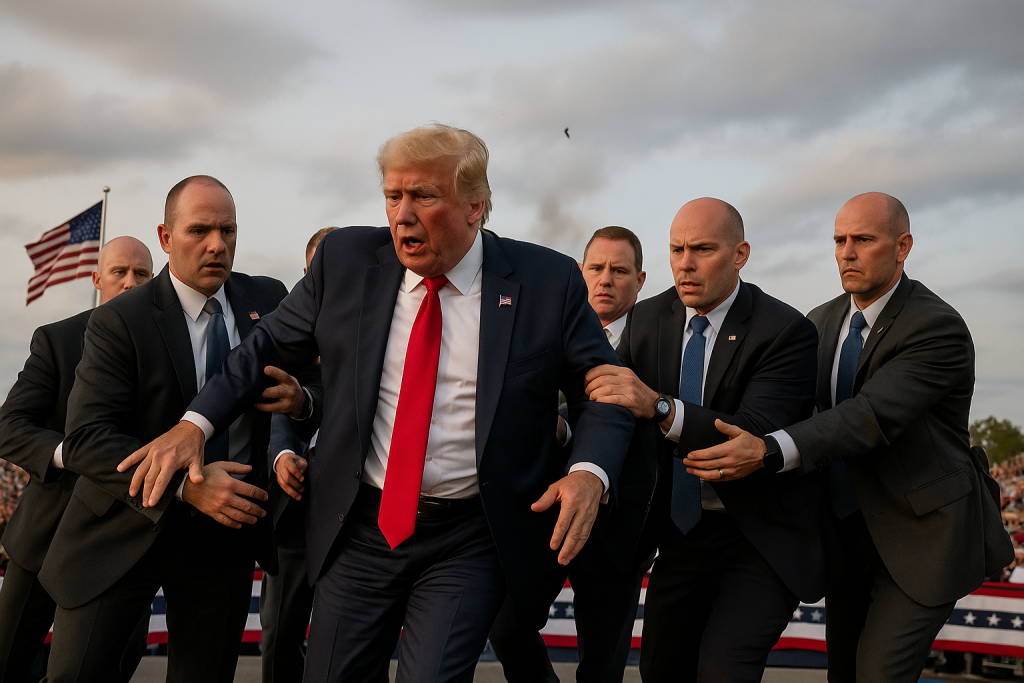
Image Credentials: Image Title: Secret Service Suspends Staff Over Failings During Trump Assassination Attempt Source: (sora.chatgpt) Date: July 2025 Attribution: Created by AI-generated imagery (sora.chatgpt), it does not depict a real-world scene.
By Staff Writer | Open Chronicle with Agencies
Washington, D.C. — The U.S. Secret Service has suspended six personnel following an assassination attempt on former President Donald Trump during a rally last year in Butler, Pennsylvania. The failed assassination attempt, in which a gunman fired at Trump, has prompted intense scrutiny and internal accountability within the Secret Service, a key agency responsible for safeguarding high-profile public figures.
On the day of the incident, a man named Matthew Crooks opened fire at Trump during the rally. One of the bullets grazed the ear of Trump, while Crooks shot and killed another rally attendee, Corey Comperatore. The former president was rushed to safety, and the assailant was fatally shot by Secret Service agents.
In a statement to CBS News, Matt Quinn, the Secret Service’s deputy director, described the incident as an “operational failure” and said the agency was fully accountable for the security lapse. Quinn, who took over as deputy director in May 2024, explained that the Butler rally marked a turning point for the agency, with a sharp focus on preventing such failures from happening again.
“The incident in Butler was an operational failure, and we are focused today on ensuring that it never happens again,” Quinn said, adding that the Secret Service had already implemented several improvements to their security infrastructure, including the use of military-grade drones and advanced mobile command posts.
While the identities of the suspended personnel and their specific roles in the event have not been publicly disclosed, the agency confirmed that six staff members received penalties ranging from 10 to 42 days of leave without pay. Quinn explained that the suspension was part of a broader effort to take accountability for the failure, but he also clarified that firing staff was not the solution.
“We are focused on fixing the root cause of the problem,” Quinn added. “The Secret Service will not fire our way out of this, but we will ensure that we never make the same mistake again.”
The Butler incident led to broader criticism of the Secret Service’s operational readiness, and investigations from both the Senate and House of Representatives pointed to significant security lapses that led to the assassination attempt. A 94-page Senate report published last September revealed that internal communication failures and poorly coordinated security measures directly contributed to the attack. The report also noted that many of these issues remained unaddressed months after the incident, creating further concern regarding the Secret Service’s preparedness.
One critical lapse identified in the investigation was the failure to secure the rooftop from which Crooks opened fire. A separate report from a House task force in December also identified this preventable flaw as one of the key weaknesses in the agency’s response to the situation.
Following the Butler attack, the then-Director of the Secret Service, Kimberly Cheatle, resigned amidst increasing scrutiny of the agency’s performance. Cheatle’s resignation was seen as an acknowledgment of the failure in leadership, further compounding public and political pressure on the Secret Service.
The Department of Homeland Security has pledged to address the issues raised by the reports, and a number of immediate changes were announced. These included increased security protocols, better coordination between agencies, and the introduction of new technologies to help safeguard high-profile figures like Trump.
In the aftermath of the Butler rally, Trump’s security was heightened. The former president began receiving protection at a level above what is typical for a presidential candidate, signaling the seriousness with which the U.S. government now viewed the threat to his life.
Further illustrating the ongoing threats against Trump, in September 2024, a second assassination attempt occurred when a would-be gunman lurked near Trump’s golf course in Florida. The suspect was detained before any harm could come to the former president. The FBI described this incident as a “potential assassination attempt”.
The Secret Service is tasked with providing protection for the President, Vice President, and other high-ranking officials, as well as safeguarding national events and institutions. The agency has a history of dealing with threats to presidential safety, dating back to its establishment in 1865. However, in recent years, the challenges of protecting U.S. leaders have grown exponentially, with both domestic and international threats increasingly targeting figures like Trump.
In addition to its security mandate, the Secret Service also protects foreign dignitaries and has been involved in key counterterrorism operations. However, the Butler incident has underscored the growing complexity of safeguarding high-profile individuals in an era of global terrorism and domestic extremism.
The Secret Service, now under new leadership and facing mounting internal and external scrutiny, is poised to transform its operations. The agency’s immediate task is to recover from the Butler failure, rebuild public trust, and ensure that the mistakes of the past are not repeated.
As the U.S. presidential election cycle continues and the threat environment remains fluid, the Secret Service will likely face increasing pressure to adapt and innovate its security measures. Whether it’s military-grade drones, new command systems, or enhanced communications strategies, the agency’s ability to adapt to evolving threats will be crucial in the years ahead.
For now, the suspended personnel, the reports from Congress, and the resignation of senior leadership all signal that the Secret Service is committed to learning from its mistakes. However, the true test of its ability to protect U.S. officials and prevent future tragedies lies ahead.
Key Points:
-
Six Secret Service personnel were suspended over failures during a Trump rally in Butler, Pennsylvania.
-
Matthew Crooks fired at Trump, killing one rally attendee, while the former president narrowly escaped injury.
-
Senate and House reports found that security lapses and communication failures directly contributed to the attack.
-
Trump’s security was heightened in the aftermath, and a second assassination attempt occurred in September 2024.
-
The Secret Service is under scrutiny and changing to prevent further incidents.