
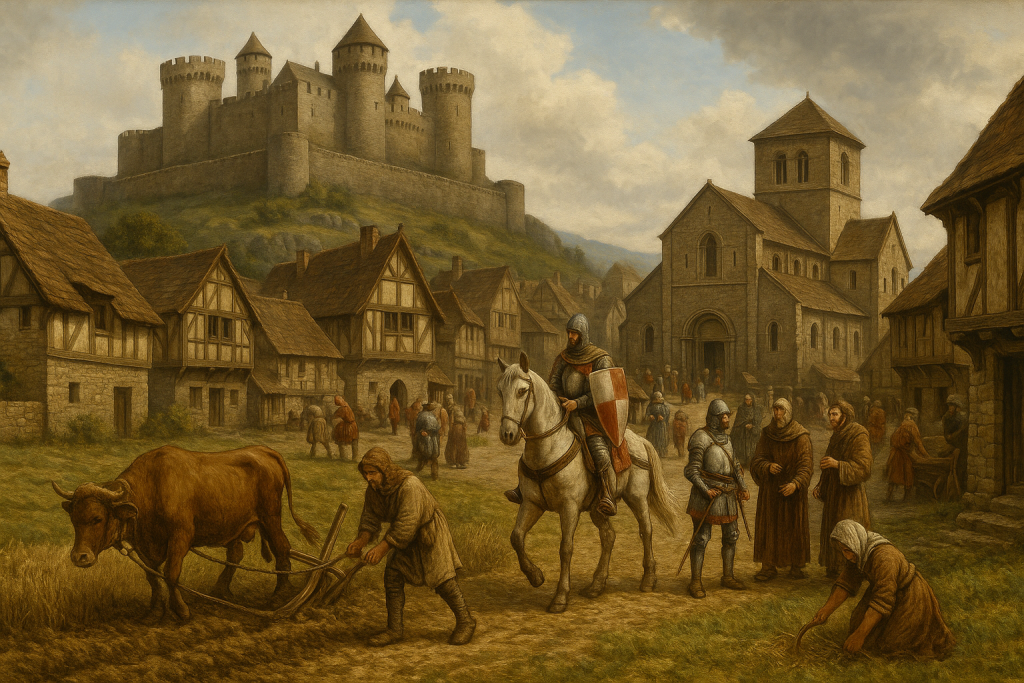
Image Credentials: Image Title: A Social and Economic History of Medieval Europe Source: (sora.chatgpt) Date: July 2025 Attribution: Created by AI-generated imagery (sora.chatgpt), it does not depict a real-world scene.
By Staff Writer | Open Chronicle
Introduction
The medieval period in Europe, roughly spanning the 5th to the 15th century CE, was a time of profound transformation marked by the decline of the Western Roman Empire, the rise of feudal societies, the spread of Christianity, and a complex interplay between economic stagnation and gradual growth. Far from being a monolithic “Dark Age,” medieval Europe was dynamic in its social hierarchies, economic structures, and institutions. This article explores the multifaceted social and economic landscape of medieval Europe, examining its agrarian foundations, feudal relationships, urban resurgence, trade networks, demographic trends, and shifting cultural ideologies.
1. The Foundations of Feudal Society
After the collapse of Roman authority in the West around 476 CE, Europe fragmented into a mosaic of kingdoms and territories, most notably under the Merovingians and Carolingians. The ensuing insecurity and decentralization of power gave rise to feudalism, a system of land-based hierarchy and reciprocal obligations.
-
Lords and Vassals: At the core of feudalism was the fief: land granted by a lord to a vassal in exchange for military service and loyalty. This system fostered a stratified society with a warrior aristocracy controlling most land and legal authority.
-
Manorialism: The economic counterpart to feudalism, manorialism organized peasants around self-sufficient estates (manors). The lord’s demesne was farmed partly by peasants, especially serfs, who were bound to the land and owed labor services in exchange for protection.
2. The Peasantry and Rural Life
The vast majority of Europeans were peasants. Their lives were shaped by the agricultural cycle, religious festivals, and obligations to both the Church and the lord.
-
Serfdom: Though not slaves, serfs had limited freedom. They paid dues in kind, labor, and later cash, and were subject to seigneurial justice. Nonetheless, there were degrees of freedom; some peasants were freeholders.
-
Technological Advances: Between the 8th and 12th centuries, European agriculture improved through innovations like the heavy plough, the three-field system, and the horse collar. These led to higher yields and supported population growth.
3. The Medieval Economy: Trade, Towns, and Guilds
While the early Middle Ages (c. 500–1000) were relatively insular and agrarian, the later medieval period saw a commercial revival, particularly after the 11th century.
-
Urban Resurgence: Towns grew out of market centers, former Roman settlements, or fortresses. Cities like Venice, Genoa, Bruges, and Paris became vibrant commercial hubs.
-
Guilds: Urban economies were regulated by guilds, which controlled entry to trades, set prices and quality standards, and protected members’ interests. There were two main types: merchant guilds and craft guilds.
-
Trade Networks: Long-distance trade expanded, linking Europe with the Islamic world, Byzantium, and later Mongol-controlled Asia. The Hanseatic League in Northern Europe and Italian maritime republics facilitated a new era of merchant capitalism.
4. The Role of the Church and Monastic Wealth
The Catholic Church was the most powerful institution in medieval Europe, deeply embedded in both social and economic life.
-
Tithes and Landholding: The Church collected tithes (usually one-tenth of agricultural produce) and controlled vast estates, making it one of the largest landowners.
-
Monasteries: Monastic institutions were centers of learning, manuscript production, and also agricultural innovation. Benedictine, Cistercian, and later mendicant orders like the Franciscans played different economic roles.
-
Moral Economy: The Church shaped economic behavior through moral teachings. Usury (lending money at interest) was condemned, affecting banking practices until the rise of alternative financial methods.
5. Demographics and the Black Death
Population growth was one of the defining features of the 11th to early 14th centuries, aided by improved agriculture and relative peace. Europe’s population may have doubled between 1000 and 1300.
-
The Crisis of the 14th Century: This expansion came to a catastrophic halt in the mid-14th century due to the Great Famine (1315–1317) and the Black Death (1347–1351), which killed an estimated 30–50% of Europe’s population.
-
Labor Shortage and Economic Change: The depopulation disrupted feudal labor systems. Survivors often demanded higher wages, and in many regions, serfdom declined as peasants gained more bargaining power. This contributed to social unrest, such as the English Peasants’ Revolt of 1381.
6. Women, Family, and Social Hierarchies
Medieval society was hierarchical, patriarchal, and deeply rooted in tradition, yet variations existed depending on region, class, and time.
-
Women: Noblewomen could hold land and manage estates in their husbands’ absence, while peasant women contributed significantly to agriculture. In towns, women sometimes worked in family businesses and were occasionally members of guilds.
-
Marriage and Family: Marriages were often arranged and served economic or political functions. The family was both a unit of production and social reproduction.
-
Social Classes: Society was generally divided into the “three orders”: those who pray (clergy), those who fight (nobility), and those who work (peasants). However, the rise of the bourgeoisie (urban middle class) in later centuries began to challenge this tripartite model.
7. The Transition to the Early Modern Period
By the late 15th century, medieval Europe’s social and economic structures were evolving rapidly.
-
Commercial Capitalism: The growth of banking (notably in Italian city-states), innovations in accounting, and the use of credit facilitated economic transformation.
-
State Formation: Monarchies like those in France, England, and Spain began consolidating power, laying the foundations for the modern nation-state.
-
Agricultural Enclosures and rural commodification started to replace traditional feudal relations in parts of Western Europe, particularly in England.
Conclusion
The social and economic history of medieval Europe reveals a continent in continuous transformation, far from the stagnant caricature once associated with the term “Dark Ages.” From the collapse of Rome to the cusp of the Renaissance, Europe saw the rise and fall of feudalism, the birth of capitalism, and a gradual shift in power from land to commerce, from lords to merchants, and from rural manors to thriving cities. The interplay between plague, technology, religion, and class conflict shaped the European landscape in ways that would influence the world for centuries to come.
📚 References
-
Bloch, M. (1961). Feudal Society. London: Routledge & Kegan Paul.
-
Duby, G. (1974). The Early Growth of the European Economy: Warriors and Peasants from the Seventh to the Twelfth Century. Ithaca: Cornell University Press.
-
Hilton, R. (1973). Bond Men Made Free: Medieval Peasant Movements and the English Rising of 1381. London: Temple Smith.
-
Lopez, R. S. (1976). The Commercial Revolution of the Middle Ages, 950–1350. Cambridge: Cambridge University Press.
-
Le Goff, J. (1980). Time, Work, and Culture in the Middle Ages. Chicago: University of Chicago Press.
-
Epstein, S. R. (2000). Freedom and Growth: The Rise of States and Markets in Europe, 1300–1750. London: Routledge.
-
Herlihy, D. (1997). The Black Death and the Transformation of the West. Cambridge, MA: Harvard University Press.
-
Wickham, C. (2005). Framing the Early Middle Ages: Europe and the Mediterranean, 400–800. Oxford: Oxford University Press.
-
Dyer, C. (2002). Making a Living in the Middle Ages: The People of Britain 850–1520. New Haven: Yale University Press.
-
Tellenbach, G. (1993). The Church in Western Europe from the Tenth to the Early Twelfth Century. Cambridge: Cambridge University Press.