
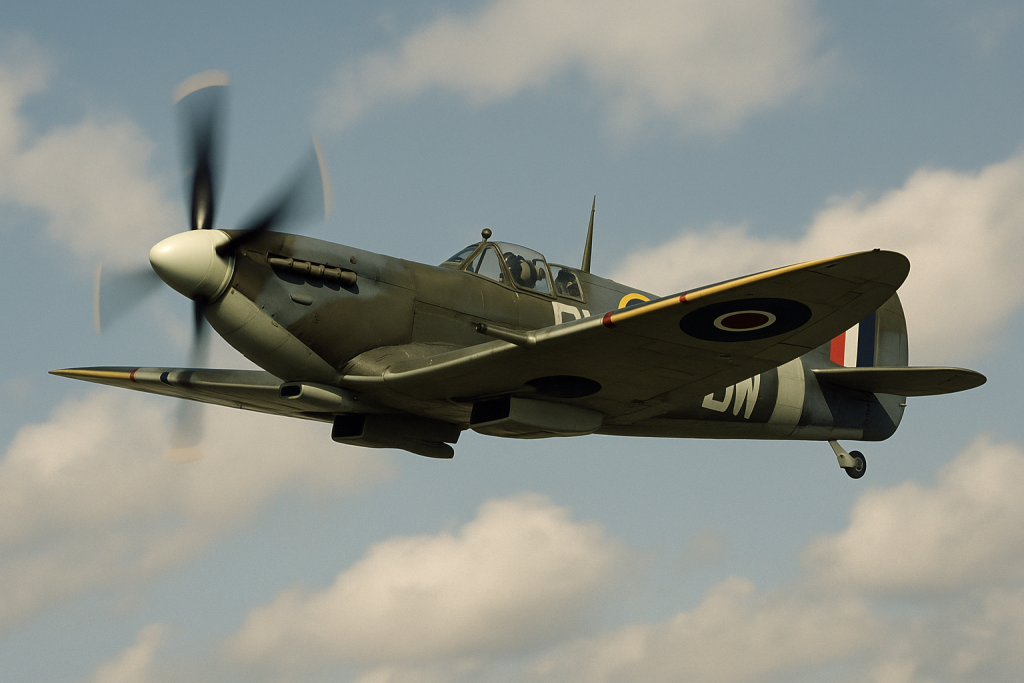
Image Credentials: Image Title: The Birth of a Legend: R.J. Mitchell’s Radical Development of the Supermarine Spitfire Source: (sora.chatgpt) Date: July 2025 Attribution: Created by AI-generated imagery (sora.chatgpt), it does not depict a real-world scene.
By Staff Writer | Open Chronicle
The Supermarine Spitfire remains one of the most iconic aircraft in aviation history, celebrated for its elegant lines, blistering speed, and unmatched agility in the skies of World War II. Yet, behind its legendary performance lies not a flash of brilliance, but a meticulous and methodical development process led by one of Britain’s most visionary aircraft designers: Reginald Joseph Mitchell.
A Foundation in Speed: The Schneider Trophy Racers
The Spitfire’s evolution can be traced back to Mitchell’s earlier work on racing seaplanes. From 1925 to 1931, Supermarine developed a series of high-speed aircraft, most notably the S. 5, S. 6, and S. 6 B, for the prestigious Schneider Trophy competition. These racers weren’t merely technological marvels; they were testbeds for cutting-edge aerodynamics, powerplant integration, and lightweight construction.
Key to their success was collaboration with Britain’s top scientific institutions. Supermarine’s engineers benefited greatly from access to the advanced wind tunnel facilities of the National Physical Laboratory and the Royal Aircraft Establishment. Working closely with engine manufacturers Napier and later Rolls-Royce, Mitchell’s team honed their understanding of high-speed flight, a knowledge base that would prove instrumental in future fighter designs.
From Racer to Fighter: Learning from Failure
Mitchell’s first attempt to apply his racing expertise to a military fighter came with the Supermarine Type 224, submitted in response to Air Ministry specification F.7/30. Though it was initially favored, the Type 224 ultimately fell short due to a combination of mechanical unreliability, aerodynamic inefficiencies, and excessive drag. Its disappointing performance in 1934 was a wake-up call, yet it served as a critical turning point.
Rather than retreat, Mitchell responded with urgency. He launched an internally funded private development program aimed at correcting the shortcomings of the Type 224. Drawing directly from lessons learned during the Schneider Trophy races, Mitchell began shaping what would become one of the most refined fighter aircraft of the era.
The Emergence of the Type 300
This renewed effort led to the Type 300, a design that embodied the best of Mitchell’s aerodynamic research and engineering innovation. Sleeker, faster, and more efficient, the Type 300 incorporated cutting-edge features, such as an elliptical wing for an optimal lift-to-drag ratio and a flush-riveted skin for smoother airflow.
By the autumn of 1934, the Air Ministry recognized the potential of the Type 300 and agreed to fund its continued development as an experimental high-speed interceptor. Within a year, the aircraft evolved into the definitive Spitfire, a fighter that was nearly 40 mph faster than its closest rival, the Hawker Hurricane.
A Timeless Legacy
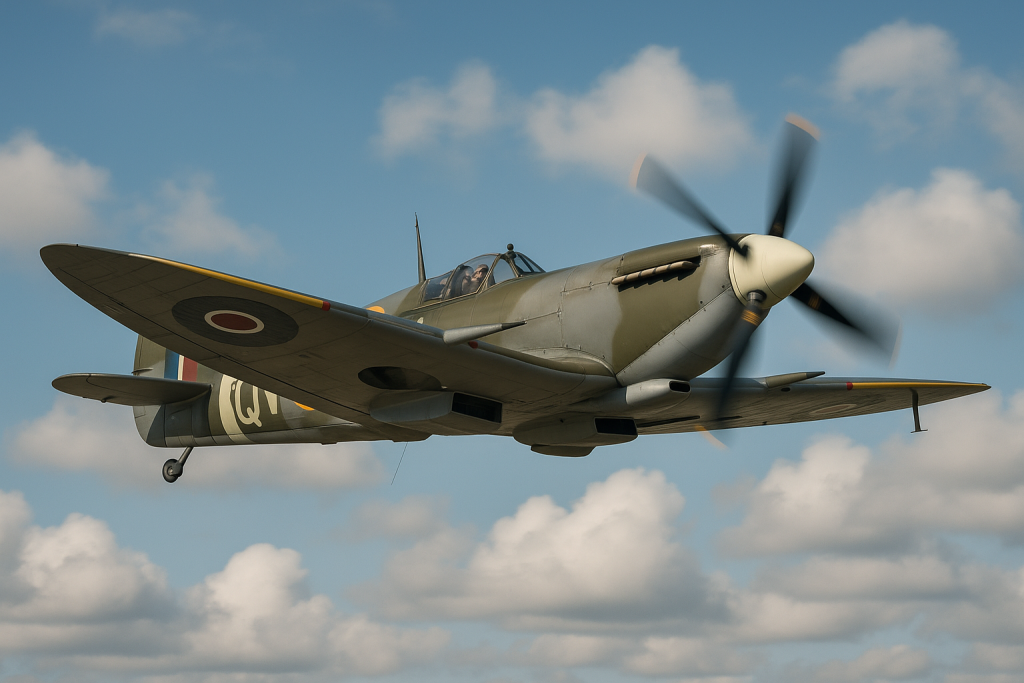
R.J. Mitchell’s journey from seaplane racer to the mastermind of the Spitfire is a testament to iterative design, scientific collaboration, and engineering resilience. The Spitfire was not the product of a single breakthrough, but of a decade-long pursuit of aerodynamic excellence. Through trial, failure, and innovation, Mitchell gave the Royal Air Force a weapon that would become a symbol of resistance and a beacon of British aviation.
Although Mitchell tragically passed away in 1937 before witnessing the Spitfire’s wartime glory, his aircraft went on to play a pivotal role in the Battle of Britain and beyond, cementing its place not only in history books but also in the national memory.
References
-
Price, Alfred. The Spitfire Story. London: Jane’s Publishing, 1982.
-
McKinstry, Leo. Spitfire: Portrait of a Legend. London: John Murray, 2007.
-
Andrews, C.F. & Morgan, E.B. Supermarine Aircraft since 1914. London: Putnam Aeronautical Books, 1981.
-
Saunders, Hilary St. George. Per Ardua: The Rise of British Air Power, 1911–1939. Oxford: Clarendon Press, 1945.
-
Buttler, Tony. British Secret Projects: Fighters and Bombers 1935–1950. Hinckley: Midland Publishing, 2004.
-
Air Ministry Specification F.7/30. The National Archives (UK), AVIA 13/64.
-
Bader, Douglas. Fight for the Sky. London: Arrow Books, 1973.
-
National Physical Laboratory Reports, 1925–1931. Archives of the Royal Aircraft Establishment.
-
Mitchell, Reginald J. Correspondence and Technical Papers. Science Museum Group Archives, London.
-
Bowyer, Chaz. Spitfire: A Documentary History. London: Arms & Armour Press, 1980.