
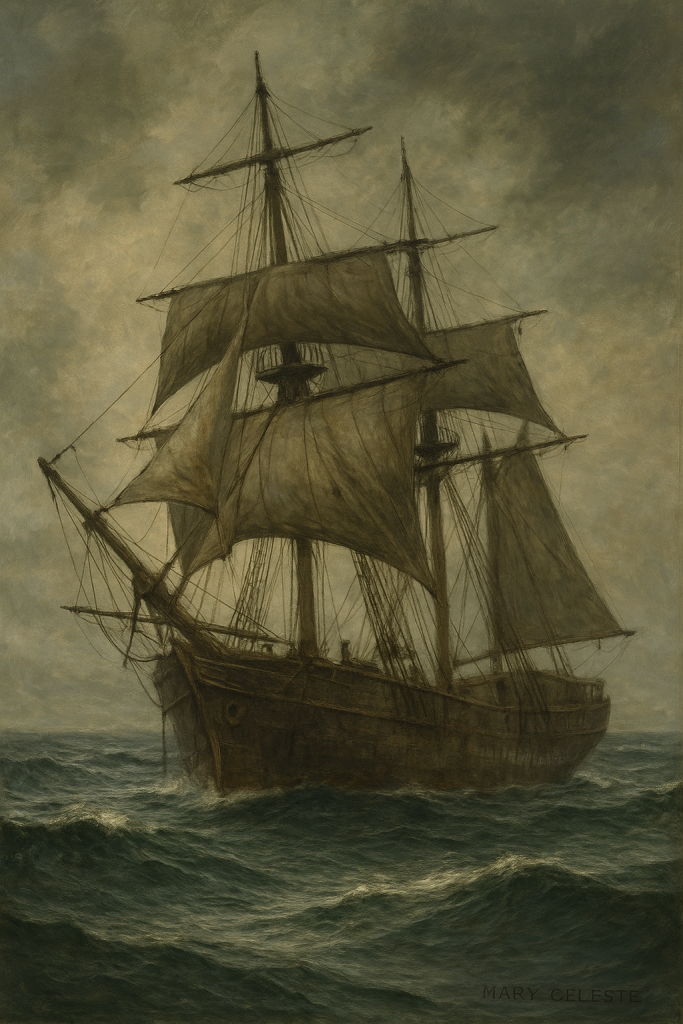
Image Credentials: Image Title: The Mystery Deepens: Queen’s Proctor and the Mary Celeste Inquiry (1872–1873) Source: (sora.chatgpt) Date: July 2025 Attribution: Created by AI-generated imagery (sora.chatgpt), it does not depict a real-world scene.
By Staff Writer | Open Chronicle
Overview
The abandonment of the Mary Celeste, discovered adrift in the Atlantic Ocean in December 1872 by the Dei Gratia, remains one of maritime history’s most enduring enigmas. Initially a salvage matter, the case soon took a darker turn when Queen’s Proctor Frederick Solly-Flood, acting on behalf of the British Admiralty at Gibraltar, began to suspect foul play. His suspicions, fueled by survey findings and court testimonies, ignited one of the earliest and most detailed legal inquiries into maritime mystery.
Suspicion and Survey
Upon hearing the testimonies of Dei Gratia’s officers, including Oliver Deveau, Wright, Lund, Anderson, and Johnson, up to 22 December 1872, Solly-Flood expressed doubts about the benignity of the abandonment. On 23 December, he ordered an exhaustive examination of the Mary Celeste. The inspection was conducted by John Austin, a marine surveyor, and Ricardo Portunato, a diver, in the presence of Court Marshal Thomas Joseph Vecchio and Solly-Flood himself.
Austin’s survey noted peculiarities that inflamed suspicions: cuts on the ship’s bow seemingly inflicted by a sharp instrument, and a sword in the captain’s cabin that appeared to have traces of blood. These findings, paired with the absence of evidence for fire, explosion, or storm damage, left Solly-Flood searching for a motive beyond nature’s forces.
Further Investigation
A second, more minute examination followed on 7 January 1873, conducted with five Royal Navy officers. The team reinforced earlier conclusions, noting bloodlike marks on the starboard top-gallant rail and an apparent blow from a sharp axe. Though no new explosive revelations emerged, the findings compounded Solly-Flood’s belief that violent acts had occurred.
Notably, the presence of domestic items, such as a phial of sewing machine oil found upright, was cited as evidence against the theory that rough weather caused the crew to abandon ship. However, these items may have been positioned during post-abandonment tidying by the Dei Gratia crew. Still, the curious positioning of everyday objects fueled a narrative of sudden and inexplicable desertion.
The Dei Gratia’s Departure and the Hearings
While the Dei Gratia was delayed in Gibraltar, incurring financial costs and logistical setbacks, Captain Morehouse remained to represent the owners in the ongoing salvage hearings. The ship eventually continued to Genoa, but Deveau was recalled for further testimony on 4 March 1873, indicating the court’s continued scrutiny of the case.
Solly-Flood’s Theory and Communication with the Board of Trade
On 22 January 1873, Solly-Flood wrote to the Board of Trade, outlining his theory of a crew mutiny fueled by alcohol. His speculation suggested the seamen murdered Captain Benjamin Briggs, his wife and child, and the first mate, then sabotaged the bow to disguise the vessel as damaged beyond salvation. He proposed that the mutineers escaped aboard another vessel headed for the Americas or the West Indies.
Though lacking definitive proof, this theory took hold in public imagination and influenced subsequent retellings of the mystery. It also framed the Mary Celeste not merely as a tale of maritime misadventure but as a case with potential criminal implications.
Legacy
The Mary Celeste investigation, with Solly-Flood’s passionate involvement and the speculative nature of the inquiry, helped cement the ship’s place in nautical folklore. Despite the absence of hard evidence to confirm violence, the episode revealed the fragility of maritime life and the challenge of interpreting silent ships adrift.
The Queen’s Proctor’s persistent suspicions and vivid theorizing were instrumental in transforming a salvage operation into a legendary maritime mystery. To this day, the fate of the Mary Celeste‘s crew remains unresolved, haunting historians, inspiring fiction, and reminding us that not all seas give up their secrets.