
OPEN CHRONICLE | WORLD NEWS DESK
By Open Chronicle World News Desk | Wednesday, November 18, 2026
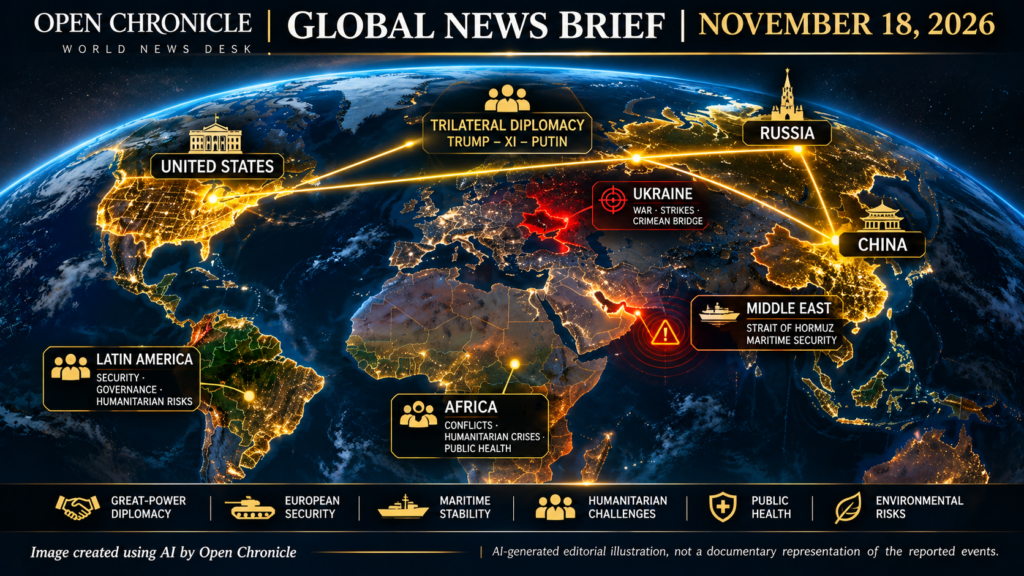
China and Russia prepare for a potentially consequential meeting with the United States, Ukraine intensifies its campaign against Russian military infrastructure, and fresh security incidents threaten the Middle East’s maritime and regional stability. Meanwhile, a historic election result reshapes the US Senate, diplomatic realignments accelerate across Asia, and humanitarian, environmental and technological challenges continue to unfold worldwide.
November 18, 2026 | Information reviewed around 09:30 UTC
This briefing combines the supplied international news feed with additional reporting. Developments are organised geographically and then by theme. Breaking claims, official announcements and independently established facts are distinguished where necessary.
The Global Picture
Three developments dominate the international agenda this morning.
First, the meeting between Chinese President Xi Jinping and Russian President Vladimir Putin in Shenzhen, ahead of their planned trilateral talks with US President Donald Trump, places relations between the world’s leading powers at the centre of global diplomacy. AFP confirms that the Chinese and Russian leaders began talks on Wednesday, with the Ukraine war, Iran and strategic stability expected to shape the wider summit.
Second, the wars in Ukraine and the Middle East continue to generate military escalation risks. Ukraine is seeking additional fighter aircraft and air defence systems, while reports of a major strike against the Crimean Bridge, attacks on Gulf shipping and missile interceptions underline the vulnerability of strategic transport and energy corridors.
Third, domestic political changes are influencing the international balance. In the United States, Democrat Mary Peltola has defeated Republican incumbent Dan Sullivan in Alaska, giving Democrats a projected 56 to 44 majority in the incoming Senate. The Associated Press and Alaska Public Media confirm the result.
The wider picture is one of increasing geopolitical competition alongside continued economic interdependence, technological vulnerability and mounting pressure on international institutions.
1. Asia-Pacific
Diplomacy and Geopolitics
China and Russia coordinate ahead of Trump’s arrival
Xi Jinping and Vladimir Putin met in Shenzhen on Wednesday, November 18, one day before their anticipated trilateral summit with Donald Trump.
The meeting comes at a particularly sensitive moment for international diplomacy. Russia remains engaged in its war against Ukraine, the United States and Iran are involved in a wider regional confrontation, and Washington and Beijing continue to compete over trade, advanced technologies and strategic influence.
Xi and Putin have presented their partnership as an alternative to what they regard as Western economic and political dominance. The Chinese president has emphasised multilateralism and open trade, while Putin has criticised sanctions and protectionist measures.
The planned trilateral meeting has raised questions about whether the three powers could pursue understandings on nuclear security, Ukraine, Iran and international trade.
However, diplomatic engagement does not necessarily imply agreement. Their interests diverge significantly, and any discussion of Ukraine’s future without direct Ukrainian participation would be politically contentious.
AFP and the Associated Press confirm the Xi-Putin meeting and preparations for the trilateral talks.
Why it matters: The summit could influence the direction of great-power diplomacy, but its significance will depend on concrete commitments rather than declarations of cooperation.
South Korea seeks Chinese cooperation on Korean Peninsula stability
South Korean President Lee Jae Myung has used the APEC gathering to strengthen relations with Beijing.
During bilateral talks with Xi, Lee connected further progress in Chinese-South Korean relations with peace and stability on the Korean Peninsula.
Seoul is attempting to balance its security alliance with Washington against the economic and diplomatic importance of China.
The Korean Peninsula remains one of Asia’s most sensitive security environments, with North Korea’s military capabilities and the possibility of renewed negotiations with Washington central to regional calculations.
Yonhap confirms that Lee raised the importance of Korean Peninsula stability during his meeting with Xi.
Japan and Taiwan face renewed military aviation concerns
Reports in the supplied news feed describe unusual Russian bomber activity near Japan and Taiwan, including allegations of airspace violations.
These claims require particular care. Military aircraft operating near an air defence identification zone are not necessarily violating sovereign airspace, and the two situations have different legal and military implications.
The precise routes, any actual territorial airspace incursions and the responses of Japanese and Taiwanese authorities require confirmation through official statements.
Nevertheless, the reported activity reflects the broader importance of military signalling in the western Pacific.
Trade and Economic Diplomacy
Xi promotes open trade as APEC becomes a geopolitical stage
China is presenting itself as a defender of open trade and regional economic integration.
At the APEC gathering, Xi called for cooperation and warned against protectionism. His message comes as governments increasingly view semiconductor supply chains, critical minerals, artificial intelligence and industrial production through a national security lens.
The central contradiction is that major economies continue to depend heavily on international commerce while simultaneously seeking greater technological and strategic independence.
China’s economic diplomacy also comes amid concerns about domestic demand and the country’s reliance on exports.
The Associated Press reports that Xi promoted lower trade barriers and greater market access, while Putin criticised economic restrictions imposed on Russia.
United States and Philippines pursue closer trade and defence ties
Trump has announced progress towards a major trade agreement with the Philippines while emphasising expanded defence cooperation.
Philippine reporting in the supplied feed suggests that Manila has described the commercial outcome more cautiously as an understanding rather than a fully concluded agreement.
That distinction matters. A political announcement does not necessarily mean that a final, legally binding trade agreement has been signed.
The strategic context is equally important. The Philippines occupies a critical position in the western Pacific, particularly in relation to the South China Sea and US regional defence arrangements.
The extent of the proposed commercial commitments and any new defence measures will require examination as official documents become available.
ASEAN and the South China Sea
Regional governments continue negotiations towards a South China Sea code of conduct.
The discussions concern maritime behaviour, competing territorial claims, freedom of navigation and the management of incidents between military and civilian vessels.
Progress would be significant, but the effectiveness of any agreement would depend on its scope, enforcement mechanisms and acceptance by the parties involved.
Environment and Public Health
Thailand faces concerns over arsenic contamination linked to Myanmar
Reports from the Thai-Myanmar border region describe growing concern about arsenic contamination affecting water supplies.
Communities are reportedly seeking safer drinking water while authorities investigate pollution sources and possible cross-border contamination.
The issue demonstrates how environmental problems can become international security and public health concerns when rivers and water systems cross national boundaries.
The precise extent of contamination, health consequences and responsibility for pollution remain important subjects for further verification.
2. Europe and the Russia-Ukraine War
War and Military Operations
Ukraine reports major damage to the Crimean Bridge
Ukraine has claimed a significant operation against the Crimean Bridge, also known as the Kerch Bridge, which connects mainland Russia with the occupied Crimean Peninsula.
Reports in the supplied feed describe the destruction of a key bridge section and suggest that Ukrainian forces used domestically developed communications technology rather than relying on Starlink.
The bridge is strategically important because it supports transport connections between Russia and Crimea, although Moscow also relies on alternative supply routes through occupied southern Ukraine.
A serious interruption could complicate Russian logistics and increase pressure on military supply networks.
However, the exact structural damage, the bridge’s operational status and the long-term consequences require independent technical verification.
Claims that the bridge has been permanently destroyed should not be treated as established without corroborating evidence.
Why it matters: Even temporary disruption of a major transport corridor can affect military logistics, economic activity and Russia’s ability to sustain operations in Crimea.
Ukraine seeks new fighter aircraft and air defence support
Ukraine’s international partners are discussing additional military assistance at the 37th meeting of the Ukraine Defense Contact Group, commonly known as the Ramstein format.
The supplied reporting indicates that Ukraine could receive 12 fighter aircraft before the end of 2026, with France expected to provide additional Mirage 2000-5F fighters.
The precise delivery schedule and aircraft contributions require confirmation from the supplying governments.
President Volodymyr Zelenskyy has emphasised the urgent need for air defence interceptors, additional fighter aircraft, defence industry financing and stronger drone cooperation.
His official November 18 statement identifies air defence as Ukraine’s leading priority, particularly against ballistic missiles, cruise missiles and increasingly sophisticated drones.
The military significance extends beyond the number of aircraft delivered. Training, maintenance, spare parts, weapons integration and the availability of pilots will determine how effectively new systems can be employed.
Ukrainian drones target Russian energy infrastructure
Reports indicate renewed Ukrainian strikes against Russian oil refineries, including facilities in southern Russia.
Such attacks form part of Kyiv’s wider campaign against infrastructure that supports Russian military operations and generates economic revenue.
The effects of individual strikes remain difficult to assess immediately, especially where competing official accounts provide different descriptions of damage.
Repeated attacks can nevertheless create operational costs through repairs, temporary shutdowns and the diversion of air defence resources.
Russia launches further attacks against Kyiv
Ukraine reported renewed Russian drone attacks against its capital on Wednesday morning.
The strikes reinforce the importance of air defence assistance and the growing role of unmanned systems in the conflict.
They also demonstrate that diplomatic discussions involving Washington, Moscow and Beijing are taking place while active hostilities continue.
Diplomacy and European Security
European governments assess the risks of a great-power settlement
The planned Trump-Xi-Putin summit has generated concern about the possibility of major powers discussing Ukraine’s future without sufficient involvement from Kyiv and European governments.
European security depends on decisions concerning territorial sovereignty, sanctions, military assistance and future security guarantees.
A diplomatic initiative could create opportunities for negotiation, but any settlement perceived as rewarding territorial conquest would face significant political resistance.
The central issue for European capitals is whether diplomacy can produce a durable peace consistent with Ukraine’s sovereignty.
Canada and European allies maintain pressure on Russia
Canada has indicated that sanctions pressure on Moscow will continue while the war persists.
The supplied feed also describes additional Canadian military assistance, including air defence equipment, ammunition and winter supplies.
European discussions concerning new financial support for Ukraine reflect the continuing challenge of sustaining Kyiv’s defence while managing domestic fiscal and political pressures.
Slovakia sees protests against its government
Thousands of demonstrators have reportedly gathered in Slovakia to protest Prime Minister Robert Fico’s government and its approach to Russia.
The demonstrations reflect wider disagreements within European politics over relations with Moscow, support for Ukraine and the direction of national foreign policy.
European Politics and Society
Italy’s antisemitism legislation raises free-expression concerns
Italy has approved legislation addressing antisemitism, according to the supplied news feed.
Supporters view stronger legal measures as necessary to counter discrimination and threats against Jewish communities.
Critics have raised concerns that certain provisions could restrict legitimate political criticism of Israeli government policies.
The exact legal language and its application will be central to assessing the legislation’s implications for freedom of expression.
Europe confronts worsening wildfire and public health risks
Reports point to an exceptionally intense European wildfire season, increasing concern about climate adaptation, emergency response and land management.
Separate reporting warns of rising drug-resistant infections in European hospitals.
These developments illustrate how Europe’s security challenges extend beyond military threats to include environmental resilience and the capacity of public health systems.
3. Middle East and North Africa
Regional Conflict and Military Security
Commercial vessel attacked in the Strait of Hormuz
One of the day’s most consequential maritime developments concerns an attack on a vessel associated with ADNOC Logistics & Services.
Reuters reports that one crew member was missing and 11 were injured following the attack, with the remaining crew evacuated.
Omani emergency authorities were involved in rescue operations, while maritime security reporting described a vessel struck by a projectile.
The incident occurred amid a wider pattern of attacks and disruptions affecting shipping through the Strait of Hormuz.
The strait is among the world’s most strategically important maritime passages because of the large volumes of oil and liquefied natural gas that normally transit its waters.
Continued insecurity could affect shipping insurance, energy prices, commercial vessel movements and the broader international economy.
Why it matters: A regional military confrontation can quickly become a global economic problem when commercial shipping and energy supply routes are threatened.
Saudi Arabia reports interception of Houthi cruise missile
Saudi authorities have announced the interception and destruction of a cruise missile reportedly launched by Houthi forces towards the Riyadh region.
The reported interception highlights the continuing threat posed by long-range missiles and drones in the Arabian Peninsula.
It also demonstrates the importance of integrated air defence systems and early warning networks for protecting major cities and critical infrastructure.
The circumstances of the launch and any damage or casualties require confirmation through official reporting.
Iran and the United States remain locked in confrontation
The supplied feed describes continued exchanges of military action involving Iran, the United States and Gulf states despite diplomatic efforts to reduce hostilities.
Reports include alleged Iranian drone activity against US military installations, further American strikes and warnings from Gulf governments.
Some individual claims, including specific targets and battlefield effects, remain unverified in the material reviewed.
The strategic danger is that attacks on military facilities, commercial shipping or energy infrastructure could trigger retaliation and expand the conflict.
Diplomatic channels remain essential, but their effectiveness depends on whether the parties can establish credible limits on military escalation.
Kuwait and Bahrain report further security threats
Authorities in Kuwait and Bahrain have reportedly responded to additional attacks involving Iranian drones or other aerial threats.
The incidents underline the exposure of Gulf states to regional escalation, even where governments are not principal participants in a conflict.
Security concerns extend to airports, ports, energy facilities and military installations.
Israel, Palestine and Regional Diplomacy
Australia imposes new sanctions over West Bank settlement expansion
Australia has announced targeted sanctions against three individuals and four organisations associated with settlement expansion and human rights abuses against Palestinians in the occupied West Bank.
Foreign Minister Penny Wong said the measures were intended to deter activities undermining the prospect of a two-state solution.
The restrictions prohibit Australians and Australian businesses from providing financial or commercial support to the designated individuals and entities.
Australia’s official announcement confirms the measures, while ABC News identifies sanctioned individuals and organisations, including Daniella Weiss and Nachala.
The decision represents a significant diplomatic development because it targets specific actors and commercial activities rather than relying solely on statements of opposition to settlement expansion.
Gaza faces renewed humanitarian and ceasefire concerns
Reports describe growing concern about the sustainability of the Gaza ceasefire and the humanitarian situation as winter approaches.
The World Health Organization has called for unobstructed humanitarian supplies, while other international bodies warn of the consequences of renewed fighting.
The principal challenges include access to food, medical supplies, shelter, clean water and functioning health facilities.
The durability of any ceasefire will depend on security arrangements, humanitarian access and political negotiations.
Türkiye warns against regional destabilisation
Turkish officials have urged Israel to end policies that Ankara believes are damaging relations with neighbouring countries.
The statements reflect Türkiye’s increasingly prominent diplomatic role in regional security debates.
Ankara’s position also illustrates the difficulties of establishing a regional security framework while conflicts involving Israel, Iran, Lebanon and other actors remain unresolved.
Iraq, Lebanon and Syria
Iraq faces tensions over armed militias
The Iraqi government has reportedly demanded that Kata’ib Hezbollah withdraw from the Jurf al-Sakhar area, while the armed group has rejected the ultimatum.
The dispute highlights a longstanding challenge for Iraq: the coexistence of state security institutions and powerful armed organisations with their own political and military networks.
Any confrontation could threaten domestic stability and complicate Baghdad’s relations with regional powers.
Lebanon and Syria pursue improved relations
Lebanese President Joseph Aoun has indicated that relations with Syria are developing positively.
Improved bilateral cooperation could influence border security, trade, refugee issues and efforts to stabilise neighbouring areas.
However, the legacy of conflict and competing political interests remains a major obstacle.
North African Security
Libya reports major drug seizures
Authorities in eastern Libya have announced the seizure of cocaine and large quantities of pills.
The operation reflects the continuing importance of North Africa in transnational trafficking networks.
Weak institutional coordination, porous borders and the presence of armed groups can complicate efforts to disrupt organised crime.
Tunisia reports increased voluntary migrant returns
Tunisia has reported a rise in voluntary returns among irregular migrants.
The development forms part of wider Mediterranean migration debates involving border management, human rights, cooperation with European states and economic opportunities in countries of origin.
4. North America
United States | Politics and Government
Mary Peltola delivers historic Democratic victory in Alaska
Democrat Mary Peltola has defeated incumbent Republican Senator Dan Sullivan in Alaska, completing one of the most consequential electoral reversals of the 2026 midterm elections.
Peltola, a former member of the House of Representatives and a Yup’ik Alaska Native, becomes the first Alaska Native elected to the US Senate.
Her victory brings the incoming Democratic Senate majority to 56 seats against 44 for Republicans.
According to the Associated Press, Peltola secured more than 50% of the first-choice vote, avoiding the need for additional rounds under Alaska’s ranked-choice voting system.
The result has important consequences for the balance of power in Washington, including congressional oversight, legislation, federal appointments and the administration’s ability to advance its domestic agenda.
The campaign was also affected by allegations concerning another candidate with a similar name to the incumbent senator. Those allegations remain disputed and should not be treated as established wrongdoing.
Why it matters: The result strengthens Democratic control of the incoming Senate and illustrates the political consequences of economic dissatisfaction, particularly in states where household costs are exceptionally high.
US technology failures raise national security concerns
American authorities continue to investigate a series of technological disruptions affecting major services and institutions.
The incidents include problems involving Microsoft 365, the Federal Aviation Administration, financial services and the NSA’s classified internal communications network.
The NSA attributed its disruption to routine maintenance and maintained that essential national security capabilities remained operational.
Secretary of State Marco Rubio has rejected suggestions that the available evidence establishes a coordinated cyberattack.
The incidents nevertheless raise questions about infrastructure modernisation, operational redundancy and the ability of essential services to withstand unexpected technical failures.
The Guardian’s November 17 coverage confirms the NSA incident and the administration’s position that there was no evidence linking the outages.
US court imposes lengthy sentence in Iran-linked assassination case
A Pakistani national convicted in connection with an alleged Iran-linked plot to assassinate Donald Trump has reportedly received a prison sentence exceeding 27 years.
The case illustrates the intersection of domestic security, foreign intelligence threats and the deteriorating relationship between Washington and Tehran.
The precise judicial findings and any proven relationship with Iranian state institutions should be distinguished from allegations made during the investigation.
Canada | Foreign Policy and Economic Security
Ottawa seeks greater economic independence
Prime Minister Mark Carney is pursuing closer commercial relations with Asian economies as Canada seeks to diversify trade and reduce vulnerabilities associated with dependence on the United States.
The diplomatic effort comes amid continuing uncertainty over tariffs, industrial competition and the future of North American trade arrangements.
Canada’s approach reflects a broader international trend in which governments are attempting to increase economic sovereignty without abandoning existing alliances.
Canada maintains support for Ukraine
Ottawa has reiterated its intention to maintain sanctions pressure against Russia and continue assisting Ukraine.
The supplied reporting also identifies additional Canadian contributions involving military equipment, ammunition and air defence capabilities.
Canada’s policies demonstrate the continuing importance of transatlantic cooperation even as economic relations between North American partners undergo adjustment.
Technology and Public Health
Waymo suspends some autonomous freeway operations
The supplied news feed reports that Waymo has halted driverless taxi operations on US freeways amid safety concerns.
The development raises questions about the regulatory and operational standards required for autonomous vehicles in complex traffic environments.
The scope of the suspension, its technical cause and any timetable for resumption require confirmation from the company and relevant authorities.
Measles resurgence intensifies public health concerns
Reports indicate that the United States has lost its measles-elimination status amid a significant resurgence of infections.
The development highlights the importance of vaccination coverage, disease surveillance and rapid public health responses.
International health authorities are also warning about the wider return of measles in countries where vaccination gaps have increased.
5. Latin America and the Caribbean
Haiti | Security and International Cooperation
Haiti formalises security agreement with El Salvador
Haiti has approved a security cooperation agreement with El Salvador following the deployment of Salvadoran personnel to help confront armed gangs.
The announcement coincided with demonstrations in Port-au-Prince expressing support for Salvadoran President Nayib Bukele and his government’s involvement.
According to Euronews, Haiti’s authorities confirmed the agreement on November 17.
The report also cites United Nations figures recording 4,595 deaths and 2,050 injuries associated with armed violence during the first ten months of 2026.
The agreement represents a significant development in Haiti’s search for international security assistance.
However, the effectiveness of the intervention will depend on operational coordination, accountability, respect for human rights and the ability of Haitian institutions to re-establish sustainable control.
Why it matters: Haiti’s crisis cannot be resolved through security operations alone. Long-term stabilisation also requires functioning institutions, economic opportunities and public confidence in the rule of law.
Brazil | Environment and Indigenous Rights
Rare contact involving isolated Indigenous people raises concerns
Reports from the Brazilian Amazon describe contact involving members of an isolated Indigenous community.
Such encounters can create serious risks, including exposure to infectious diseases, territorial encroachment and disruption of traditional ways of life.
The reports have renewed attention to the protection of Indigenous territories and the pressures created by illegal logging, mining and agricultural expansion.
The circumstances of the contact and the community’s immediate needs require careful assessment by qualified Indigenous protection authorities.
Regional Economy and Security
Latin American governments continue to face interconnected challenges involving organised crime, public security, migration and economic inequality.
The region is also becoming increasingly important in international competition for critical minerals, renewable energy investment and agricultural supply chains.
These developments give Latin America greater strategic significance in discussions about global trade diversification and industrial policy.
6. Africa
Sudan | War and Humanitarian Crisis
Military developments intensify pressure on Sudan’s rival forces
Reports indicate that Sudanese army forces have made gains in West Kordofan as the Rapid Support Forces face pressure in parts of the region.
The claims require independent battlefield verification.
The wider conflict continues to generate severe humanitarian consequences, including displacement, food insecurity and the destruction of essential infrastructure.
International diplomatic efforts remain complicated by the fragmentation of armed groups, competing external interests and the absence of a durable political settlement.
Washington increases pressure over Islamist influence
The supplied feed describes increasing US scrutiny of Islamist networks associated with Sudan’s political and military environment.
The issue could affect relations between Washington and Sudanese military leaders as international actors consider possible routes towards ending the war.
Democratic Republic of the Congo | Health and Development
Ebola vaccine research advances
Two Ebola vaccine candidates are reportedly expected to enter Phase 2 clinical trials in the Democratic Republic of the Congo.
If confirmed, the development would represent an important step in evaluating additional tools for preventing future outbreaks.
Phase 2 trials generally examine safety, immune responses and dosing in a larger group of participants. They do not, by themselves, establish that a vaccine is ready for widespread use.
The announcement should therefore be understood as a research milestone rather than confirmation of an approved vaccine.
Critical minerals remain central to economic diplomacy
The Democratic Republic of the Congo continues to attract international interest because of its mineral resources, particularly those used in batteries and advanced manufacturing.
Proposals for new transport corridors and export infrastructure could improve market access, but their success will depend on security, investment conditions and the distribution of economic benefits.
Nigeria | Governance and Security
Police reform could reshape Nigeria’s security system
Nigeria has reportedly approved legislation allowing individual states to establish their own police forces.
Such a change would represent a significant shift in the country’s security architecture, which has traditionally relied heavily on federal policing.
Supporters argue that local authorities need greater capacity to address regional security threats.
Critics may question whether decentralisation could create risks of political interference, unequal resources or inconsistent accountability.
The law’s precise provisions and implementation arrangements require confirmation.
Ghana and Tunisia | Public Accountability and Migration
In Ghana, reports of controversy over a new presidential aircraft highlight public sensitivity to government expenditure and economic priorities.
In Tunisia, rising voluntary returns of irregular migrants continue to shape discussions about migration management and cooperation with European governments.
Both developments reflect broader pressures on African governments to balance security, economic constraints and public expectations.
7. Oceania
Australia | Diplomacy and Human Rights
Canberra expands sanctions targeting West Bank settlements
Australia has imposed new sanctions against individuals and organisations involved in settlement expansion in the occupied West Bank.
The measures include financial restrictions and travel bans, and were announced by Foreign Minister Penny Wong.
Canberra says the sanctions are intended to protect the viability of a two-state solution and discourage human rights abuses.
The announcement was coordinated with international partners and reflects Australia’s increasingly active role in diplomatic pressure over settlement policy.
Australia | Economy and Technology
Gender pay gap reaches reported record low
The supplied news feed indicates that Australia’s gender pay gap has declined to its lowest recorded level.
The development suggests progress in workplace equality, although the precise measurement, whether it concerns base salaries or total remuneration, and differences between industries remain important.
A narrower national gap does not necessarily mean that pay disparities have disappeared.
Australia promotes international cooperation on AI
Australian authorities are seeking stronger cooperation with international partners on artificial intelligence.
The central policy challenge is to encourage innovation and productivity while addressing cybersecurity, workforce disruption, data protection and the concentration of technological power.
New Zealand | Natural Hazards
Tsunami warning withdrawn after offshore activity
New Zealand authorities have reportedly withdrawn a tsunami warning following activity recorded off the North Island.
The incident highlights the importance of early warning systems and public communication in a country exposed to significant seismic and maritime hazards.
The precise cause and measured ocean conditions should be assessed through official emergency management and geological monitoring agencies.
8. Global Issues | Developments Beyond National Borders
Global Health
UNICEF warns of renewed measles transmission
UNICEF has warned of a resurgence of measles, with several countries reportedly losing elimination status.
The situation demonstrates the consequences of declining immunisation coverage and gaps in disease surveillance.
Measles is highly contagious, making sustained vaccination programmes essential for preventing outbreaks.
Climate and Environment
Europe faces escalating wildfire risks
Reports of an exceptionally severe European wildfire season underline the growing challenges posed by extreme heat, drought and changing environmental conditions.
The implications extend beyond burned landscapes to public health, agricultural production, insurance costs and the resilience of energy and transport networks.
Chemical pollution emerges as a global concern
New scientific reporting referenced in the supplied feed warns about potential health and environmental risks associated with chemicals found in everyday products.
The implications include stronger testing requirements, improved disclosure and international cooperation on chemical safety.
The specific findings and levels of risk should be evaluated against the underlying scientific assessment rather than generalised across all consumer products.
Technology and Cybersecurity
US and South Korea issue warnings over Java vulnerabilities
The United States and South Korea have reportedly issued urgent advisories concerning vulnerabilities in Java-related software.
The exact products, affected versions and vulnerability identifiers need to be checked before organisations make remediation decisions.
The wider significance lies in the dependence of government and enterprise systems on widely deployed software components.
Europe increases scrutiny of online marketplaces
The European Union has reportedly taken enforcement action against Temu over concerns about illegal products sold through its platform.
The case reflects increasing regulatory pressure on large online marketplaces to monitor product safety, seller compliance and consumer protection.
International Security
NATO examines next-generation communications
NATO has announced a new alliance-wide strategy for next-generation communications networks, according to the supplied feed.
The initiative reflects the growing importance of resilient digital communications, interoperability and secure information exchange between allied armed forces.
Its significance is heightened by the increasing use of drones, artificial intelligence, distributed sensors and electronic warfare in modern military operations.
Global Risk Monitor
Editorial assessment based on the developments covered in this briefing. These indicators are qualitative judgements, not numerical forecasts.
Middle East regional escalation
HIGH
Military exchanges, missile threats and maritime attacks create continuing escalation risks.
Russia-Ukraine war
HIGH
Attacks on infrastructure, Russian strikes and unresolved diplomatic questions.
Great-power competition
ELEVATED
Trump-Xi-Putin diplomacy, sanctions and competing strategic interests.
Global energy and shipping
ELEVATED
Strait of Hormuz insecurity threatens maritime trade and energy supplies.
Critical technology resilience
ELEVATED
Recent outages and cybersecurity warnings expose complex system dependencies.
Humanitarian and public health
HIGH
Sudan, Haiti, Gaza and infectious disease resurgence remain serious concerns.
Bar lengths are illustrative editorial indicators, not measured probabilities or comparable statistical scores. Risk classifications reflect the Open Chronicle editorial assessment of the developments covered in this briefing and may change as new information becomes available.
Five Developments to Watch Next
Five critical developments that could shape the international agenda in the coming days.
November 19 | Trump, Xi and Putin
Will the trilateral meeting produce concrete understandings on Ukraine, Iran, nuclear stability or trade, or remain primarily symbolic?
Ukraine | Crimean Bridge and Allied Assistance
Independent confirmation of bridge damage, the operational consequences for Russian logistics and detailed military assistance commitments.
Middle East | Strait of Hormuz
Further maritime attacks, the search for missing crew members, military retaliation and the impact on international shipping.
United States | Political and Institutional Change
The implications of the Democratic Senate majority, congressional leadership decisions and the response to infrastructure failures.
Global Stability | Humanitarian and Environmental Risks
Developments in Haiti, Sudan and Gaza, alongside public health warnings and environmental emergencies.
These five developments have been selected for their potential geopolitical, security, economic and humanitarian implications. Their significance will depend on subsequent decisions, verified information and the evolution of events. Open Chronicle will continue to distinguish confirmed developments from preliminary reports and emerging assessments.
The Big Picture | A World Negotiating While Conflicts Continue
November 18, 2026, presents a revealing picture of the international system.
The leaders of China, Russia and the United States are preparing for discussions that could influence the direction of global diplomacy. Yet military operations continue in Ukraine, regional confrontation threatens shipping in the Middle East, and governments across the world face mounting domestic and economic pressures.
The contrast is striking.
Diplomatic activity is increasing, but there is little evidence that the underlying sources of instability have disappeared.
In Europe, the war in Ukraine continues to shape defence policy, energy security and relations with Russia.
In Asia, economic interdependence coexists with intensifying military competition and uncertainty about the future of regional security arrangements.
In the Middle East, localised attacks carry the potential to disrupt global trade and energy supplies.
In the Americas, political change and security challenges are reshaping national priorities.
Across Africa, conflict, governance problems and humanitarian emergencies demand attention even when they receive less international coverage.
Meanwhile, technology failures, environmental pressures and infectious disease outbreaks demonstrate that many of the most consequential global risks cannot be contained within national borders.
The defining challenge is no longer simply how individual countries respond to crises, but how an increasingly interconnected world manages several crises simultaneously.
That is the central story emerging from today’s global developments.
Sources and Further Reading
The following selection includes independently retrieved reporting and official material. Other developments in the briefing originate from the news feed supplied for editorial review and are identified with appropriate caution where independent confirmation remains outstanding.
Xi-Putin meeting and anticipated trilateral summit.
Local reporting on Mary Peltola’s victory in the Alaska Senate election.
Office of the President of Ukraine
Ramstein meeting priorities, air defence requirements and international military assistance.
ADNOC vessel attack, missing crew member and maritime security in the Strait of Hormuz.
Australian Department of Foreign Affairs
Official announcement concerning sanctions related to West Bank settlement expansion.
South Korea-China diplomacy and cooperation concerning peace on the Korean Peninsula.
Haiti-El Salvador security agreement and public demonstrations supporting international anti-gang assistance.
US government developments, the NSA classified network outage and recent infrastructure disruptions.
This Global News Brief was prepared from the international news headlines supplied for November 18, 2026, supplemented by reporting and official statements retrieved for selected major developments. Open Chronicle distinguishes independently corroborated information from breaking claims, preliminary battlefield reporting, official assertions and editorial interpretation. Some developments, particularly military incidents, alleged airspace violations, weapons deliveries and newly announced government measures, may change as additional information becomes available. The regional risk assessment and concluding analysis are editorial interpretations rather than official intelligence assessments.