
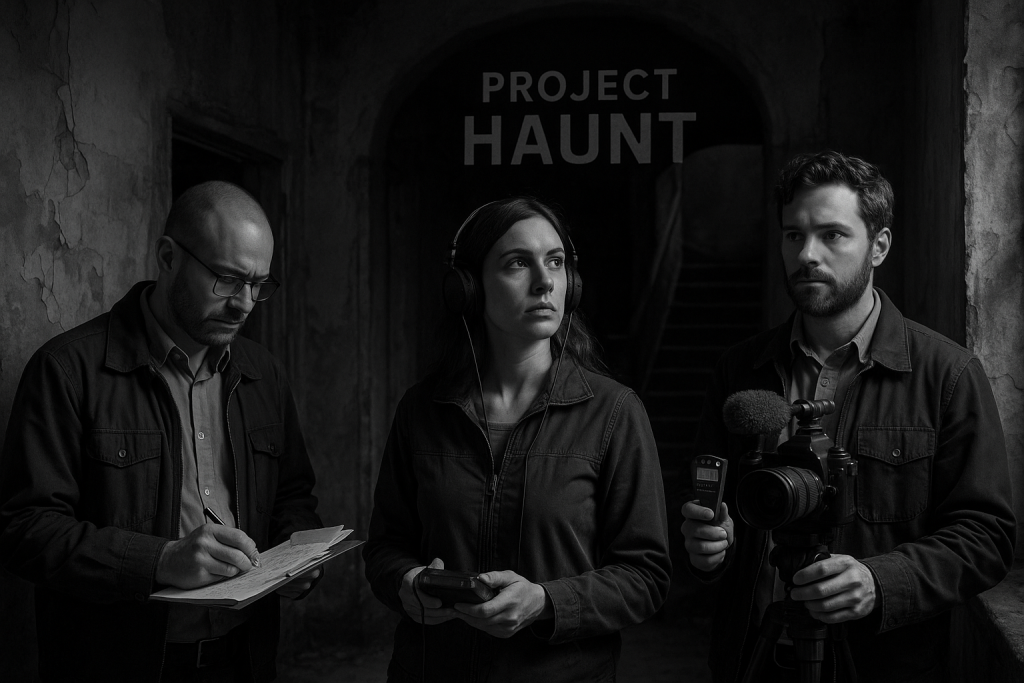
Image Credentials: Image Title: Inside Project HAUNT (2008): The Science Behind Haunted Feelings Source: (sora.chatgpt) Date: July 2025 Attribution: Created by AI-generated imagery (sora.chatgpt), it does not depict a real-world scene.
By Staff Writer | Open Chronicle
In 2008, a group of researchers set out to explore one of the most mysterious and emotionally charged phenomena in human experience, the sensation of being haunted. Their goal wasn’t to chase ghosts, but to understand how environmental, psychological, and neurological factors might explain why so many people report encountering supernatural entities. The result was Project HAUNT, a landmark investigation into the science of hauntings.
The Purpose of Project HAUNT
Led by psychologist Dr. Chris French and a team at the University of London’s Anomalistic Psychology Research Unit, Project HAUNT (Hauntings: Analysis of Unexplained Nocturnal Terror) aimed to determine whether “haunted” experiences could be reproduced in controlled environments, without involving any actual paranormal activity.
Rather than assuming ghosts were real, the researchers asked a different question:
What makes people feel haunted?
Methodology: Recreating the Haunted Experience
To answer that question, the researchers designed experiments that simulated typical “haunted” environments. Participants were invited into specially prepared rooms or buildings, where they would be exposed to a variety of subtle sensory triggers known to influence perception. These included:
-
Low-frequency sound waves (also called infrasound), which can cause unease, dizziness, or feelings of presence
-
Slight temperature shifts or cold drafts, associated with ghostly chills
-
Unusual lighting patterns, like flickering or dimness
-
Electromagnetic fields (EMFs), which may affect brain activity and mood
-
Ambiguous stimuli, like indistinct noises or shadows
Participants were not told the rooms were “haunted”, avoiding psychological priming. Yet many still reported sensations commonly described in paranormal encounters:
-
A feeling of being watched
-
Seeing fleeting shadows
-
Feeling sudden anxiety or pressure
-
Interpreting ambiguous sounds as whispers or footsteps
Key Findings
Project HAUNT found that feelings of a haunting could be induced using purely natural, explainable conditions. Some participants even developed narratives to explain what they were experiencing, such as believing a ghost had passed by, despite no actual stimuli beyond environmental manipulation.
This supported the theory that many hauntings are the result of suggestive settings, sensory confusion, and brain interpretation, rather than genuine contact with the supernatural.
The researchers concluded that:
-
Haunted feelings are real experiences, but not necessarily caused by ghosts
-
The brain interprets certain environmental cues as threatening or otherworldly, especially in uncertain or low-light conditions
-
People’s beliefs and expectations play a major role in how they interpret ambiguous experiences
Implications for Paranormal Research
Project HAUNT did not disprove the possibility of ghosts, but it offered strong evidence that many classic signs of a haunting could stem from known psychological and environmental influences. The study challenged paranormal investigators to apply more scientific rigor when examining haunted sites, and reminded the public to consider natural explanations before jumping to supernatural conclusions.

Legacy
Project HAUNT remains one of the most cited examples of anomalistic psychology, the study of unusual experiences through a scientific lens. Its influence continues to grow in the fields of cognitive science, environmental psychology, and even architecture, where researchers explore how space and sensory design affect human perception.
By showing that ghosts can be created in the mind under the right conditions, Project HAUNT helped turn haunted houses into scientific laboratories of perception — and revealed that sometimes, the scariest things aren’t from another world, but from within our brains.