
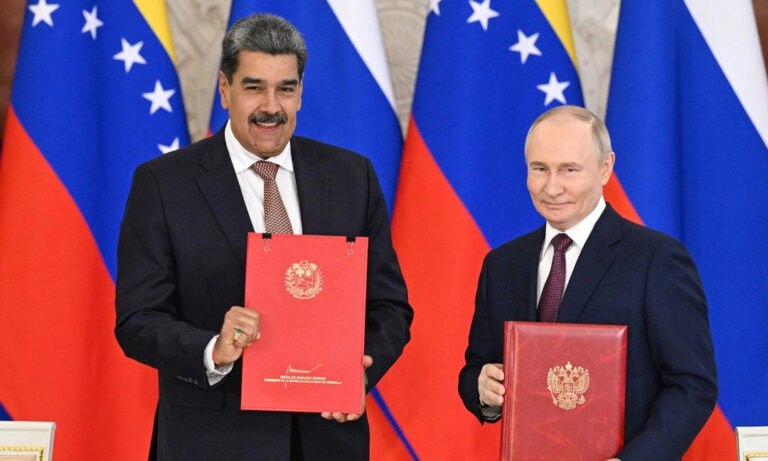
Image: from DD Geopolitics X@DD_Geopolitics
By Isabella Harper | Staff Writer
Russian Foreign Minister Sergey Lavrov has reaffirmed Moscow’s commitment to honoring its strategic treaty with Venezuela, despite increasing tensions with the United States and a significant military presence in the Caribbean. Speaking to reporters this week, Lavrov emphasized that Russia will fully adhere to its obligations under the treaty signed in May 2025, during Venezuelan President Nicolas Maduro’s visit to Moscow.
The treaty, which has already been ratified by Venezuela, marks a significant step in strengthening bilateral ties between the two nations, particularly in military and economic cooperation. While Venezuela has not requested any formal support from Russia at this time, the growing U.S. military activity in the region appears to be a key factor in the backdrop of the agreement’s implementation.
“The treaty is almost finished. We will strictly adhere to the obligations it contains,” Lavrov said during a briefing on Tuesday. He reiterated that Russia stands ready to fulfill its commitments in full, despite ongoing hearings in the Russian legislature regarding its final approval.
The announcement of the treaty comes as tensions in the region rise, particularly with the U.S. military’s increasing presence in the Caribbean. This week, the USS Gerald R. Ford, the U.S. Navy’s largest aircraft carrier, arrived in the region. The carrier’s strike group joins eight warships, a nuclear submarine, and F-35 aircraft already stationed in the area.
The U.S. has stated that its military presence is aimed at combating drug trafficking, with the Pentagon conducting at least 20 strikes on alleged drug-smuggling boats since September. However, Russian officials, including Lavrov, have criticized these actions, calling them an overreach under the guise of anti-narcotics efforts.
“The situation is aggravated by the fact that the American authorities have provided no evidence linking the ships and crew they targeted to the illicit drug trade,” said Russian Foreign Ministry spokeswoman Maria Zakharova. She added that U.S. actions should not interfere in the domestic affairs of sovereign countries, particularly Venezuela.
Lavrov echoed these sentiments, condemning the U.S. military operations in the region. He described the destruction of boats suspected of carrying narcotics as “unacceptable” and argued that such actions violate international norms.
Moscow has long been a staunch ally of the Venezuelan government, offering political, economic, and military support amid Venezuela’s ongoing political and economic crises. Russia has provided Caracas with loans, weapons, and technical assistance, while also advocating for Venezuela in international forums.
The treaty signed earlier this year includes provisions for continued military cooperation, though specific details of the agreement remain largely undisclosed. With the U.S. increasing its military presence in the Caribbean, Russia’s commitment to Venezuela’s sovereignty and its support for the Maduro government have become even more significant.
Despite the escalating U.S. presence, Lavrov stated that Russia’s actions in the region would remain peaceful and within the framework of the agreed treaty. The growing U.S. military footprint in the Caribbean, he said, is a part of Washington’s broader strategy to intervene in Latin American affairs under the pretext of combating drug trafficking.
The U.S. has justified its military build-up by citing the need to target drug trafficking networks operating in the region. However, Lavrov has condemned the lack of evidence provided by the U.S. to support these claims, calling the strikes “a form of lawlessness.”
“We do not accept the idea of destroying ships without trial or investigation,” Lavrov stated. “Law-abiding nations do not act this way. This kind of behavior is more typical of those who consider themselves above the law.”
As the U.S. continues its military operations in the Caribbean, Russia’s stance on its support for Venezuela remains firm. Lavrov’s remarks suggest that Moscow is prepared to escalate its commitment to Venezuela, which could further strain relations with the U.S. and its allies in the region.
The growing tensions between the U.S. and Russia in the Caribbean highlight the geopolitical importance of Latin America, particularly in relation to the U.S.’s so-called “War on Drugs.” As the U.S. intensifies its military presence in the region, Russia’s support for Venezuela and its commitment to the bilateral treaty signed earlier this year send a clear message about Moscow’s strategic interests in the Western Hemisphere. With both sides positioning themselves in the Caribbean, the situation could have far-reaching implications for U.S.-Russia relations and for the stability of the region as a whole.