
Image Credentials: Image Title: ⚙️ F1 Fine-Tunes the Rules: Fastest Lap Point Axed, Rookie Time Doubled, and New Heat Measures Source: (sora.openai) Date: December 2025. Attribution: This image was created using AI-generated imagery (sora.openai) and does not depict a real-world scene.
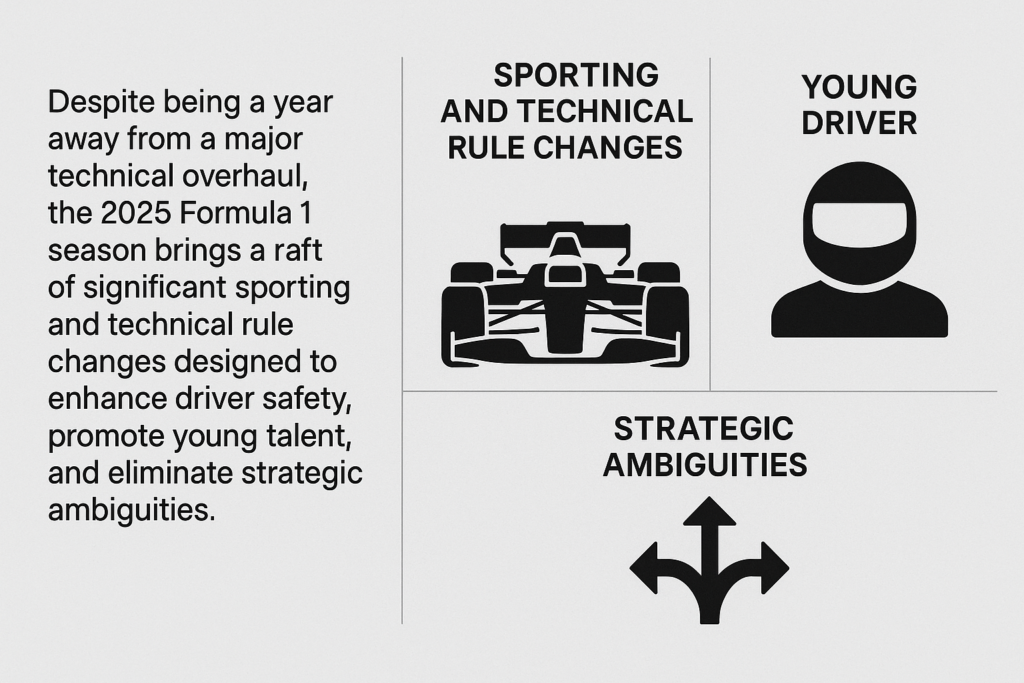
Despite being a year away from a major technical overhaul, the 2025 Formula 1 season brings a raft of significant sporting and technical rule changes designed to enhance driver safety, promote young talent, and eliminate strategic ambiguities.
Here are the seven key tweaks that teams, drivers, and fans need to know:
1. The End of the Fastest Lap Point
In the most visible change to the scoring system, the bonus point for setting the fastest lap of the race has been removed. Introduced in 2019, the point was intended to inject late-race excitement. However, the rule often sparked controversy, particularly when a driver outside the top 10 would pit late for fresh tyres to “steal” the point from a top-10 competitor, thus impacting championship battles without scoring themselves.
The points system reverts to the pre-2019 standard: points are awarded only to the top 10 drivers in a Grand Prix and the top 8 drivers in a Sprint.
2. Mandatory Driver Cooling Systems
Following extreme heat incidents at races like the 2023 Qatar Grand Prix, driver safety is being prioritized. If a weather forecast predicts temperatures of 31°C or above during a Sprint or Grand Prix, a Heat Hazard will be declared by the FIA.
Teams will then be required to fit a mandated driver cooling system. This system is defined as a fireproof shirt with fluid-pumping tubes, a pump, plumbing, and a thermal store (like an ice block). The car’s minimum weight limit will be increased by +5kg for the Sprint or Grand Prix to compensate for the equipment. A smaller +2kg increase applies to practice and qualifying sessions where the system is not mandated for use.
3. Increased Running for Rookies
The mandatory Free Practice 1 (FP1) running time for rookie drivers, defined as those who have participated in no more than two F1 races, has been doubled.
Since 2022, teams have had to run a rookie at least once in each of their two cars (two sessions total). For 2025, this mandate increases to twice per car, meaning every team must field a rookie in FP1 for a total of four occasions throughout the season. This provides double the opportunity for young talent to gain crucial track experience.
4. Tighter Restrictions on DRS and Wing Flex
The FIA has closed off loopholes in the technical regulations concerning the rear wing. The main focus is on banning so-called “mini-DRS” concepts, where the wing elements could subtly tilt backward at high speeds to reduce drag without the DRS being formally deployed. The rules now define the Drag Reduction System (DRS) as having strictly two positions: closed and open.
Furthermore, rear wing deflection testing has been made more stringent, with the applied load for checking the rear wing slot gap increasing from $10N$ to $30N$ to limit excessive flexibility.
5. Limits to Race Driver Testing of Old Cars
While teams can conduct up to 20 days of Testing of Previous Car (TPC) running in a year (using a car at least two seasons old), their current race drivers are now heavily restricted. A race driver is only allowed to participate in a maximum of four TPC days, during which they cannot exceed a total running distance of 1,000km. This change aims to distribute more TPC track time to test and reserve drivers.
6. Qualifying Classification Clarification
In case an entire Qualifying or Sprint Qualifying session cannot take place due to exceptional circumstances (like extreme weather, as was nearly seen in São Paulo last year), the starting grid will now be determined by the current Drivers’ Championship classification. If it’s the first race of the season and the championship order is unavailable, the stewards will decide the grid order at their discretion.
7. Mule Car Tyre Test for 2026
The traditional post-season test in Abu Dhabi will be split into two parts ahead of the 2026 regulation change. While the Young Driver Test will proceed as usual with a current car, the second car must be a mule car, a modified 2025 car, or an older chassis—adapted for the sole purpose of testing the development tyres for the 2026 season. These tyres will feature different dimensions and specifications.
You can watch a video discussing the impact of these changes on race strategy: F1 Confirms Why Fastest Lap Point Was Scrapped for 2025 [F1 News].
Explore this subject
Continue exploring related Open Chronicle Encyclopedia entries through the categories associated with this article.

Staff Writers at Open Chronicle produce trusted journalism, strategic analysis and authoritative reference content across global affairs, geopolitics, defense, science, history, technology, business, culture and sport. Their work combines accurate reporting with historical perspective and analytical depth, helping readers understand not only what is happening, but why it matters. Beyond daily news coverage, Staff Writers contribute to the Open Chronicle Encyclopedia, investigative features, original research projects and long-form reports, building a comprehensive knowledge platform designed to inform, educate and preserve reliable information for a global audience.