
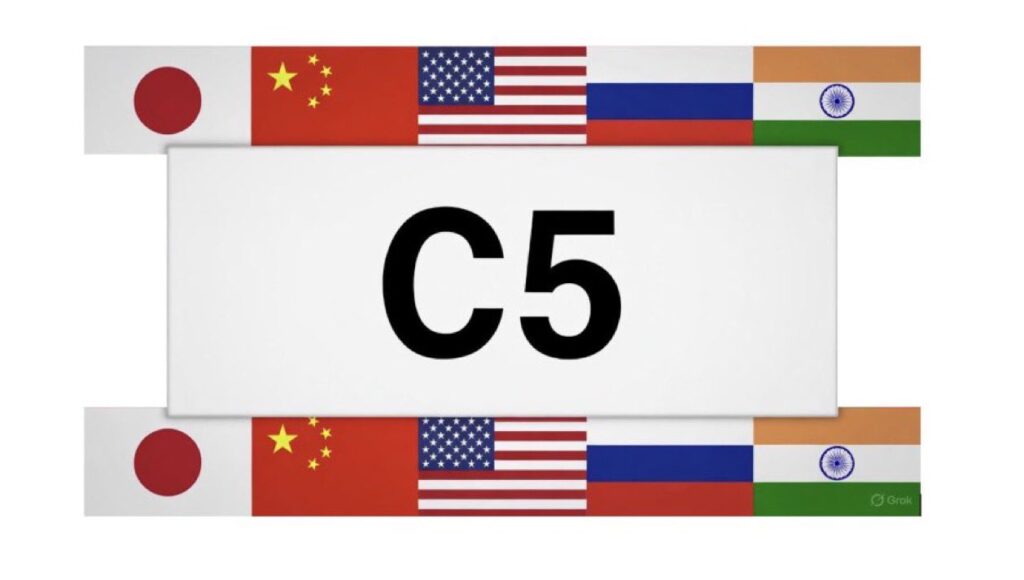
Image Credentials: Image Title: Trump Reportedly Weighing ‘Core Five’ Super-Club to Replace G7, Sidelining Europe Source: (Grok) Date: December 2025. Attribution: This image was created using AI-generated imagery (Grok) and does not depict a real-world scene.
By Open Chronicle Staff with Agencies
WASHINGTON D.C. — President Donald Trump is reportedly contemplating a radical overhaul of the global order, with details emerging of a plan to establish an exclusive “Core Five” (C5) grouping featuring non-traditional allies, designed to supersede the existing G7 alliance. The news comes amid unprecedented, scathing criticism from the U.S. government directed at European allies.
According to reporting from Defense One and Politico, the proposal is outlined in a longer, unpublished draft of the U.S. National Security Strategy (NSS). The White House, however, has publicly denied the existence of any alternative strategic document.
The ‘Core Five’: Power Over Principles
The alleged “Core Five” would consist of the United States, India, China, Russia, and Japan.
The key difference from the G7, analysts note, is that the C5 would abandon the criteria requiring member nations to be both wealthy and democratically governed. Instead, the focus is reportedly on major global powers defined by “hard power”, military might, population size, and economic weight—regardless of their political system.
The C5 would meet regularly for high-level summits, with its first reported agenda item being Middle East security, specifically focusing on normalizing relations between Israel and Saudi Arabia.
This concept aligns with President Trump’s earlier statements lamenting Russia’s expulsion from the G7 (then G8) and his desire to see China included in major international forums. If implemented, the C5 would be a seismic shift, elevating India to an elite diplomatic tier alongside the world’s major military and economic powers while engaging rivals Russia and China in a structured forum.
Europe Decries ‘Civilisational Erasure’ Warning
The reports of the C5 emerge in the wake of a public clash with European allies following the official release of the U.S. National Security Strategy. The official document caused shock across the continent with its pointed attack on European policy and sovereignty.
The NSS issued a broadside warning that Europe was facing “civilisational erasure” and that U.S. policy should include “cultivating resistance” within the European Union. The document painted European allies as weak, criticized their migration and free speech policies, and offered tacit support to far-right parties. European officials have slammed the document as hostile, with some calling it a “declaration of political war” that elevates European institutions as rivals rather than partners.
Security experts view the C5 idea as “very Trumpian,” reflecting a transactional, non-ideological worldview that favors cooperation among great powers to maintain spheres of influence, even at the expense of traditional alliances like NATO and the G7.
The reported C5 proposal, coupled with the harsh NSS rhetoric, signals the potential for a fundamental break with decades of U.S. foreign policy orthodoxy, forcing global allies and rivals alike to prepare for a severely reshaped geopolitical landscape.