
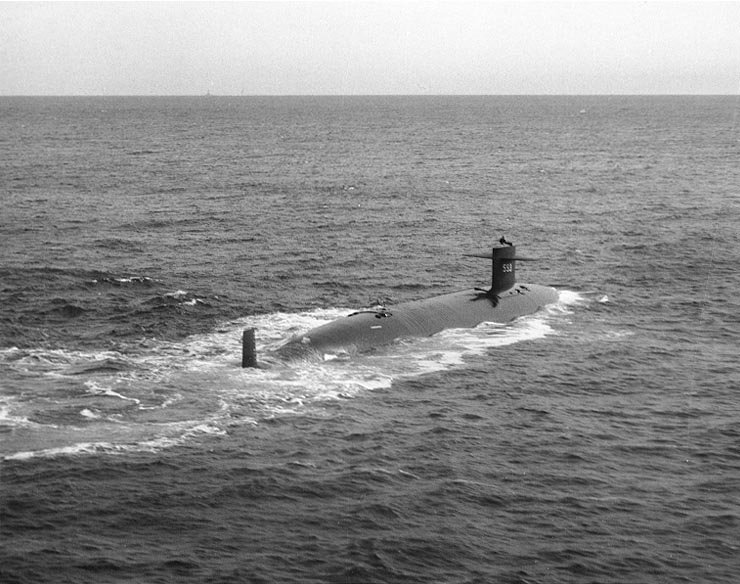
Image: USS Thresher (SSN-593), starboard quarter view, taken while the submarine was underway on 30 April 1961. Photographed by J.L. Snell – From the collections of the Naval Historical Center. USNHC # NH 97551.http://www.history.navy.mil/photos/images/h97000/h97551c.htm, Public Domain, (Wikipedia)
By José Carlos Palma
The worst submarine disaster in U.S. history, which claimed 129 lives, was caused by a devastating “tangle of errors” rather than a single mechanical failure, according to recently declassified archives.
In April 1963, the USS Thresher, the cutting-edge lead vessel of the U.S. Navy’s nuclear submarine fleet, sank during deep-sea trials, resulting in the loss of all 129 personnel on board. The 85-meter-long submarine was the pinnacle of Cold War naval technology, designed to be fast and silent to counter the Soviet threat.
The recent unsealing of archives—obtained through legal action by former commander James Bryant, has finally shed light on the chain of events that led to the catastrophe.
The Final Moments
During deep-sea trials, while descending to its test depth of 1,300 feet (approximately 400 meters), the Thresher signaled to its accompanying surface ships that it was experiencing “slight difficulties” and intended to purge its main ballast tanks to ascend.
A sound of escaping air was detected by the accompanying vessel, but then silence. The Thresher never resurfaced.
Initial theories speculated widely, ranging from construction flaws to fragile welds giving way under pressure, which would have caused a rapid flood and short-circuited the electrical equipment, thereby crippling propulsion. However, the new documents reveal a far more complex picture rooted in a chain of human and systemic failures.
The Chain of Errors
The investigation, detailed in an article by Popular Mechanics, uncovered that the disaster was not due to a single, fatal design flaw but rather an “entanglement of errors.”
-
Defective Welds: Defective soldered tubing likely failed under pressure, allowing seawater to rush into the engine room.
-
Inoperable Ballast System: Due to the flooding, the crew was unable to access the necessary equipment or operate the ballast tanks to expel the water and force the submarine to the surface.
-
Crew Training Deficiencies: The inquiry also highlighted a deficiency in crew training. In the rush of the Cold War arms race, crews were deployed too quickly, coupled with an overconfidence in the sophisticated engineering of the new nuclear submarines.
With the crew unable to seal the leak or surface, the Thresher lost control. In approximately five minutes, it exceeded its theoretical collapse depth. The hull began to deform and ultimately gave way: the submarine imploded, marking the worst submarine catastrophe in U.S. history.
The Birth of SUBSAFE
The tragedy served as a brutal wake-up call for the Navy, resulting in a crucial turning point. The Navy immediately institutionalized the SUBSAFE program.
SUBSAFE is an extraordinarily rigorous safety protocol and quality control certification system designed to minimize the risk of a fatal sinking. This protocol dictates strict standards for materials, construction, maintenance, and crew training for all critical systems related to hull integrity and the ability to surface.
The program’s success is undeniable: no other U.S. submersible has been lost since SUBSAFE’s implementation in 1968.
For historians like Norman Friedman and former commander James Bryant, the belated transparency has confirmed that the sinking was the result of systemic errors, not conspiracy. The archives were classified not to conceal the facts from the American public, but primarily to avoid providing the Soviet adversaries with sensitive technical details about the advanced nuclear submarine design.
The SUBSAFE program is one of the most successful and rigorous safety initiatives ever implemented by the U.S. Navy. It was born directly out of the loss of the USS Thresher in 1963.
🛡️ The SUBSAFE Program: Ensuring Submarine Survival
The purpose of the SUBSAFE program is to ensure that, in the event of any casualty (such as flooding, fire, or mechanical failure), a submarine retains the ability to return to the surface and the integrity of the hull is maintained.
This goes beyond standard quality control; it is a meticulous, all-encompassing certification process covering every critical component related to the submarine’s safety envelope.
Key Areas and Requirements
SUBSAFE requires mandatory certification for all components, maintenance, and repairs performed in the following five critical areas:
1. Hull Integrity and Structure
This is the foundational area, ensuring the submarine can withstand the immense pressure of deep diving.
-
Requirement: All parts of the pressure hull and anything attached to it must meet incredibly strict quality standards. This includes the welds, penetrations (where pipes or cables pass through the hull), and critical fasteners.
-
Improvement: The Thresher disaster highlighted faulty welds; SUBSAFE introduced procedures ensuring that every single weld on critical systems is inspected, documented, and tested, often via non-destructive testing (NDT) methods like X-ray or ultrasound.
2. Main Ballast Tank (MBT) Systems
The MBT system is the primary means of controlling buoyancy and the crucial mechanism for making an emergency ascent. The Thresher‘s inability to blow its ballasts was a fatal flaw.
-
Requirement: Components must be designed and maintained to ensure that the ballast tanks can be rapidly and reliably purged (blown) with high-pressure air to expel water, even in the event of power loss or flooding.
-
Improvement: Emphasis is placed on the reliability of the Emergency Blow System components, ensuring they are protected from seawater intrusion and can operate under all foreseen casualty conditions.
3. Submarine Piping Systems
These systems include all critical pipes that penetrate the pressure hull and carry sea pressure (e.g., seawater systems).
-
Requirement: Piping must have proper isolation valves to prevent uncontrolled flooding. All pipes that can connect the high-pressure external sea environment to the lower-pressure internal environment must be certifiably robust.
-
Improvement: This directly addressed the likely cause of the Thresher sinking, where a failed pipe or fitting in the engine room allowed catastrophic flooding.
4. Electrical Cable Penetrations and Boundary Integrity
Where electrical cables or wires pass through the hull or pressure-retaining bulkheads, the integrity of the seal must be absolute.
-
Requirement: Seals, glands, and connectors must be designed to withstand full ocean pressure and prevent both water leakage and electrical short-circuits, which can disable controls.
5. Material Control and Certification
Beyond the physical parts, the administrative process is rigorous.
-
Requirement: Every piece of material used in a SUBSAFE-certified system must be meticulously tracked, documented, and verified to meet specifications, from the supplier’s mill to the point of installation. Traceability is paramount.
Impact and Legacy
The implementation of SUBSAFE transformed the Navy’s submarine program from a focus on speed and technology to an uncompromising focus on safety and reliability. The program requires extensive documentation, rigorous personnel training (addressing the human error aspect of the Thresher loss), and a culture where safety takes precedence over schedules or cost.
The legacy of the Thresher is evident in the subsequent safety record: the loss of the USS Scorpion in 1968 was the last non-SUBSAFE-certified submarine lost by the U.S. Navy. Since 1968, the certification program has maintained a flawless record for preventing the fatal sinking of any certified vessel.
References (Bibliography)
-
Bryant, James. Thresher: The Death of a Nuclear Submarine. [This represents the book or source published by the former commander who successfully sought declassification of the archives].
-
Friedman, Norman. U.S. Submarines Since 1945: An Illustrated Design History. Annapolis, MD: Naval Institute Press.
-
Holzer, Robert. “The USS Thresher Tragedy and the Birth of SUBSAFE.” Naval History Magazine (U.S. Naval Institute).
-
U.S. Navy Submarine Safety Program (SUBSAFE). Naval Sea Systems Command (NAVSEA) Documentation. [Reference to the official mandates and standards governing the program].
-
Various Authors. “Declassified documents reveal cause of USS Thresher sinking.” Popular Mechanics or a similar reputable publication. [Reference to the specific article that published the analysis of the newly released archives].