
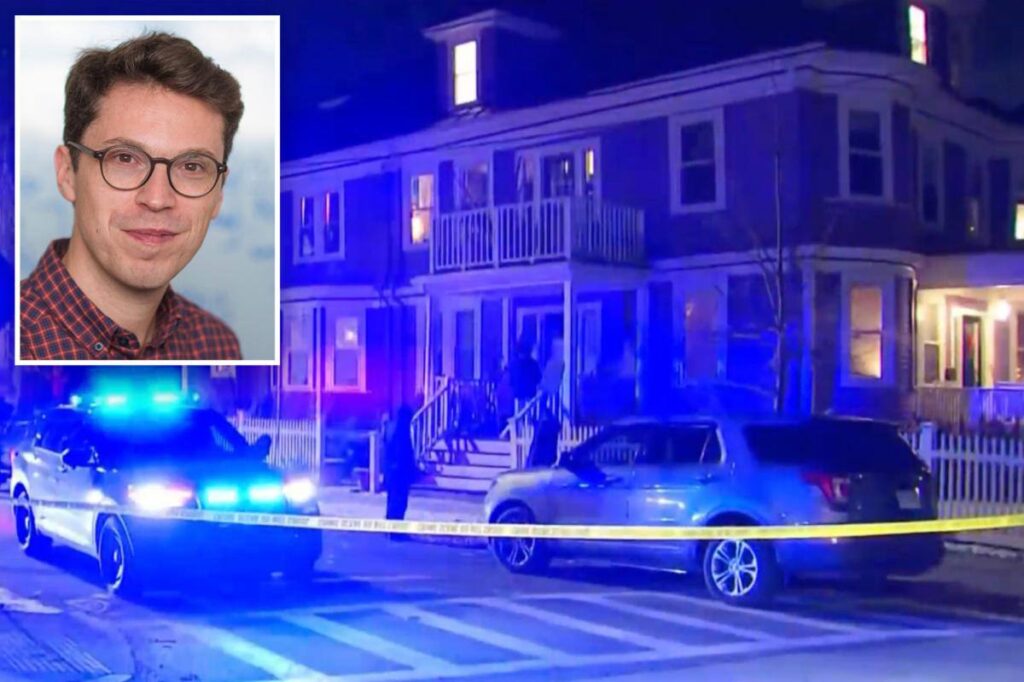
Image: from Monika X@Monika_is_His
By Open Chronicle Staff with Agencies
BROOKLINE, MA — A homicide investigation is underway after a leading Massachusetts Institute of Technology (MIT) professor and laboratory director was found shot to death in his Brookline residence late Monday night.
Nuno F.G. Loureiro, 47, the Director of MIT’s Plasma Science and Fusion Center, was transported to a local hospital on Monday night with apparent gunshot wounds after the Brookline Police Department responded to a report of a man shot at his home, according to the Norfolk District Attorney’s Office.
Professor Loureiro was pronounced dead on Tuesday morning.
The case is being treated as an active and ongoing homicide investigation, led by the Massachusetts State Police. As of Tuesday evening, the suspect in the shooting remains at large.
MIT’s communications office confirmed Loureiro’s prominent role within the university. He was a faculty member in both the Departments of Nuclear Science & Engineering and Physics, in addition to directing the Plasma Science and Fusion Center.
“Our deepest sympathies are with his family, students, colleagues, and all those who are grieving,” stated MIT spokesperson Kimberly Allen. “Focused outreach and conversations are taking place within our community to offer care and support for those who knew Prof. Loureiro, and a message will be shared with our wider community.”
Out of respect for the integrity of the ongoing investigation, MIT has stated it will not release any further information at this time.
Professor Loureiro was a globally respected figure in the field of plasma physics and fusion energy. His academic career spanned multiple continents and prestigious institutions:
-
Education: He majored in physics at the Instituto Superior Técnico in Lisbon, Portugal (2000), and earned his doctorate in physics from Imperial College London, UK (2005).
-
Postdoctoral Work: He completed research fellowships at the Princeton Plasma Physics Laboratory (2005–2007) and the UKAEA Culham Centre for Fusion Energy (2007–2009).
-
MIT Tenure: Loureiro joined MIT in 2016, following his work as a researcher at the Institute for Plasmas and Nuclear Fusion at IST Lisbon.
Loureiro’s research focused on the theory and computational modeling of nonlinear plasma dynamics. His group utilized analytical tools and state-of-the-art simulations to study crucial phenomena like magnetic reconnection, turbulence, and related instabilities. He was also a pioneer in using emerging computational methods for plasma research, including machine learning and quantum computing.
His exceptional contributions were recognized through numerous accolades, including:
-
2015: American Physical Society Thomas H. Stix Award for Outstanding Early Career Contributions to Plasma Physics Research.
-
2017: National Science Foundation Career Award.
-
2022: Ruth and Joel Spira Award for Excellence in Teaching in MIT’s School of Engineering.
-
2025: Presidential Early Career Award for Scientists and Engineers.
Police urge anyone with information related to the case to contact the Massachusetts State Police or the Brookline Police Department.
Professor Nuno F.G. Loureiro was a leading figure in the theoretical and computational modeling of plasma physics, specializing in dynamics critical for the development of fusion energy.
His work was fundamental to understanding the behavior of the extremely hot, ionized gas known as plasma—often called the fourth state of matter—which is the medium required for sustained fusion reactions.
Loureiro’s research group at MIT’s Plasma Science and Fusion Center focused on several interrelated, complex phenomena:
1. Magnetic Reconnection
This was one of the central pillars of his work. Magnetic reconnection is a physical process that occurs in highly conducting plasmas where magnetic energy is converted into kinetic energy and heat. This process is crucial because it can be both destructive (e.g., triggering solar flares and geomagnetic storms in space) and essential (e.g., initiating the burning process in laboratory fusion reactors).
-
Methodology: His group used advanced analytical tools and state-of-the-art computational simulations to study how magnetic field lines rapidly break and reconnect, releasing massive amounts of energy.
2. Plasma Turbulence and Instabilities
Loureiro investigated plasma turbulence, which refers to the chaotic, random motions within plasma. Controlling and understanding turbulence is vital because it causes energy and particles to escape the magnetic confinement necessary for fusion reactors (like tokamaks).
-
Focus: His research sought to identify and model the various instabilities that lead to this turbulence, aiming to develop methods to mitigate these losses and improve confinement efficiency.
3. Advanced Computational Methods
Recognizing the immense complexity of plasma behavior, Professor Loureiro was an advocate and pioneer in applying emerging computational techniques to the field.
-
Techniques: He pursued the use of machine learning to analyze vast amounts of simulation data and accelerate modeling, as well as the potential application of quantum computing for tackling previously intractable plasma dynamics problems.
The underlying goal of much of his research was to contribute to the global effort to harness nuclear fusion—the same process that powers the sun—as a clean, nearly limitless energy source on Earth. By providing a deeper theoretical understanding of plasma control, confinement, and heating, his work was considered essential groundwork for building commercially viable fusion power plants.
Professor Loureiro, who was the Director of MIT’s Plasma Science and Fusion Center, died Tuesday morning at a local hospital after being shot multiple times at his Brookline home on Monday night, December 15, 2025.
Investigation Status
The Norfolk District Attorney’s Office and the Massachusetts State Police, leading the investigation, are providing only limited information as the case develops.
-
Suspect Status: Authorities have confirmed that no arrests have been made, and the suspect remains at large.
-
Location: Police responded to reports of gunshots around 8:33 p.m. Monday at an apartment on 9 Gibbs Street in Brookline, where Professor Loureiro was found wounded in the building’s foyer.
-
Motive: A source has indicated that the potential motive for the shooting is currently unknown, and “everything is still on the table.”
Neighbors expressed shock and concern that such an incident could occur in the typically safe community of Brookline. Some neighbors have questioned whether Professor Loureiro might have been specifically targeted, though authorities have not released any information to support this theory.
MIT has confirmed that Professor Loureiro was a highly respected faculty member in the Departments of Nuclear Science & Engineering and Physics.
“Our deepest sympathies are with his family, students, colleagues, and all those who are grieving,” an MIT spokesperson said in a statement. The university is actively providing outreach and support services to those in the community who knew Professor Loureiro.
Police are urging anyone with any information, no matter how small, to contact the Massachusetts State Police or the Brookline Police Department to assist with this ongoing homicide investigation.