
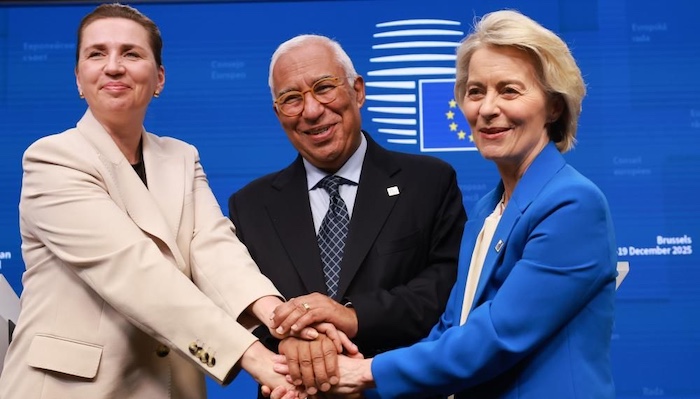
Image: from ARISE NEWS X@ARISEtv
By Open Chronicle Staff with Agencies
Following intense negotiations in Brussels, European Union leaders reached a landmark agreement early Friday to provide Ukraine with a €90 billion loan package. The funding is designed to stabilize Kyiv’s economy through 2026 and 2027, resolving a critical budget shortfall that threatened to undermine the country’s wartime resilience.
In a shift from previous proposals, the EU has abandoned immediate plans to seize or directly use frozen Russian central bank assets to fund the loan. Instead, the bloc will raise the €90 billion on capital markets, utilizing the common EU budget as collateral.
Key terms of the agreement include:
- Repayment Structure: The loan is interest-free for Ukraine. Repayment is deferred until Russia pays formal war reparations.
- Asset “Backstop”: Approximately €210 billion in Russian central bank reserves will remain frozen in the EU. These assets serve as a long-term guarantee; if Russia refuses reparations, the assets will be utilized to settle the debt.
- Enhanced Cooperation: To bypass opposition, the loan uses a mechanism allowing reluctant states—specifically Hungary, Slovakia, and the Czech Republic to opt out of financial liabilities and interest payments.
The agreement follows months of legal deadlock. Belgium, which holds the vast majority of the frozen reserves (€185 billion), raised significant concerns regarding financial stability and legal liabilities. Prime Minister Bart De Wever praised the final deal for avoiding “chaos and division” within the union.
German Chancellor Friedrich Merz noted that while the timeline for using Russian funds has shifted, the principle remains intact. “The assets remain a backstop,” Merz stated. “If Russia refuses to pay reparations, they will be used.”
- Ukraine: President Volodymyr Zelenskyy welcomed the “financial security guarantee,” noting that it strengthens Ukraine’s resilience for the coming years.
- Russia: Envoy Kirill Dmitriev characterized the EU’s decision to drop the direct seizure as a win for “law and sanity,” dismissing the original plan as illegal.
- EU Leadership: Council President António Costa emphasized that the bloc has fulfilled its commitment to Kyiv, providing the necessary certainty required by international lenders like the IMF.
The €90 billion package covers two-thirds of Ukraine’s estimated €135 billion financial requirement for the next two years. Brussels is now turning to international allies, including the United Kingdom, Norway, and Canada, to provide the remaining €45 billion.
Without this intervention, international analysts warned that Ukraine could have faced a total financial collapse as early as April 2026.