
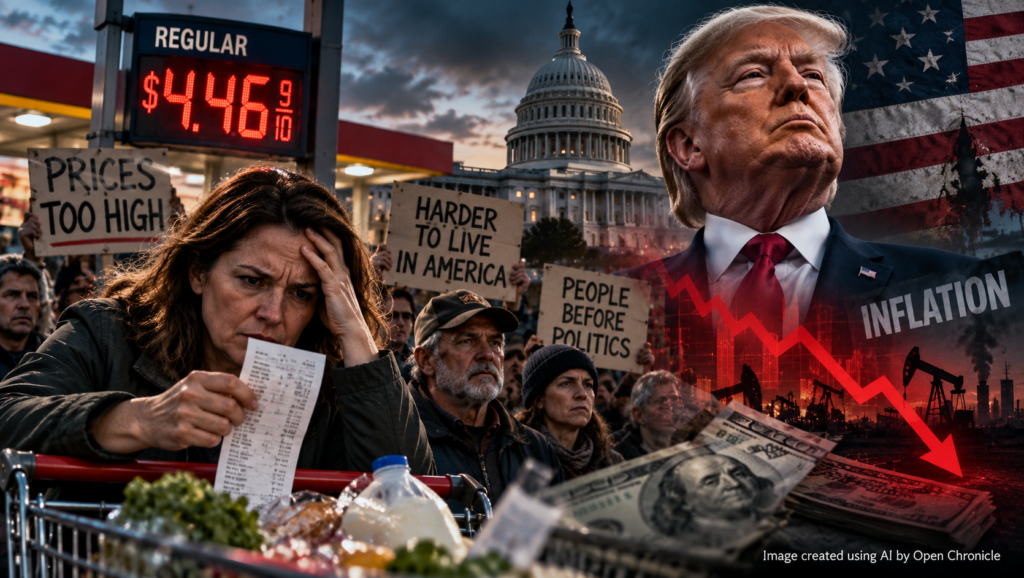
Americans’ confidence in the economy fell sharply in September to its lowest level in more than a decade, according to the Conference Board, as elevated prices, weak wage growth and economic uncertainty surrounding the Iran war weigh on households. The decline comes little more than a month before the US midterm elections.
By Open Chronicle with agencies | September 30, 2026
WASHINGTON — American consumer confidence deteriorated sharply in September, falling to its lowest level since 2014 as households confronted persistent inflation, high fuel prices and slowing wage growth.
The Conference Board said Tuesday that its consumer confidence index dropped 6.7 points to 81.9 in September from 88.6 in August.
The reading was the weakest recorded by the survey since April 2014 and fell below the lowest level registered during the COVID 19 pandemic.
The deterioration was evident both in assessments of current economic conditions and expectations for the months ahead.
Confidence falls across major measures
The Conference Board’s measure of how consumers view their present situation declined 7.9 points to 109.3.
Expectations for the short term outlook also weakened, dropping 5.9 points to 63.6.
The figures suggest that economic anxiety is spreading beyond concerns about future conditions and increasingly affecting Americans’ perceptions of the economy today.
“The Consumer Confidence Index deteriorated notably in September, following two prior months of softening,” said Dana Peterson, chief economist at the Conference Board.
Peterson said consumers’ assessment of current business conditions became negative for the first time since September 2024.
High prices dominate household concerns
Responses collected by the Conference Board between September 1 and September 23 were predominantly pessimistic.
Consumers frequently cited the high cost of gasoline, goods and services.
Inflation has remained a major concern for American households after several years of elevated prices, while modest wage increases have made those costs more difficult for many families to absorb.
The latest government figures showed consumer prices rising 3.4 percent in August compared with the same month a year earlier.
Inflation also accelerated on a monthly basis.
Prices increased 0.4 percent from July to August, four times the 0.1 percent monthly increase recorded previously.
Iran war adds pressure to energy prices
The continuing war involving Iran has placed additional pressure on energy markets and contributed to higher fuel costs.
Gasoline prices currently average about $4.46 for a gallon of regular fuel, according to the supplied data.
The impact is particularly visible because fuel prices affect household budgets directly while also increasing transportation and distribution costs throughout the economy.
Gasoline is not the only category becoming more expensive.
Prices for appliances, vehicle repairs and wireless telephone services also increased in August.
Those increases are contributing to the sense among consumers that everyday expenses remain difficult to control.
Inflation has increased since Trump’s inauguration
President Donald Trump has continued to attribute high prices to policies implemented under his predecessor, Joe Biden.
However, the supplied figures show that inflation has increased since Trump returned to office in January 2025.
The Federal Reserve’s preferred inflation measure, the personal consumption expenditures price index, was 2.5 percent when Trump was inaugurated.
It stood at 2.8 percent before the Iran war began on February 28 and reached 3.7 percent in June compared with a year earlier.
That represented an improvement from the 4.1 percent annual increase recorded in May, but inflation remained substantially above its level before the beginning of the conflict.
The government is scheduled to publish August PCE figures on Wednesday.
Federal Reserve responds with higher interest rates
Persistent inflation has already prompted action from the Federal Reserve.
Two weeks ago, the central bank raised its benchmark interest rate for the first time since 2023.
The quarter point increase brought the Fed’s key rate to approximately 3.9 percent.
Federal Reserve officials also indicated that another increase could occur later this year if inflationary pressure remains elevated.
Higher interest rates are intended to restrain inflation by cooling demand across the economy.
For households, however, they can also increase borrowing costs.
Mortgages, automobile loans and credit card borrowing could gradually become more expensive as the effects of the higher benchmark rate spread through financial markets.
That creates another potential source of pressure for consumers already dealing with higher everyday expenses.
Labour market sentiment also deteriorates
Americans also became less optimistic about the labour market during September, although the Conference Board said perceptions remained in positive territory.
Survey respondents generally continued to expect their household incomes to increase, but their expectations were weaker than in previous months.
The employment picture nevertheless showed signs of improvement during August.
US employers added a stronger than expected 162,000 jobs, ending a summer characterised by relatively weak hiring.
The unemployment rate remained at 4.1 percent.
However, the supplied data notes that part of the relatively low unemployment rate can be attributed to people leaving the labour force after giving up their search for employment during previous months.
The government’s September employment report is scheduled for release on Friday.
Wage growth loses momentum
For many households, the interaction between wages and prices remains particularly important.
Average hourly earnings increased 3.1 percent in August compared with a year earlier.
That was the weakest annual increase in wages since May 2021.
When wages grow slowly while consumer prices remain elevated, households can experience increasing pressure on their purchasing power even if employment remains relatively strong.
That helps explain why economic sentiment can deteriorate despite continued job creation and a relatively low headline unemployment rate.
After five years of elevated inflation, many consumers are evaluating economic conditions based not simply on whether inflation is slowing, but on the cumulative increase in the cost of living.
Economic concerns carry political significance
The decline in consumer confidence comes at a politically sensitive moment.
The US midterm elections are a little more than a month away and will determine control of Congress.
Inflation and household finances are therefore likely to remain central subjects during the final weeks of campaigning.
The economic environment presents a challenge for Trump and congressional Republicans as voters assess the administration’s handling of prices, employment and the consequences of the Iran war.
At the same time, Republicans continue to argue that the inflation problem has roots in economic policies implemented during the Biden administration.
The Conference Board survey does not determine how voters will respond politically. It does, however, provide evidence of widespread deterioration in public perceptions of economic conditions.
Two major economic reports now in focus
Financial markets and policymakers will receive additional evidence about the health of the US economy this week.
The August PCE inflation report is due Wednesday and will provide an updated reading of the price measure most closely watched by the Federal Reserve.
The September employment report will follow on Friday.
Together, those releases could influence expectations surrounding the Federal Reserve’s next interest rate decision.
If inflation remains stubbornly elevated while employment continues to expand, policymakers could have greater justification for another rate increase.
A significant weakening of the labour market, however, would complicate that decision.
For American households, the September confidence survey already provides a clear indication of the prevailing mood.
Despite continued job creation and expectations of rising household income, consumers are becoming increasingly uneasy about the economy.
With gasoline averaging $4.46 a gallon, wage growth at its weakest annual pace in more than five years and inflation remaining elevated, Americans entered the final weeks before the midterm elections considerably less confident about their economic circumstances than they were only a few months ago.