
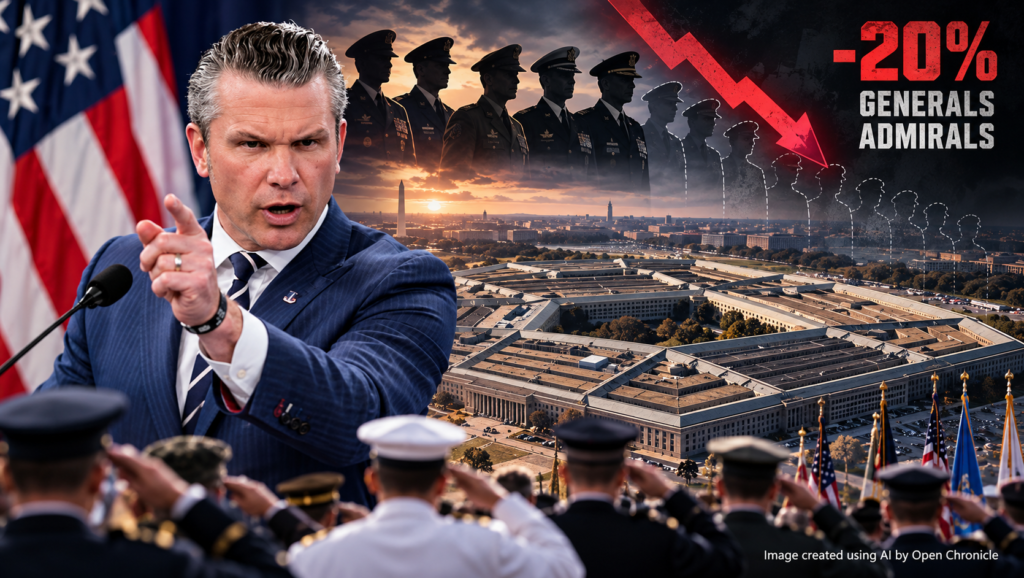
US Defense Secretary Pete Hegseth is preparing a major reduction in senior military leadership positions, with the Pentagon expected to cut approximately 20 percent of positions designated for generals and admirals across the armed forces. The restructuring expands an effort already underway to reduce senior command structures and redirect resources toward operational forces.
By Open Chronicle with agencies | September 30, 2026
WASHINGTON — US Defense Secretary Pete Hegseth is expected to announce a 20 percent reduction in positions designated for generals and admirals as part of a broader restructuring of the Pentagon’s senior military leadership.
The reductions are expected to affect leadership positions across the Army, Navy and Air Force and represent a significant expansion of Hegseth’s campaign to reduce the number of senior officers within the American military.
Two Pentagon officials confirmed the planned announcement, which Hegseth is expected to make Wednesday during his State of the Force address at Quantico, Virginia.
The speech will be delivered at the Marine Corps base to junior officers and enlisted leaders, with Hegseth expected to outline his priorities for the Defense Department over the coming months.
Pentagon targets senior command structure
The planned reductions are part of Hegseth’s broader effort to reshape the Pentagon’s leadership structure.
According to the supplied information, the military services have been asked to implement the reductions by January 1.
Not every affected position will necessarily disappear completely. Some senior posts are expected to be downgraded rather than eliminated.
The changes would affect positions allocated to generals and admirals rather than simply imposing an identical reduction across every military organisation.
The Pentagon has presented the restructuring as an attempt to reduce unnecessary layers of senior command and move resources closer to operational forces.
An expansion of earlier cuts
The new initiative follows reductions ordered by Hegseth in May 2025.
At that time, he directed Pentagon leaders to reduce the number of active duty four star generals and admirals by at least 10 percent.
The order also called for the number of general officers in the National Guard to be reduced by at least 20 percent.
Across the military more broadly, Hegseth sought a 10 percent reduction in general and flag officers, meaning personnel holding ranks of one star or higher.
The latest proposal would expand that restructuring by targeting approximately one fifth of positions allocated to generals and admirals.
“Less Generals, more GIs”
Hegseth has argued that the military has accumulated excessive layers of senior leadership and headquarters bureaucracy.
His May directive described the objective as “Less Generals, more GIs.”
The Defense secretary said the Pentagon should shift resources away from what he described as “bloated headquarters elements” and toward American warfighters.
He also argued that eliminating redundant command structures was necessary to streamline military leadership.
The underlying argument is that a smaller senior command structure could make the armed forces more efficient while directing personnel and resources toward operational units.
Critics question the impact on military leadership
The restructuring has also generated concern over the potential loss of institutional experience and command capacity.
Senior military officers often accumulate decades of operational, strategic and organisational experience before reaching general or admiral rank.
Critics therefore question whether substantial reductions could remove experienced commanders or weaken the military’s ability to manage increasingly complex global responsibilities.
The debate extends beyond the number of authorised senior positions.
Hegseth has fired or pushed out more than two dozen senior military leaders since taking charge at the Pentagon, according to the supplied account.
Those personnel decisions have caused concern among lawmakers from both major political parties.
Susan Collins raises concerns
Republican Senator Susan Collins of Maine, chair of the Senate Appropriations Committee, expressed concern in July about the removal of senior military officers and the blocking of promotions for personnel at lower ranks.
“I find this deeply troubling,” Collins said during a Senate hearing.
“These are men and women who volunteered to serve our country and swore an oath to support and defend our Constitution.”
Her comments reflected broader congressional concerns about how rapidly senior leadership changes are being implemented and the potential consequences for military personnel management.
Randy George removal drew criticism
Republican Representative Austin Scott of Georgia, a member of the House Armed Services Committee, also raised concerns earlier this year.
During an April hearing, Scott said Hegseth’s removal of General Randy George, the former US Army chief of staff, could have a “chilling effect” on the way the armed services operate.
The concern reflects a wider debate about the relationship between civilian political leadership and senior uniformed commanders.
Civilian control of the military is a fundamental principle of the American system, and senior officers ultimately serve under elected civilian authority.
At the same time, lawmakers have questioned whether repeated dismissals could make commanders more cautious about providing military advice that conflicts with political preferences.
Promotions also affected
The restructuring has extended into the military promotion system.
Hegseth has blocked promotions involving officers selected for advancement to one star and two star ranks.
He has defended those decisions by emphasising that senior military leaders serve at the pleasure of the president.
The combination of blocked promotions, senior officer removals and planned reductions in authorised positions represents a substantial reshaping of the Pentagon’s leadership structure.
The long term effect will depend partly on which positions are eliminated, which are downgraded and how responsibilities are redistributed among the remaining commands.
Quantico speech will outline next phase
Hegseth’s State of the Force address at Quantico is expected to provide further details about the restructuring.
The Pentagon is requiring personnel attending the speech to comply with waist to height requirements and maintain what the department describes as “impeccable” grooming standards.
Those requirements reflect Hegseth’s broader emphasis on military standards, physical readiness and discipline.
The leadership reductions, however, are expected to be among the most consequential elements of the address.
A broader effort to reshape the Pentagon
The proposed 20 percent reduction signals that Hegseth intends to continue restructuring the senior ranks rather than treating the previous cuts as a one time adjustment.
Supporters of the approach argue that modern armed forces do not necessarily require the number of senior command positions accumulated over decades of organisational expansion.
Reducing headquarters structures, they argue, could free resources for combat units, equipment, training and readiness.
Concerns raised by lawmakers focus instead on the potential consequences of losing experienced commanders, disrupting promotion pathways and creating uncertainty within the officer corps.
The scale of the impact will become clearer once the Pentagon identifies which positions will disappear and which will be downgraded.
With implementation expected by January 1, the US military could enter 2027 with a substantially different senior command structure as Hegseth’s overhaul moves into its next phase.