
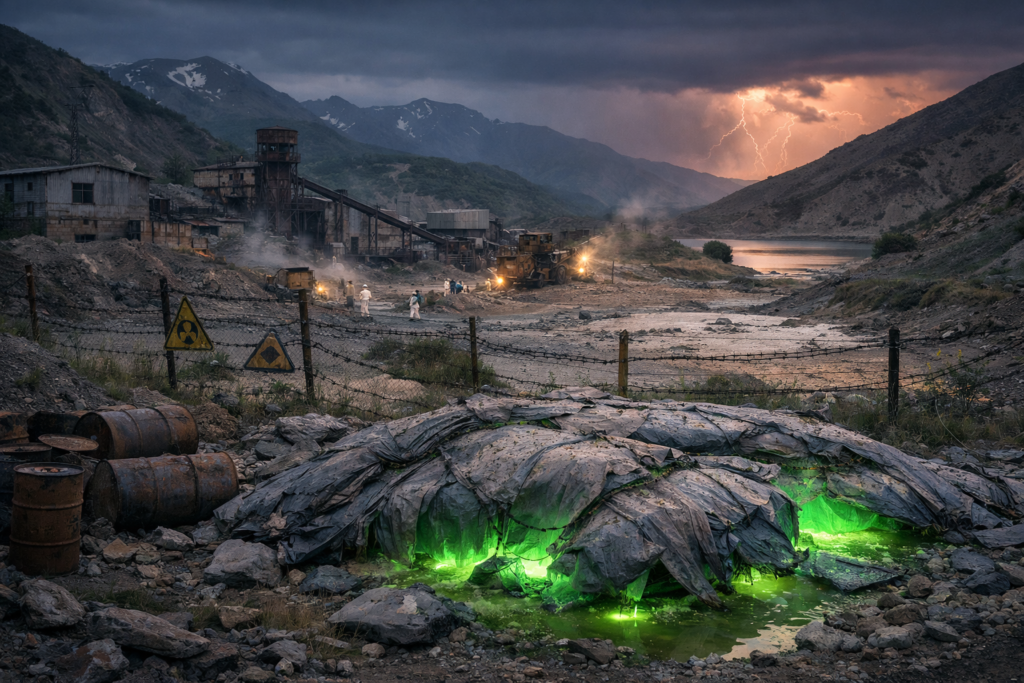
Image Credentials: Image Title: Underground and in the Shadows: Uzbekistan’s Radioactive Soviet LegacySource: (sora.openai) Date: December 2025. Attribution: This image was created using AI-generated imagery (sora.openai) and does not depict a real-world scene.
By Elliot Hayes | Senior Editor | December 21, 2025
TASHKENT — Decades after the fall of the Soviet Union, Uzbekistan continues to grapple with a silent, glowing inheritance: millions of tons of radioactive waste. While the government has launched ambitious remediation projects at sites like Yangiabad and Charkesar, experts warn that a lack of transparency and a changing climate are turning these “conserved” facilities into a ticking humanitarian and transboundary time bomb.
The Ministry of Ecology recently announced the completion of physical remediation at the Yangiabad site in August 2025. However, for the communities living in the shadow of these mountains, the “completion” of a project does not always mean the end of the risk.
The Geography of Risk
Uzbekistan was once a cornerstone of the Soviet nuclear complex, supplying the raw uranium that fueled the USSR’s military and energy ambitions. Today, that history is written in “tailings”, vast pits of sand-like waste that contain 85% of the original ore’s radioactivity.
-
Yangiabad: Located 70km from Tashkent in a seismically active zone, this site contains 2.6 million cubic meters of waste.
-
Charkesar: A village still home to 3,500 people, where uranium was mined until 1995.
-
Navoi Region: The heart of modern Uzbek uranium production, which the government aims to double to 7,100 tons by 2030, raising fresh concerns about new waste management.
The “Rebound Effect” and Hidden Contamination
Nuclear physicist Andrei Ozharovsky and other independent researchers point to a “rebound effect” in remediated areas. Even when contaminated water is pumped out or flushed, uranium often remobilizes from the surrounding rock back into the groundwater due to long-term chemical instability.
Unlike acute radiation accidents, the danger here is chronic and internal. Prolonged exposure through drinking water or irrigation is linked to:
-
Nephrotoxicity: Serious kidney damage caused by uranium’s chemical toxicity as a heavy metal.
-
Cancer Clusters: Elevated rates of lung and stomach cancer in populations living near unmonitored tailing ponds.
“Tailings left without long-term oversight inevitably degrade,” Ozharovsky warned. “Protective layers erode, dams age, and groundwater pathways change. Without open maps and monitoring, it is impossible to assess the real risk.”
A Transboundary Climate Threat
The risk is no longer contained within Uzbekistan’s borders. The Syr Darya river basin, the agricultural heart of Central Asia, is at risk of contamination if any legacy dam fails.
The U.N. Economic Commission for Europe has identified these sites as a regional threat. As climate change increases the frequency of extreme rainfall and mudflows in the mountains, the likelihood of a “tailing spill” that could poison water supplies as far downstream as Kazakhstan has moved from a theoretical fear to a contemporary security concern.
A central tension exists between the state’s need for security and the public’s right to know. In August 2025, videos from “urban explorers” entering abandoned mines in Yangiabad went viral, forcing authorities to clarify that the sites were being sealed.
Political scientist Elyor Usmanov notes that while secrecy is a global standard for preventing the theft of radioactive materials for “dirty bombs,” it often goes too far, blocking essential environmental data.
| Remediation Progress (2025) | Status |
| Charkesar-2 | Completed (Aug 2024) |
| Yangiabad | Completed (Aug 2025) |
| Uchkuduk | Ongoing monitoring |
| Public Data Access | Highly Restricted |
While Germany’s handling of the Wismut mines is cited as the gold standard for long-term responsibility, Uzbekistan remains reliant on international grants from the EBRD and the EU. Despite a robust regulatory framework, including the recent Presidential Decree UP-224 (2024) creating a dedicated nuclear safety committee, independent oversight remains extremely rare.
As Uzbekistan looks toward a future that includes planned nuclear power plants in the Jizzakh region, the ghosts of its radioactive past serve as a stark reminder, remediation is not a one-time event, but a multi-generational commitment to transparency and safety.
Bibliography
- Cabinet of Ministers of the Republic of Uzbekistan. 2022. “On Measures to Further Improve the System of Ensuring Radiation and Nuclear Safety” [Resolution No. 76]. Tashkent, February 2022.
- EBRD (European Bank for Reconstruction and Development). 2025. “Environmental Remediation Account for Central Asia: Project Status Update for Yangiabad and Charkesar.” London: EBRD. https://www.ebrd.com.
- Fayzieva, Khurshida. 2025. “Underground and in the Shadows: How Uzbekistan Lives With Its Radioactive Legacy.” The Diplomat, December 18, 2025. https://thediplomat.com.
- IAEA (International Atomic Energy Agency). 2025. “Safe Remediation of Uranium Legacy Sites in Central Asia.” Vienna: IAEA. https://www.iaea.org.
- Ozharovsky, Andrei. 2025. “Absence of Public Monitoring Data Increases Environmental Risks in Uzbekistan.” Interview by UCA News, December 15, 2025.
- President of the Republic of Uzbekistan. 2024. “On the Establishment of the Committee for Industrial, Radiation, and Nuclear Safety” [Decree No. UP-224]. Tashkent, 2024.
- UN Economic Commission for Europe (UNECE). 2024. “Syr Darya Basin: Assessment of Transboundary Water-Food-Energy-Ecosystems Nexus.” Geneva: United Nations.