
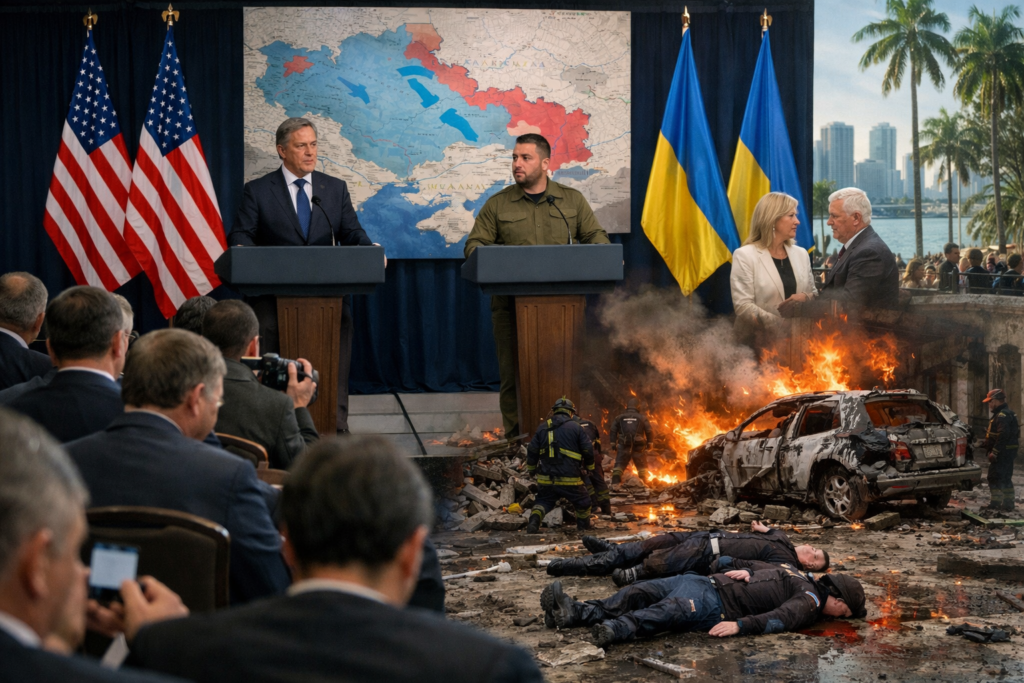
Image Credentials: Image Title: Diplomacy Under Fire: Ukraine and US Unveil Revised 20-Point Peace Plan Amid Moscow Bombings Source: (sora.openai) Date: December 2025. Attribution: This image was created using AI-generated imagery (sora.openai) and does not depict a real-world scene.
By Open Chronicle Staff | December 25, 2025
KYIV / WASHINGTON — In a high-stakes attempt to break a four-year stalemate, Ukraine and the United States have made public a revised 20-point peace plan following intensive negotiations in Miami. The proposal, which suggests a radical redrawing of the region’s economic and security architecture, comes at a moment of extreme volatility: just as a second deadly bombing in three days rocked Moscow, killing two police officers.
The “Miami Framework”: A New Vision for Sovereignty
The updated plan represents a significant shift in the American approach under the Trump administration, moving toward “Article 5-style” security assurances and the preservation of a massive Ukrainian military.
-
Military Strength: Unlike earlier drafts that suggested demilitarization, the new plan allows Ukraine to maintain an army of 800,000 personnel, ensuring the nation remains a potent military power in Europe.
-
Security Guarantees: Ukraine would receive robust, legally binding security guarantees from the US, NATO, and European allies, effectively granting it the protection of NATO’s collective defense without formal membership in the immediate term.
-
Economic Integration: The plan fast-tracks EU membership and a Free Trade Agreement with the US, positioning Ukraine as a central economic hub.
The “Free Economic Zone” Strategy
The most innovative and controversial aspect of the plan involves the occupied eastern territories. President Volodymyr Zelenskyy noted that a “Free Economic Zone” (FEZ) could serve as a “potential option” to resolve the deadlock over the Donbas.
“A demilitarised zone or a free economic zone could potentially resolve the stalemate,” Zelenskyy stated, though he emphasized that any such change to the sovereign state would require a national referendum.
An FEZ would allow these regions to operate under relaxed customs and tax regulations, potentially incentivizing reconstruction and reintegration through commerce rather than combat.
A 20-Point Roadmap to Stability
| Point | Key Provision | Status/Detail |
| 1-3 | Sovereignty & Security | Reaffirmed sovereignty; non-aggression pact; Article 5-style guarantees. |
| 4 | Army Size | Maintained at 800,000 troops. |
| 7-10 | Economic Path | EU membership, US Free Trade Agreement, Global Development Package. |
| 12 | Zaporizhzhia NPP | Unresolved. US proposes a 3-way consortium (US, UA, RU) with US management. |
| 14 | Territory | Unresolved. Russia wants the whole East; Kyiv wants the current lines; the US suggests FEZ. |
| 19 | Peace Council | Legally binding agreement overseen by a council chaired by Donald Trump. |
The Moscow Factor: Shifting the Narrative
The release of the plan coincides with a surge in “rear-guard” violence within Russia. On Wednesday, two police officers were killed in a Moscow bombing, following the assassination of a high-ranking general on Monday.
Analysts suggest that these incidents, although not officially claimed by Kyiv, may be a strategic move to demonstrate that Ukraine remains capable of striking the Russian heartland, thereby strengthening its hand at the negotiating table. “It’s a way of showing they are still on the offensive even while talking peace,” noted correspondent Ivor Bennett.
Unresolved Sticking Points
Despite “bringing positions closer,” two major hurdles remain:
-
Territorial Integrity: Russia continues to demand regions it has not fully captured, while Ukraine refuses to cede land.
-
Zaporizhzhia Nuclear Plant: The US proposal for a joint stakeholder management consortium among the US, Ukraine, and Russia has yet to be accepted by President Zelenskyy.
The plan now awaits a high-level meeting between Zelenskyy and Trump to address these “sensitive issues” at the leaders’ level.