
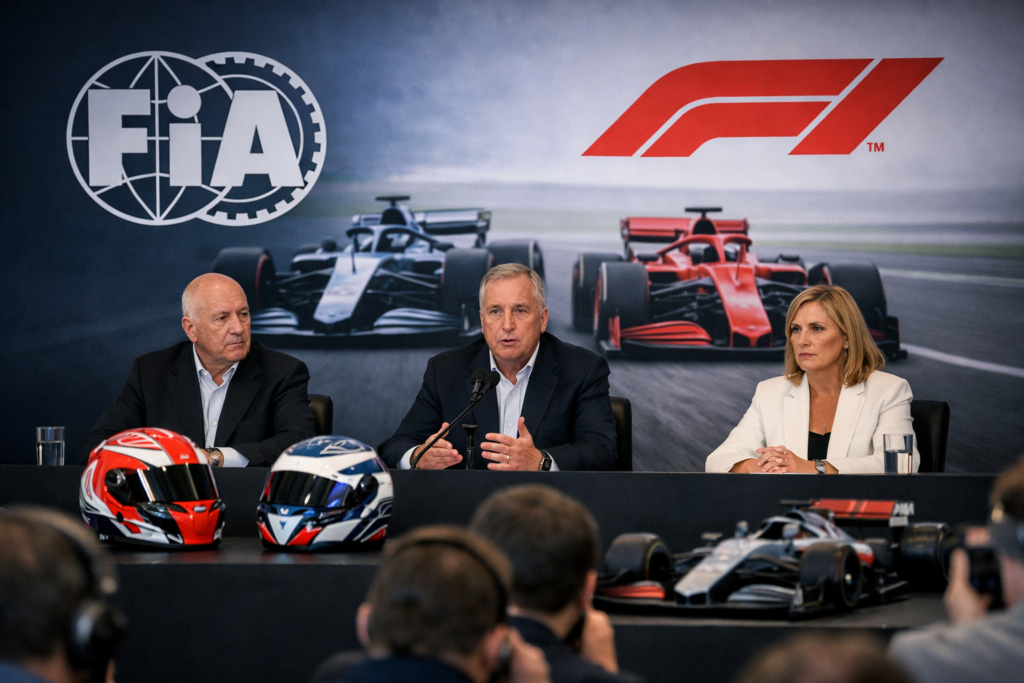
Image Credentials: Image Title: 2025 Formula One Technical Regulations: Weight Adjustments Source: (sora.openai) Date: December 2025. Attribution: This image was created using AI-generated imagery (sora.openai) and does not depict a real-world scene.
The 2025 Formula One technical regulations introduced specific amendments to the minimum weight requirements for both drivers and cars. These changes were ratified by the FIA World Motor Sport Council and the Formula One Commission with the primary objective of enhancing driver health and ensuring a more equitable playing field for athletes of different physical statures.
Background and Rationale
Historically, Formula One drivers have faced immense pressure to maintain extremely low body weights to provide engineers with more “ballast” to optimize the car’s center of gravity. This often led to unhealthy dieting and dehydration practices.
In 2019, a standard driver weight (including seat and equipment) was established at 80 kg to mitigate this. However, as cars became more complex and physically demanding, taller and heavier drivers remained at a relative disadvantage. The 2025 adjustment serves as a further refinement to accommodate the physical diversity of the grid.
Technical Specifications
Driver Weight Allowance
The mandated minimum weight for a driver, which includes their racing suit, helmet, HANS device, and seat, has been increased:
-
Pre-2025: 80 kg (176.4 lb)
-
2025 Regulation: 82 kg (180.8 lb)
If a driver weighs less than this 82 kg limit, the team must install ballast (typically tungsten plates) in a specific area of the cockpit defined by the FIA. This ensures that lighter drivers do not gain a performance advantage by placing that weight elsewhere in the car.
Total Car Minimum Weight
To reflect the increase in driver allowance, the overall minimum weight of the car (excluding fuel) has been adjusted upwards:
-
Pre-2025: 798 kg (1,759 lb)
-
2025 Regulation: 800 kg (1,764 lb)
Impact on Driver Well-being
The additional 2 kg allowance is specifically targeted at “driver well-being.” By increasing the floor for driver weight, the FIA aims to:
-
Reduce Extreme Caloric Restriction: Drivers can maintain a healthier muscle mass and hydration level.
-
Support Taller Athletes: Drivers like Nico Hülkenberg or George Russell, who are naturally taller, are less penalized for their biological frame.
-
Safety: A healthier, well-hydrated driver is less prone to fatigue and maintains higher cognitive performance during high-G maneuvers.
Comparison of Changes
| Metric | 2024 Requirement | 2025 Requirement | Change |
| Minimum Driver Weight | 80 kg | 82 kg | +2 kg |
| Minimum Car Weight | 798 kg | 800 kg | +2 kg |
| Primary Goal | Performance Parity | Driver Well-being | Health & Equity |
Bibliography
Primary Sources
- Fédération Internationale de l’Automobile. 2025 Formula 1 Technical Regulations. Issue 1. Paris: FIA, 2024. https://www.fia.com/regulation/category/110.
- Formula One Commission. “Decisions of the F1 Commission Regarding 2025 Technical Amendments.” News release, July 23, 2024. Formula 1 Official Website. https://www.formula1.com.
- Secondary Sources
- Cooper, Adam. “F1 Minimum Weight Increased to 800kg for 2025.” Autosport, July 23, 2024. https://www.autosport.com/f1/news/f1-minimum-weight-increased-to-800kg-for-2025/10637735/.
- Edmondson, Laurence. “F1 to Increase Minimum Weight for Drivers in 2025.” ESPN, July 24, 2024. https://www.espn.com/f1/.
- Noble, Jonathan. “F1 Commission Approves 2025 Technical Rule Changes.” Motorsport.com, July 23, 2024. https://www.motorsport.com/f1/news/f1-commission-approves-2025-technical-rule-changes/10637722/.
- Straw, Edd. “Why F1’s 2025 Weight Increase is a Health Victory for Drivers.” The Race, July 25, 2024. https://www.the-race.com/formula-1/f1-2025-weight-increase-driver-health/.
Back to 2025 Formula One Season Portal
Explore this subject
Continue exploring related Open Chronicle Encyclopedia entries through the categories associated with this article.

Staff Writers at Open Chronicle produce trusted journalism, strategic analysis and authoritative reference content across global affairs, geopolitics, defense, science, history, technology, business, culture and sport. Their work combines accurate reporting with historical perspective and analytical depth, helping readers understand not only what is happening, but why it matters. Beyond daily news coverage, Staff Writers contribute to the Open Chronicle Encyclopedia, investigative features, original research projects and long-form reports, building a comprehensive knowledge platform designed to inform, educate and preserve reliable information for a global audience.