
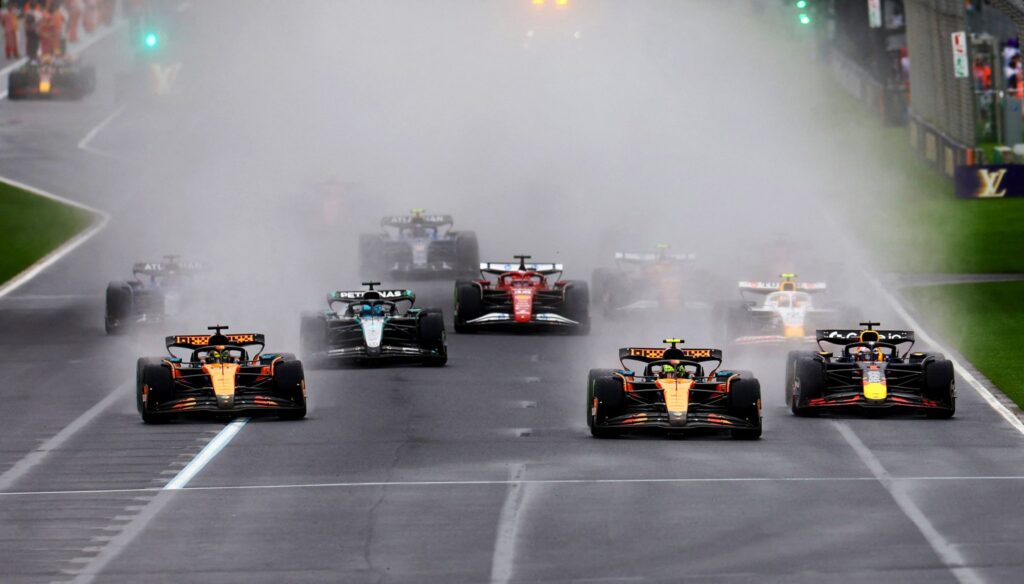
Image: from Daniel Valente X@F1GuyDan
The 2025 Formula One technical regulations saw a significant tightening of aero-elasticity controls, specifically targeting “flexible wings.”1 Through a series of Technical Directives (TD), the FIA introduced more stringent deflection tests for both front and rear wings. These measures were designed to eliminate the performance gains achieved through “mini-DRS” effects and ensure that aerodynamic surfaces remain structurally rigid under high aerodynamic loads.
Rear Wing Deflection and “Mini-DRS”
During the early stages of the 2025 season, several teams were scrutinized for designs that allowed the rear wing slot gap (the space between the mainplane and the flap) to widen at high speeds.2 This phenomenon, dubbed “mini-DRS,” reduced drag on straights without the driver activating the formal Drag Reduction System.
Slot Gap Restrictions
To counteract this, the FIA implemented a two-stage tightening of the deflection tests:
-
Initial 2025 Standard: The slot gap was restricted to a maximum deflection of 2 mm (0.079 in) when a load of 2 kN (450 lbf) was applied.
-
Chinese Grand Prix Amendment: Following further analysis of wing behavior, the tolerance was drastically reduced.3 From the Chinese Grand Prix onwards, the maximum allowable deflection under the same 2 kN load was set at just 0.5 mm (0.020 in).
This effectively mandated near-total rigidity of the rear wing flap connection, ensuring the slot gap remains constant regardless of aerodynamic pressure.
Front Wing Technical Directive
In addition to rear wing controls, the FIA addressed “flexible front wings,” which teams used to shift the aerodynamic balance of the car during high-speed cornering.
Spanish Grand Prix Directive
Following a four-month notice period (a “forewarned technical directive”), stricter tests were introduced for the Spanish Grand Prix:
-
Load Test: A force of 1 kN (220 lbf) is applied to the front wing endplates or specific chord points.
-
Deflection Limit: The maximum allowable movement was halved from 10 mm (0.39 in) to 5 mm (0.20 in).
This change required many teams to redesign the carbon fiber layup of their front wings to increase structural stiffness, preventing the wing tips from “diving” or rotating at high speeds to shed drag.
Summary of 2025 Flexibility Tests
| Component | Event Effective | Load Applied | Previous Limit | New 2025 Limit |
| Rear Wing (Slot Gap) | Season Start | 2 kN | N/A | 2.0 mm |
| Rear Wing (Slot Gap) | Chinese GP | 2 kN | 2.0 mm | 0.5 mm |
| Front Wing | Spanish GP | 1 kN | 10.0 mm | 5.0 mm |
Regulatory Philosophy
The FIA’s intervention in 2025 reflects a philosophy of “active policing” of aero-elasticity. Article 3.2.2 of the Technical Regulations states that all components influencing aerodynamic performance must be “rigidly secured” and “immobile.” By reducing deflection tolerances to sub-millimeter levels (0.5 mm), the FIA essentially eliminated the “grey area” teams had exploited to create variable-geometry wings through clever carbon fiber weave manipulation.
Key Technical Insights:
-
The “Mini-DRS” Crackdown: The reduction of the rear wing slot gap deflection to 0.5 mm is an extremely tight tolerance, designed to stop the “trick” where the gap opened slightly at high speed to dump drag without the actual DRS being active.
-
Carbon Fiber Engineering: These changes forced teams to rethink their “layup” (how they layer carbon fiber sheets). Making a wing that is light enough but stiff enough to pass a 2 kN load with almost zero movement is a major engineering challenge.
-
Phased Rollout: Notice how the FIA gave teams a four-month warning for the front wing changes at the Spanish GP. This allowed teams to manufacture new, stiffer wings without wasting budget on “illegal” parts mid-season.
2025 Technical Regulations: Master Summary Table
To help you organize your data, here is a consolidated view of the major technical shifts discussed:
| Feature | 2024 Standard | 2025 Regulation | Key Implementation |
| Driver Weight | 80 kg | 82 kg | Improved well-being |
| Minimum Car Weight | 798 kg | 800 kg | Adjusts for driver allowance |
| Heat Hazard Weight | N/A | +5 kg | Only when temp > 30.5°C |
| Gearbox Limit | 4 per season | Unlimited | Reliability renders the limit obsolete |
| DRS Slot Gap | 10–15 mm | 9.4–13 mm | Tighter closed-mode tolerance |
| RW Deflection | N/A | 0.5 mm @ 2 kN | Effective from the Chinese GP |
| FW Deflection | 10 mm @ 1 kN | 5 mm @ 1 kN | Effective from the Spanish GP |
Bibliography
Primary Sources
- Fédération Internationale de l’Automobile. 2025 Formula 1 Technical Regulations. Issue 2. Paris: FIA, 2024. https://www.fia.com/regulation/category/110.
- Fédération Internationale de l’Automobile. “Technical Directive TD034: Front and Rear Wing Deflection Limits.” Issued February 12, 2025.
- World Motor Sport Council. “Summary of Decisions: 2025 Technical and Sporting Amendments.” News release, December 2024. https://www.fia.com.
Secondary Sources
- Hughes, Mark. “The Engineering Behind F1’s 2025 Wing Flexibility Crackdown.” The Race, April 15, 2025. https://www.the-race.com/formula-1/2025-wing-flexibility-technical-analysis/.
- Noble, Jonathan. “FIA to Introduce Stricter Front Wing Tests from Spanish Grand Prix.” Motorsport.com, May 20, 2025. https://www.motorsport.com/f1/news/fia-stricter-front-wing-tests-spanish-gp/10654432/.
- Somerville, Craig. “Understanding the Mini-DRS: How Teams Exploited the Slot Gap.” F1 Technical, March 2025. https://www.f1technical.net/features/2025-mini-drs-explained/.
Back to 2025 Formula One Season Portal
Explore this subject
Continue exploring related Open Chronicle Encyclopedia entries through the categories associated with this article.

Staff Writers at Open Chronicle produce trusted journalism, strategic analysis and authoritative reference content across global affairs, geopolitics, defense, science, history, technology, business, culture and sport. Their work combines accurate reporting with historical perspective and analytical depth, helping readers understand not only what is happening, but why it matters. Beyond daily news coverage, Staff Writers contribute to the Open Chronicle Encyclopedia, investigative features, original research projects and long-form reports, building a comprehensive knowledge platform designed to inform, educate and preserve reliable information for a global audience.