
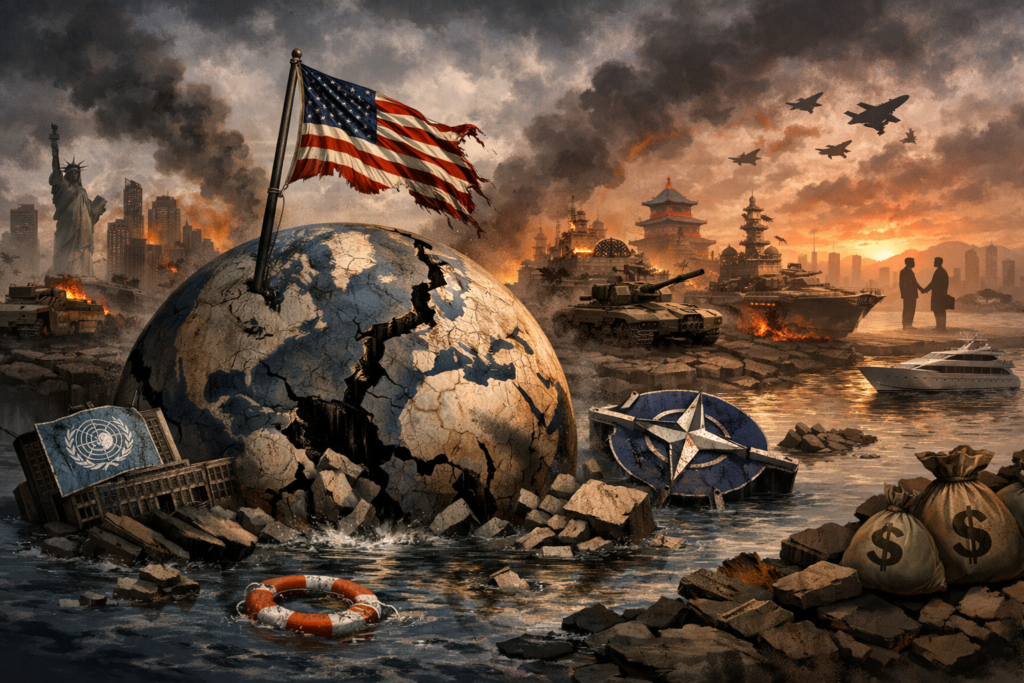
Image Credentials: Image Title: Beyond the Unraveling: A New Strategic Framework for American Containment Source: (sora.openai) Date: December 2025. Attribution: This image was created using AI-generated imagery (sora.openai) and does not depict a real-world scene.
By José Carlos Palma*
The American-led liberal international order, the hallmark of the post-Cold War era, has reached a point of terminal decline. Its core institutions are gridlocked by divergent interests, its founding logic has become obsolete in a multipolar landscape, and its benefits are increasingly captured by strategic adversaries and “free-riding” partners.
However, the collapse of this universalist order does not equate to the decline of American power. On the contrary, the United States possesses a structural edge, rooted in its unique geography, favorable demography, and an unparalleled innovation base, that remains superior to any rival. The current crisis is not one of strength, but of strategic incoherence. To secure its future, Washington must transition from managing global stability as a “globalist” end in itself to a “realist” strategy of selective containment and coalition consolidation.
The attempt to maintain a dysfunctional universal order has allowed revisionist regimes, specifically China and Russia, to exploit the system they intend to destroy. Rather than succumbing to nostalgia for the old liberal order or fatalism regarding American decline, the United States must recognize that the era of universalizing American values is over.
The goal for the 21st century is focused and transactional, to contain powerful, revisionist regimes and reinforce key partners.
The United States should leverage its military and economic advantages to build a resilient geopolitical bloc that works primarily for U.S. interests. This strategy rejects the passivity of isolationism and the overextension of globalism, proposing a framework anchored in three pillars:
1. North American Industrial Scale
The bedrock of this new coalition is the consolidation of North American industrial capacity. By reshoring and “friend-shoring” critical manufacturing and energy production, the U.S. creates a hardened economic core that is immune to the coercive tactics of Eurasian autocracies.
2. Layered and Conditional Defense Partnerships
The era of unconditional security guarantees must end. U.S. protection should be viewed as earned, not owed.
-
Europe: A focused partnership centered on containing Russian expansionism, contingent on European allies meeting their defense commitments.
-
The First Island Chain: A reinforced defensive perimeter in East Asia to check Chinese maritime projection.
3. Controlled Integration
The coalition must be integrated through reciprocal trade and, crucially, joint control of critical supply chains and advanced technologies. This “technological sovereignty” ensures that the innovations of the free world do not fuel the military-industrial complexes of its rivals.
Implementing this framework requires a ruthless prioritization of resources. It demands both significant investments in emerging technologies and substantial budget cuts to obsolete commitments.
| Strategic Pivot | From: Globalist Order | To: Realist Containment |
| Objective | Universal Stability | Containment of China & Russia |
| Alliances | Unconditional / Static | Conditional / Performance-Based |
| Trade | Global Free Trade | Reciprocal / Secure Supply Chains |
| Military | Global Police Force | Selective Strength / Hub-and-Spoke |
This framework draws heavily on the Cold War-era “Containment” doctrine, specifically the practice of selective strength and alliance discipline. While America cannot, and should not, attempt to remake the world in its own image, it must prevent authoritarian great powers from redrawing the map of Eurasia through force.
By consolidating a tighter, more strategically aligned coalition, the United States can effectively contain the most dangerous threats to its security and prosperity, ensuring that the next century is defined not by the unraveling of the old order, but by the resilience of a new, realistic American strategy.
Bibliography
- Kennan, George F. “The Sources of Soviet Conduct.” Foreign Affairs 25, no. 4 (July 1947): 566–82.
- Mearsheimer, John J. The Tragedy of Great Power Politics. Updated ed. New York: W. W. Norton & Company, 2014.
- Walt, Stephen M. The Hell of Good Intentions: America’s Foreign Policy Elite and the Decline of U.S. Primacy. New York: Farrar, Straus and Giroux, 2018.
- Allison, Graham. Destined for War: Can America and China Escape Thucydides’s Trap? Boston: Houghton Mifflin Harcourt, 2017.
- Friedberg, Aaron L. Getting China Wrong. Cambridge: Polity Press, 2022.
- Posen, Barry R. Restraint: A New Foundation for U.S. Grand Strategy. Ithaca, NY: Cornell University Press, 2014.
The Grand Strategy Institute
Continue Exploring Strategic Analysis
Return to The Grand Strategy Institute for strategic assessments, long-form analysis and research examining geopolitics, military affairs, international security, emerging technologies and the changing international order.
← Back to The Grand Strategy Institute