
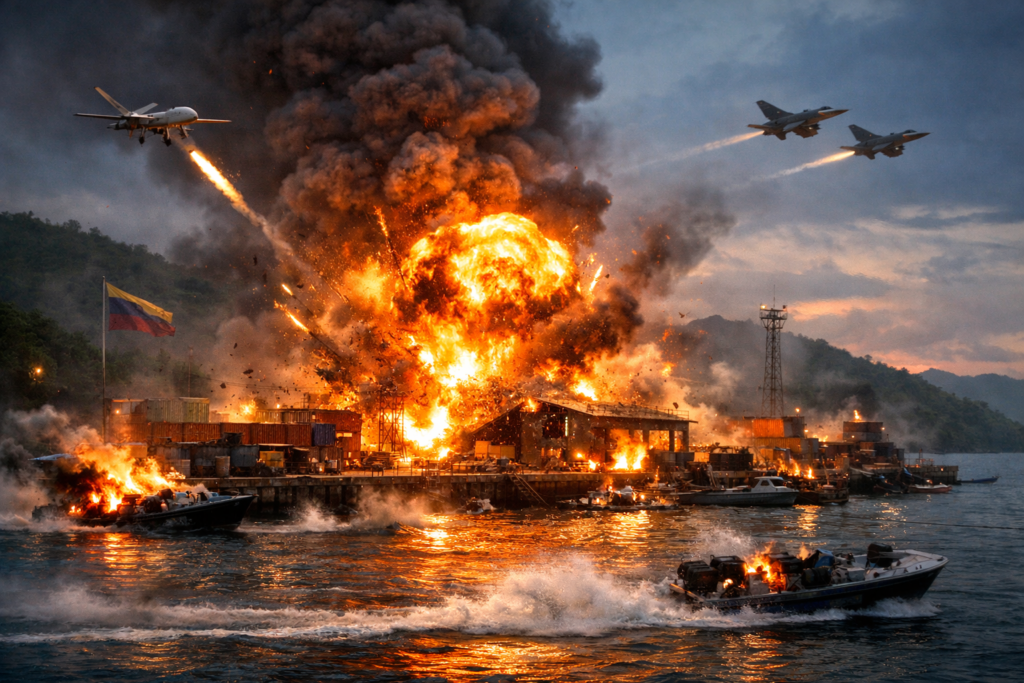
Image Credentials: Image Title: Precision Strike: US Drone Attack Targets Strategic Port in Venezuela Source: (sora.openai) Date: December 2025. Attribution: This image was created using AI-generated imagery (sora.openai) and does not depict a real-world scene.
By Open Chronicle Defense Desk with Agencies | December 30, 2025
Executive Summary
In a significant escalation of regional tensions, the United States has conducted its first known kinetic strike on sovereign Venezuelan soil. President Donald Trump confirmed that US assets successfully targeted a “dock facility” used for narcotics trafficking. The operation represents a critical shift in the administration’s strategy, moving from maritime interceptions in international waters to direct land strikes within Venezuelan territory.
1. The Strike: Target and Execution
Sources familiar with the operation indicate that the CIA conducted the drone strike earlier this month. The target was a port facility on the Venezuelan coast allegedly controlled by the transnational criminal organization Tren de Aragua.
-
Intelligence: The facility was identified as a primary storage hub for narcotics bound for the US. Intelligence support was reportedly a point of contention; while some sources cited involvement from US Special Operations Forces, Col. Allie Weiskopf of US Special Operations Command officially denied providing such support.
-
Casualties: Initial reports suggest there were no casualties at the dock facility, as the site was empty at the time of the impact.
-
Presidential Confirmation: Speaking with radio host John Catsimatidis, President Trump stated, “They have a big facility where the ships come from… Two nights ago, we knocked that out. We hit them very hard.”
2. A “Secretary of War” Strategy
The strike is part of a broader, more aggressive campaign spearheaded by the administration. While the military has conducted 30 strikes in international waters since early September—resulting in at least 107 deaths—this land-based operation signals a new phase in the conflict.
Secretary of War Pete Hegseth has maintained a transparent tally of boat strikes on social media, yet the Pentagon remained silent on the port facility attack, referring all queries to the White House. This silence underscores the sensitive, potentially covert nature of the operation, particularly following Trump’s October authorization for the CIA to conduct covert operations within the country.
3. Geopolitical Implications and Response
The Trump administration justifies these actions by declaring a state of “armed conflict” with drug cartels. However, the political ramifications in Caracas are profound.
-
The Maduro Perspective: President Nicolás Maduro has denounced the strikes, asserting that the anti-narcotics campaign is a thin veil for a “regime change” operation intended to force him from power.
-
The “Uncle” Policy: Reinforcing this view, White House Chief of Staff Susie Wiles recently told Vanity Fair that the President intends to continue military pressure until Maduro “cries uncle.”
-
Regional Military Buildup: Beyond drone strikes, the US has increased its naval presence in the region, seizing oil tankers and deploying additional warships to enforce a de facto blockade.
4. Analysis: Tactical Shift or Permanent Escalation?
By striking the “implementation area” on land, the US is testing the boundaries of international law and sovereign immunity. Trump’s meeting with Israeli Prime Minister Benjamin Netanyahu in Florida, during which he discussed the “major explosion,” suggests that the administration is seeking to project a posture of global decisiveness.
The transition from striking boats to striking infrastructure marks a “point of no return” for US-Venezuela relations in 2025. With warships patrolling the coast and drones striking inland, the “Shadow Protocols” of regional intervention appear to be fully engaged.