
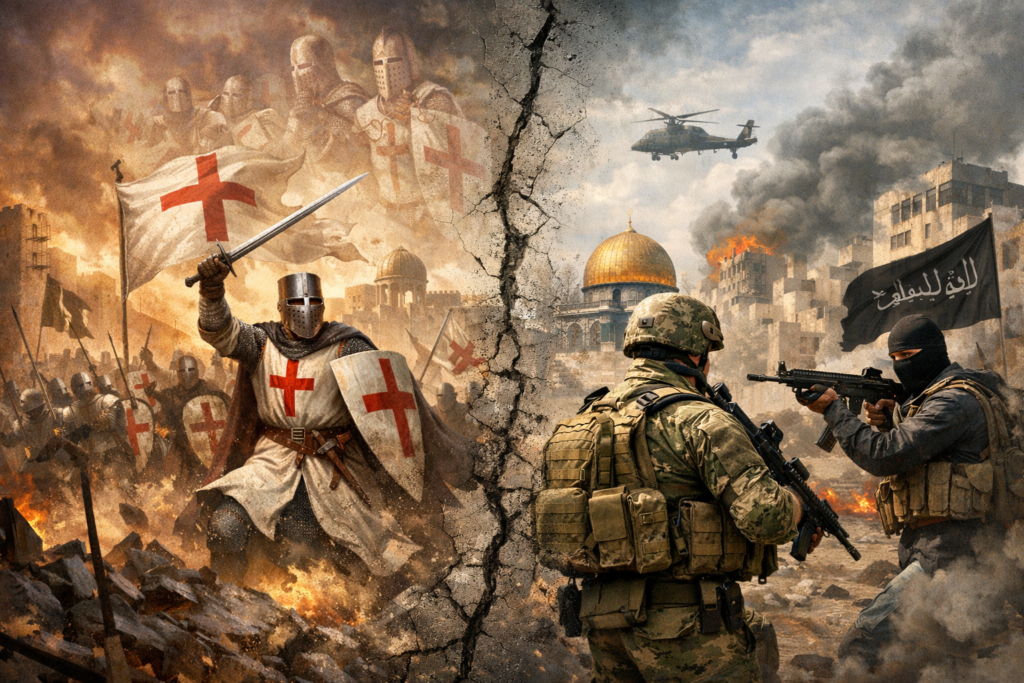
Image Credentials: Image Title: Echoes of the Holy War: Why the World Still Lives in the Shadow of the Crusades Source: (sora.openai) Date: December 2025. Attribution: This image was created using AI-generated imagery (sora.openai) and does not depict a real-world scene.
By Open Chronicle Global History Desk | December 31, 2025
For nearly four centuries during the Middle Ages, the cry of “Deus vult!” (God wills it!) echoed across Europe and the Levant, launching a series of military expeditions known as the Crusades. Ostensibly fought to “liberate” the Holy Land, these wars ended in the 13th century, yet their ghost continues to haunt 21st-century geopolitics, rhetoric, and cultural identity.
Historians argue that while we no longer live in a medieval world, we are trapped in a constructed memory of the Crusades, a memory often used as a weapon in modern “clashes of civilizations.”
The Constructed Conflict: West vs. East
The most pervasive legacy of the Crusades is the idea of an inevitable, eternal struggle between Christianity and Islam. However, experts suggest this is a modern simplification of a much more complex reality.
-
Medieval Complexity: In the Middle Ages, the Crusades were not always about “Christian vs. Muslim.” They involved shifting political alliances, trade, scientific exchange, and periods of religious tolerance. Crusaders often fought other Christians (such as the Fourth Crusade’s sack of Constantinople), and Muslim leaders frequently allied with Crusader states against rival Muslim factions.
-
19th-Century Invention: The “Clash of Civilizations” narrative was largely revived in the 1800s. European imperial powers used “Crusader rhetoric” to justify colonial expansion into North Africa and the Middle East, while indigenous resistance movements adopted the image of Saladin as a symbol of anti-Western defiance.
The Power of Rhetoric: From Allenby to Jihadism
The language of the Crusades remains a potent political tool. When history is “written by the present,” old symbols are given new, often dangerous, meanings.
| Event / Figure | Modern Invocation of the Crusades |
| Gen. Edmund Allenby (1917) | British media compared his entry into Jerusalem to Richard the Lionheart. |
| Gen. Henri Gouraud (1920) | Reputedly told Saladin’s tomb in Damascus: “Awake, Saladin—we have returned!” |
| U.S. Wars (Iraq/Afghanistan) | Often denounced by Islamist groups as “Crusader invasions” to incite resistance. |
| Western Far-Right | Uses Crusader imagery (crosses and knights) to promote anti-immigrant and nationalist agendas. |
The “Moral” Crusade: A Shift in Language
In the modern English lexicon, the word “crusade” has been stripped of its medieval military context and rebranded as a struggle against a perceived moral wrong.
We now speak of a “crusade against drugs,” a “crusade against poverty,” or a “crusade for civil rights.” This reflects a lingering Victorian-era ideal: the belief that an individual has a righteous, almost divine, obligation to intervene and destroy “evil.” Whether it was the volunteers of the Spanish Civil War or modern social movements, the archetype of the “righteous warrior” remains a cornerstone of Western identity.
Tangible Legacies: Castles, Taxes, and Charity
While the Crusader States (like the Kingdom of Jerusalem) vanished centuries ago, they left behind physical and institutional fingerprints:
-
Architecture: The “Cracker-style” castles and fortifications seen across Syria, Jordan, and Israel (such as Krak des Chevaliers) were engineering marvels that influenced European castle-building.
-
Statecraft: The need to fund massive overseas expeditions led to the development of sophisticated state taxation systems in Europe.
-
Sovereign Orders: The Order of St. John of Jerusalem, once a military powerhouse, survives today as the Sovereign Military Order of Malta, a global charitable organization.
A Mythical Shadow
Are we truly living in the shadow of the Crusades? Historically, the answer is no. The medieval institutions of the Church, such as the “crusade indulgence”, died out in the 17th century. Modern states cannot trace their legal origins back to the 12th-century Levant.
However, mythologically, the shadow is immense. Because populist leaders and extremist groups on both sides “pilfer” a crude vision of the past to justify contemporary conflict, the legacy remains real. The Crusades continue to affect lives today, not because of what happened 800 years ago, but because of how we choose to remember it.
References
I. Primary Medieval Sources & Translations
-
Gabrieli, F. (Ed.). (1984). Arab Historians of the Crusades. University of California Press.
A crucial collection of reports from the Muslim side of the conflict, providing a counter-narrative to European chronicles.
-
Hallam, E. (Ed.). (2000). Chronicles of the Crusades: Eye-witness Accounts of the Wars between Christianity and Islam. Welcome Rain Publishers.
-
William of Tyre. (1943). A History of Deeds Done Beyond the Sea. (E.A. Babcock & A.C. Krey, Trans.). Columbia University Press.
One of the most important contemporary Latin chronicles of the Crusader States.
II. Modern Historiography & “The Shadow of the Crusades”
-
Allenby, E. (1917). The Entry of the British Army into Jerusalem. Official War Office Records.
Primary documentation of the 20th-century reuse of Crusader imagery during WWI.
-
Hillenbrand, C. (1999). The Crusades: Islamic Perspectives. Edinburgh University Press.
The definitive study on how the Crusades were viewed by contemporaries and how that memory evolved in the Islamic world.
-
Maalouf, A. (1984). The Crusades Through Arab Eyes. Al Saqi Books.
A highly influential work that shifted the Western perspective on the “savagery” of the conflict.
-
Maimbourg, L. (1675). Histoire des Croisades.
A 17th-century French text used as propaganda to justify the persecution of Protestants, illustrating the early “recycling” of the Crusades.
III. Contemporary Academic Analysis (2025 Context)
-
Asbridge, T. (2010). The Crusades: The Authoritative History of the War for the Holy Land. Echoes of the Past Publishing.
-
Riley-Smith, J. (2008). The Crusades, Christianity, and Islam. Columbia University Press.
An exploration of why the Crusades were “rediscovered” in the 19th century and their role in modern political rhetoric.
-
Tyerman, C. (2019). The World of the Crusades. Yale University Press.
Analyzes the diverse impacts of the movement, from the Baltic to Spain, and their long-term institutional effects.
Institutional Resources & Archives
| Source | Description | Location / Access |
| Imperial War Museum | Holds Kaiser Wilhelm II’s 1898 gilt bronze wreath for Saladin. | London, UK |
| National Archives (UK) | Records of the British Mandate and Gen. Allenby’s dispatches. | nationalarchives.gov.uk |
| Vatican Apostolic Library | Original papal bulls and letters regarding the “Crusade Indulgences.” | Vatican City |
Strategic Summary of Perspectives
-
The Romantic View (19th Century): Focused on chivalry, Richard I, and the “civilizing mission” of the West.
-
The Polemical View (20th/21st Century): Focused on the Crusades as a precursor to Western imperialism and an “eternal clash.”
-
The Academic View (Current): Focused on the Crusades as a specific medieval phenomenon driven by localized religious and material concerns, often distinct from modern politics.