
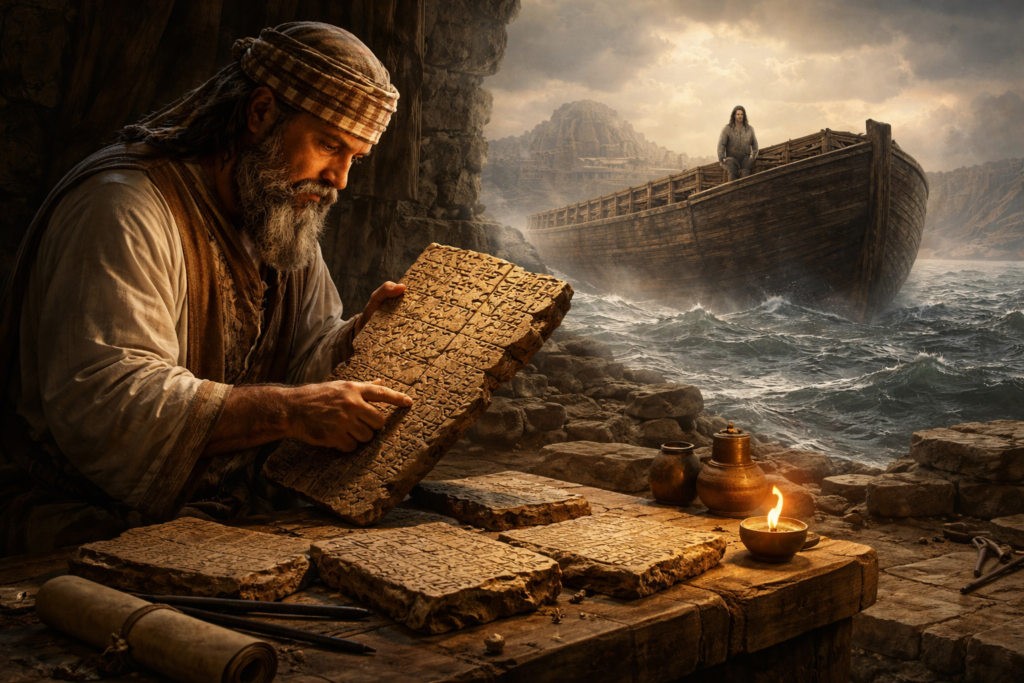
Image Credentials: Image Title: The First Ark: The 4,000-Year-Old Mesopotamian Myth That Preceded Noah Source: (sora.openai) Date: December 2025. Attribution: This image was created using AI-generated imagery (sora.openai) and does not depict a real-world scene.
By Open Chronicle History Desk | December 31, 2025
While the story of Noah and his Ark is one of the most recognizable pillars of the Judeo-Christian tradition, archaeologists and historians have discovered that the “Global Deluge” was a literary masterpiece long before the first lines of the Bible were ever written. Deep in the dust of ancient Iraq, 4,000-year-old clay tablets tell a story of divine regret, a massive vessel, and a chosen survivor that mirrors the Book of Genesis with startling precision.
The Cradle of the Flood: Mesopotamia
The myth was born in Mesopotamia, the “Land Between the Rivers.” Flanked by the Tigris and Euphrates, this region (modern-day Iraq and Syria) was home to the world’s first urban centers. These civilizations, including the Sumerians, Babylonians, and Assyrians, utilized cuneiform script—wedge-shaped marks pressed into wet clay, to record their laws, commerce, and profound mythologies.
Among these records is the Atra-Hasis Epic, composed during the Old Babylonian period (c. 1900–1600 BCE). It is the oldest known account of a divine flood sent to cleanse the Earth, written centuries before the Hebrew Bible took shape.
The Story of Atra-Hasis: “Exceeding in Wisdom”
In the Mesopotamian tradition, the reason for the flood was far less “moral” than in the biblical account. According to the myth, the gods had created humans to perform labor, but the human population grew so large and “unruly” that their noise began to disturb the sleep of the gods.
-
The Divine Decree: Led by the supreme god Enlil, the gods decided to wipe out humanity simply because they were “too loud and annoying.”
-
The Secret Warning: The god Ea (Enki), who valued humanity, secretly warned a wise king named Atra-Hasis (meaning “exceeding in wisdom”).
-
The Instructions: Ea commanded Atra-Hasis to “tear down your house and build a boat,” instructing him to preserve “the seed of all life on Earth” within its hull.
Puns, Dread, and the Three Birds
The epic contains haunting human details. Atra-Hasis holds a final feast for his community, but he is paralyzed by guilt. He gives a speech full of linguistic wordplay; he tells his neighbors that the gods will “rain down cuckoo cakes and wheat.” In Akkadian, these words were puns for “weapons” and “heavy,” a hidden warning of the violence to follow.
Once the storm subsides, Atra-Hasis performs a ritual to see if it is safe to disembark. He releases:
-
A Dove
-
A Swallow
-
A Raven
When the raven fails to return, Atra-Hasis knows that land has been found. This identical sequence, sending out birds to scout for dry land, is perhaps the most striking “literary fingerprint” shared with the story of Noah.
Comparative Mythology: The Flood Heroes
| Feature | Atra-Hasis (Mesopotamia) | Noah (Bible) |
| Reason for Flood | Humans were too noisy/populous. | Humans were wicked and corrupt. |
| Divine Savior | The god Ea (Enki). | God (Yahweh). |
| The Vessel | A reed/wooden boat or “ark.” | A wooden “ark” ($gopher$ wood). |
| The Test | Releasing three birds (Dove, Swallow, Raven). | Releasing a Raven and a Dove. |
| Outcome | Survival of the “human seed.” | A new covenant and the rainbow. |
How the Story Traveled: From Clay to Genesis
Historians believe the flood myth was a recurring “cultural motif” across the Near East. Variants appear in the Epic of Gilgamesh and older Sumerian poetry.
The Path to the Bible: During the Babylonian Exile (6th century BCE), Jewish scribes lived in Babylon and were exposed to its vast libraries and oral traditions. It is widely theorized that these thinkers reframed the existing Mesopotamian deluge through a monotheistic lens. While the Babylonian gods acted out of irritation, the God of Genesis acted out of a desire for moral justice, yet the architectural blueprints of the story remained the same.
A Global Archetype
The Mesopotamian tablets prove that the story of the flood is one of humanity’s oldest shared memories. From India’s Manu to China’s Yu the Great, the idea of a catastrophic water-reset has appeared in cultures worldwide. However, the cuneiform tablets of Atra-Hasis remain our earliest written window into this ancient, terrifying, and hopeful human drama.
To support the historical and archaeological claims made in the article “The First Ark: The 4,000-Year-Old Mesopotamian Myth That Preceded Noah,” the following bibliography includes primary cuneiform sources, academic translations, and scholarly analyses of comparative mythology.
Institutional Resources & Archives
| Source | Description | Location/Access |
| The British Museum | Holds the original “Flood Tablet” (K.3375) and the “Ark Tablet.” | britishmuseum.org |
| Electronic Text Corpus of Sumerian Literature (ETCSL) | Online database of Sumerian poetry, including early flood fragments. | etcsl.orinst.ox.ac.uk |
| Cuneiform Digital Library Initiative (CDLI) | High-resolution images and transcriptions of original tablets. | cdli.ucla.edu |
References
I. Primary Cuneiform Sources & Translations
-
Lambert, W. G., & Millard, A. R. (1969). Atra-Hasis: The Babylonian Story of the Flood. Oxford: Clarendon Press. (Reprinted by Eisenbrauns, 1999).
This is the definitive academic source for the Old Babylonian tablets. It provides the transliterated Akkadian text alongside English translations of the Atra-Hasis Epic.
-
George, A. R. (2003). The Babylonian Gilgamesh Epic: Introduction, Critical Edition and Cuneiform Texts (Vol. 1 & 2). Oxford University Press.
Tablet XI of the Standard Babylonian version contains the most complete account of the flood as told by Utnapishtim.
-
Dalley, S. (2000). Myths from Mesopotamia: Creation, the Flood, Gilgamesh, and Others. Oxford World’s Classics.
A highly accessible translation of the Atra-Hasis and Gilgamesh flood accounts for general readers and students.
II. Archaeological & Contextual Analysis
-
Finkel, I. (2014). The Ark Before Noah: Decoding the Story of the Flood. Hodder & Stoughton.
Written by the British Museum curator who translated the “Ark Tablet,” this book explains the technical instructions for building a circular (coracle) ark and explores the transmission of the story to the Bible.
-
Chen, Y. S. (2013). The Primeval Flood Catastrophe: Origins and Early Development in Mesopotamian Traditions. Oxford University Press.
An academic deep-dive into the evolution of the flood motif across Sumerian and Akkadian literature.
-
Smith, G. (1873). “The Chaldean Account of the Deluge.” Transactions of the Society of Biblical Archaeology.
The historical paper that first announced the discovery of the Mesopotamian flood story to the modern world, identifying the commonalities with the Book of Genesis.
III. Comparative Religion & Cross-Cultural Studies
-
Van Der Toorn, K. (2007). Scribal Culture and the Making of the Hebrew Bible. Harvard University Press.
Explains how Israelite scribes in Babylon would have interacted with and adapted Mesopotamian cuneiform literature.
-
Dundes, A. (1988). The Flood Myth. University of California Press.
An anthology of flood myths from around the world, providing a global context for the Mesopotamian and Biblical narratives.