
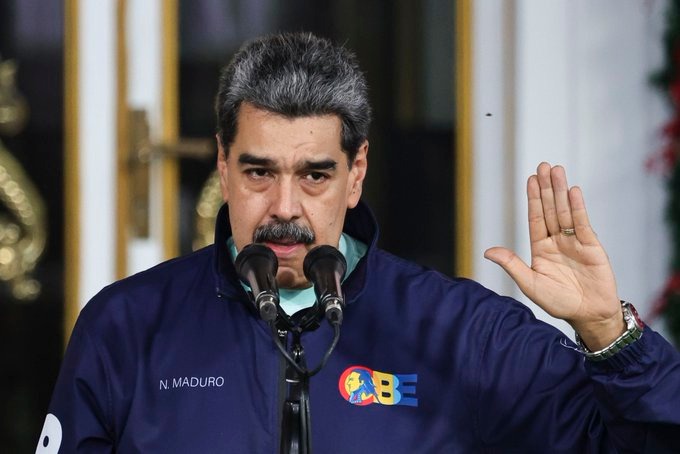
Image: from Luca Taner X@LucaTaner
WASHINGTON, D.C. — Following a weekend of unprecedented military action, U.S. Attorney General Pam Bondi has officially unveiled a high-stakes criminal indictment against the captured Venezuelan leader Nicolás Maduro and his wife, Cilia Flores.
The indictment, filed in the Southern District of New York, serves as the legal anchor for the “large-scale strike” announced by Donald Trump earlier on Saturday. The move marks a historic and highly controversial shift in international law, as the United States prepares to try a captured foreign head of state in a domestic courtroom.
The Charges: A Criminal Architecture
Attorney General Bondi detailed a sweeping list of charges that frame the Maduro regime not as a political entity, but as a criminal enterprise designed to destabilize the United States.
-
Narco-Terrorism Conspiracy: Alleging that Maduro used the Venezuelan state to coordinate with terrorist organizations to “flood” the U.S. with narcotics.
-
Cocaine Importation Conspiracy: Specifically targeting the illicit flow of drugs facilitated by the Cártel de los Soles.
-
Heavy Weaponry Possession: The indictment includes counts for the possession and conspiracy to possess machine guns and destructive devices used in furtherance of drug trafficking.
“They will soon face the full wrath of American justice on American soil in American courts,” Bondi declared in a statement on X (formerly Twitter).
❗️Maduro and wife INDICTED on charges of 'NARCO-TERRORISM CONSPIRACY' — AG Bondi CONFIRMS
Other conspiracies of 'cocaine importation… possession of machineguns and destructive devices'
'They will soon face FULL WRATH OF AMERICAN JUSTICE'
RT pic.twitter.com/HDAC1cV7su— TifaniesweTs (@TifaniesweTs) January 3, 2026
Formalizing the “Capture.”
The legal filing provides the necessary framework for the status of Maduro and Flores, who were reportedly extracted from Caracas by U.S. Delta Force operators. By framing the military operation as a “law enforcement action,” the Trump administration aims to justify the extraterritorial arrest of a sovereign leader.
A Controversial Precedent for International Law
The indictment has immediately sparked a firestorm of diplomatic debate regarding national sovereignty and the immunity of state leaders.
-
Extraterritoriality: Legal scholars are questioning the U.S.’s authority to apply domestic criminal law to a sitting head of state on foreign soil.
-
Global Sovereignty: Nations such as Türkiye and other members of the international community have expressed deep concern, arguing that this sets a precedent where military force can be used globally as a tool for domestic law enforcement.
-
Immunity Challenges: Under traditional international law, heads of state enjoy immunity from the jurisdiction of foreign courts—a principle this indictment directly challenges.
Comparing the 2020 vs. 2026 Indictments
| Feature | 2020 Indictment (Barr) | 2026 Indictment (Bondi) |
| Status of Maduro | At Large (In Caracas) | In U.S. Custody |
| Key Defendants | Maduro & Cabinet Members | Maduro & Cilia Flores |
| Primary Venue | Southern District of NY | Southern District of NY |
| Physical Assets | Bounty Offered ($15M) | Direct Military Seizure |
The Road to Trial
As Maduro and Flores are prepared for their first appearance in a U.S. federal court, the world watches to see how the American judicial system will handle the complexities of a “narco-state” trial. The outcome will likely redefine the boundaries of American power and the concept of “sovereign immunity” for decades to come.