
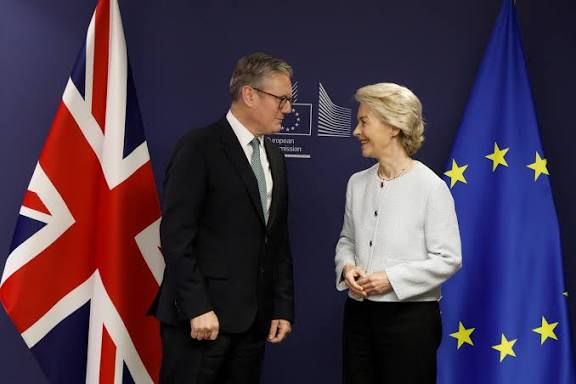
Image: from Col. Klink news. X@blobbers01
By Open Chronicle News Desk with Agencies | January 6, 2026
London – Prime Minister Keir Starmer was facing renewed political turbulence on Sunday after signalling that his government could pursue closer alignment with the European Union single market, prompting fierce accusations of a fresh betrayal of Brexit pledges and a breach of Labour’s election commitments.
In a series of interviews, Sir Keir said he wanted to explore “even closer alignment with the single market” and suggested Britain should be prepared to “go further” with the EU where it serves the national interest. His remarks immediately ignited a backlash from opposition parties and Brexit supporters, who warned that any move in that direction risks reopening some of the most divisive debates in modern British politics.
Although the Prime Minister ruled out rejoining the customs union, which would remove tariffs and checks on goods, he left open the possibility of deeper regulatory alignment with Brussels. Such a step would be highly sensitive because full participation in the single market normally requires acceptance of freedom of movement between EU member states, a principle that was at the heart of the 2016 referendum.
Keir Starmer admits he is about to betray the brexit vote and rejoin the EU single market. He will trap us to international treaties with the EU to tie the hands of future leaders. This is his game he wants a civil war. #bbclaurak pic.twitter.com/R7M2MlCSmz
— Col. Klink news. 🇬🇧 (@blobbers01) January 4, 2026
Sir Keir insisted that he had no intention of restoring unrestricted movement of people, but confirmed he was seeking a youth mobility scheme that would allow 18 to 30-year-olds to live and work across the UK and the EU. He also suggested that Britain could look to models such as Switzerland, which operates through a complex web of sector-by-sector agreements, or other forms of mutual recognition, particularly in services.
The comments come as Labour struggles in the opinion polls and internal discontent simmers within the party. The Prime Minister sought to project confidence in his leadership, saying he expected to remain in Downing Street until at least 2027 and warning that any attempt to remove him would unleash what he described as “utter chaos”.
Opposition figures were swift to attack. Nigel Farage, leader of Reform UK, accused Sir Keir of breaking faith with voters and claimed that tighter EU alignment would bind Britain to what he called “crazy” net zero policies and carbon taxes, worsening the cost of living and accelerating deindustrialisation. “We will fight Starmer every step of the way,” Farage said.
Conservative leader Kemi Badenoch also accused the Prime Minister of weakness, arguing that his comments revealed how fragile his position has become. She said reopening the Brexit debate at the start of the year was reckless and urged him instead to focus on cutting spending, lowering taxes, and getting more people back into work.
Sir Keir defended his position by arguing that the UK had already aligned with the EU in key areas such as food and agriculture, and that further alignment should be judged pragmatically. “We take a sovereign decision whether we align or not,” he said. “If it is in our national interest to go further, then we should consider that.”
He also argued that Britain’s recent trade deals with the United States and India made membership of the customs union less attractive, since it could constrain future agreements. In his view, closer ties with the single market offer more flexibility while still delivering economic benefits.
The row comes against the backdrop of growing speculation that Labour is preparing to soften its stance on Brexit. Health Secretary Wes Streeting recently described the EU as offering “enormous economic benefits”, while a group of 13 Labour MPs last month backed a proposal to pursue a customs union. The Liberal Democrats, who tabled that motion, say they plan to force the government to open formal talks with Brussels.
Downing Street had insisted only weeks ago that its red lines remained unchanged, including not rejoining the single market, not entering a customs union, and not restoring freedom of movement. Combined with recent reversals on tax pledges, critics say the Prime Minister is steadily eroding trust in his leadership.
Whether Sir Keir’s latest remarks mark a genuine shift in policy or a tactical attempt to stabilise his government, they have once again put Brexit at the centre of British politics, five years after the UK formally left the European Union.