
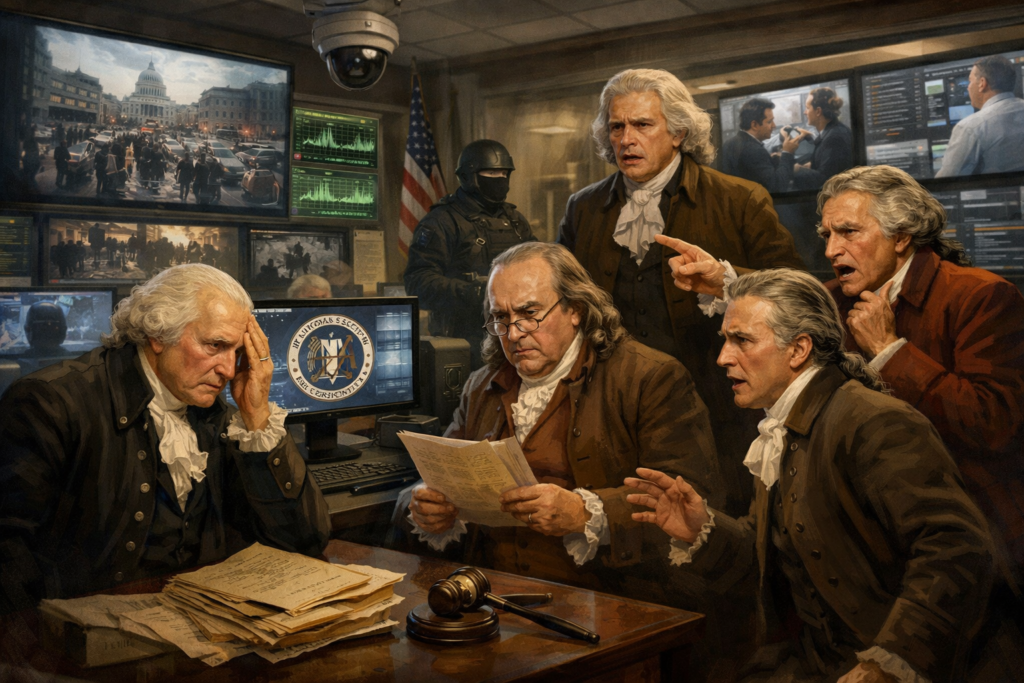
Image Credentials: Image Title: The Year in Rock 2025: Legends Reunited, New Icons Crowned, and Bittersweet Farewells Source: (sora.openai) Date: December 2025. Attribution: This image was created using AI-generated imagery (sora.openai) and does not depict a real-world scene.
By Elliot Hayes | Senior Editor | Open Chronicle U.S. Politics
If the Founding Fathers were alive today, the Patriot Act would likely be among the policies that shocked them the most. The Act, passed in the wake of the September 11 attacks, grants the government sweeping powers to monitor private communications, access personal records, and conduct surveillance with limited oversight. To the architects of the Constitution, who meticulously crafted the Bill of Rights to protect individual liberties, such measures would appear as a dramatic overreach of executive power. The Fourth Amendment, in particular, guarantees citizens protection against “unreasonable searches and seizures,” and the idea that the government could gather detailed information on ordinary Americans without probable cause would likely strike them as an alarming erosion of fundamental freedoms.
Layered on top of this, the recent actions during the Trump Administration would probably intensify their concern. The aggressive immigration policies, including travel bans targeting specific countries, and the controversial use of emergency declarations to circumvent Congressional approval, could be perceived as direct challenges to the separation of powers. The Founders designed the U.S. government with checks and balances precisely to prevent any single branch from accumulating unchecked authority, and such maneuvers might appear to contravene that principle. Similarly, the administration’s frequent use of executive orders to shape policy, along with attempts to influence election outcomes, pardon controversial allies, and expand surveillance measures, could be seen as undermining democratic norms and threatening the rule of law.
The Founding Fathers were deeply skeptical of concentrated power; they feared the rise of a ruler who could override institutional safeguards and infringe on citizen rights. From their perspective, the combination of broad surveillance under the Patriot Act and the Trump Administration’s expansion of executive authority might seem a dangerous concentration of power reminiscent of the monarchical systems they had fought to escape. Even policies framed as necessary for national security or economic benefit could be alarming if they erode transparency, accountability, and public trust.
Ultimately, they would likely recognize that protecting the nation is crucial, but they would insist that it must never come at the expense of the liberties and institutional safeguards that define the republic. The tension between security and freedom, already present in their time, has arguably reached new heights in the modern era, illustrating the persistent challenge of balancing government power with individual rights. In their eyes, policies like the Patriot Act and the recent assertive actions of the executive branch would serve as a cautionary tale of how quickly the mechanisms of liberty can be tested, and potentially compromised, when fear and expediency outweigh constitutional principles.