
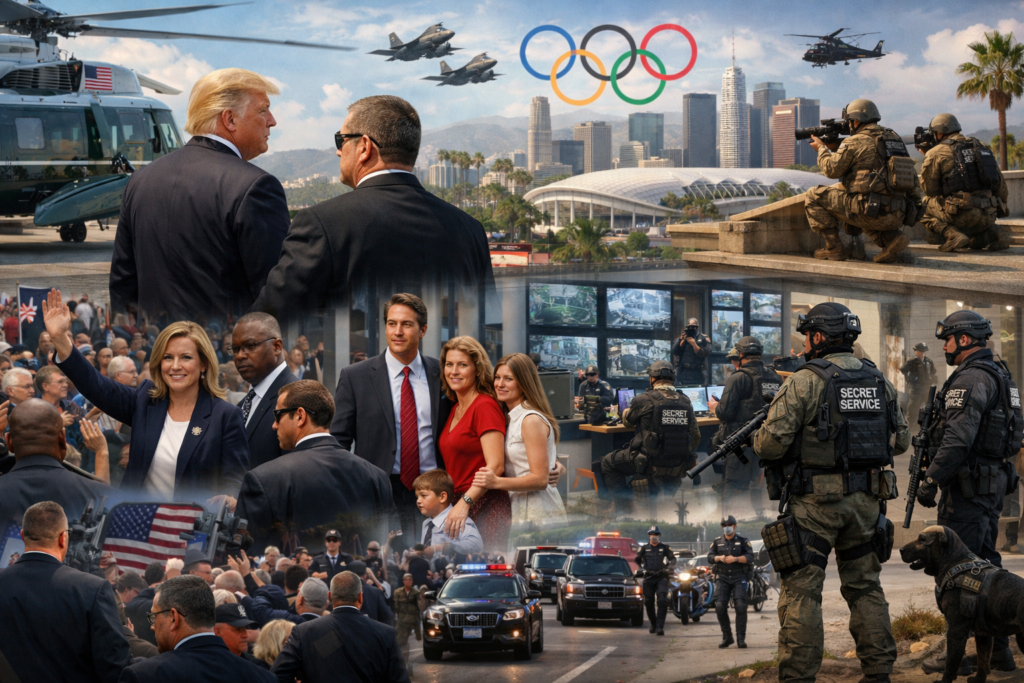
Image Credentials: Image Title: Inside the Overstretched Secret Service Facing a High Risk 2028 Election Year Source: (sora.openai) Date: January 2026. Attribution: This image was created using AI-generated imagery (sora.openai) and does not depict a real-world scene.
By Open Chronicle Intelligence Desk with Agencies
The United States Secret Service is preparing for what officials internally regard as one of the most demanding operational periods in its history, as the 2028 election cycle converges with extraordinary national and global security pressures.
By the summer of 2028, President Donald Trump is expected to remain in office while constitutionally barred from seeking another term. This means the agency will be responsible for protecting multiple presidential and vice presidential candidates from both major political parties, as well as their families and running mates. Each of these individuals requires full protective details, significantly expanding the scope of the agency’s mission.
At the same time, the United States will host the Summer Olympic Games in Los Angeles, the first time the country has staged the event since 1996. The Olympics are designated as a National Special Security Event, which places the Secret Service at the center of security planning and execution. This will require large-scale deployment of personnel, coordination with international partners, and sustained operations over several weeks.
These demands come while the agency remains under scrutiny following two assassination attempts against President Trump. In addition, ongoing threats to senior officials have kept protective operations at an elevated level across the country. The security environment surrounding top leadership remains volatile, requiring continuous resource allocation.
The agency is also dealing with severe staffing pressures. A large portion of the current workforce was hired in the years following the September 11, 2001, terrorist attacks. Many of those agents are approaching retirement eligibility, creating a looming loss of experience and manpower. This wave of departures is expected to hit at the same time that operational demands are rising.
Efforts to expand the workforce have been ongoing for more than a decade, but progress has been disrupted by leadership changes, administrative delays, and the impact of the COVID-19 pandemic. Although the agency previously aimed to exceed 10,000 employees by 2025, those targets were not met.
Competition from other federal law enforcement agencies has further complicated recruitment. Immigration and Customs Enforcement and other security bodies have significantly expanded hiring in support of large-scale enforcement policies, drawing from the same pool of qualified applicants as the Secret Service. This has intensified the challenge of filling positions that require high physical, psychological, and security clearance standards.
In response, the Secret Service has launched an accelerated recruitment and training initiative. The agency plans to increase its total workforce by approximately 4,000 personnel before 2028, bringing total staffing above 10,000 for the first time. This expansion includes both special agents and members of the Uniformed Division, which is responsible for securing the White House, the vice presidential residence, and foreign diplomatic missions.
To meet these goals, the agency has shortened its hiring process, which previously took up to 18 months. New accelerated hiring programs allow candidates to complete interviews, physical fitness testing, and polygraph examinations within days rather than months. The target is to reduce total hiring time to under one year.
The Secret Service has also expanded recruitment efforts beyond traditional law enforcement pipelines, targeting military veterans, collegiate athletes, and other candidates with the physical and psychological resilience required for protective operations. Applicant engagement has been increased to prevent candidates from leaving for faster hiring agencies.
Despite these measures, the scale of the task remains formidable. Protecting a sitting president, multiple presidential candidates, senior political leaders, and a global sporting event simultaneously places unprecedented strain on personnel, logistics, and command structures.
The agency’s leadership has acknowledged that even if recruitment goals are met, the summer of 2028 will test the Secret Service’s capacity at every level. The convergence of political volatility, global visibility, and domestic security threats has created a situation unlike any the organization has faced in modern history.