
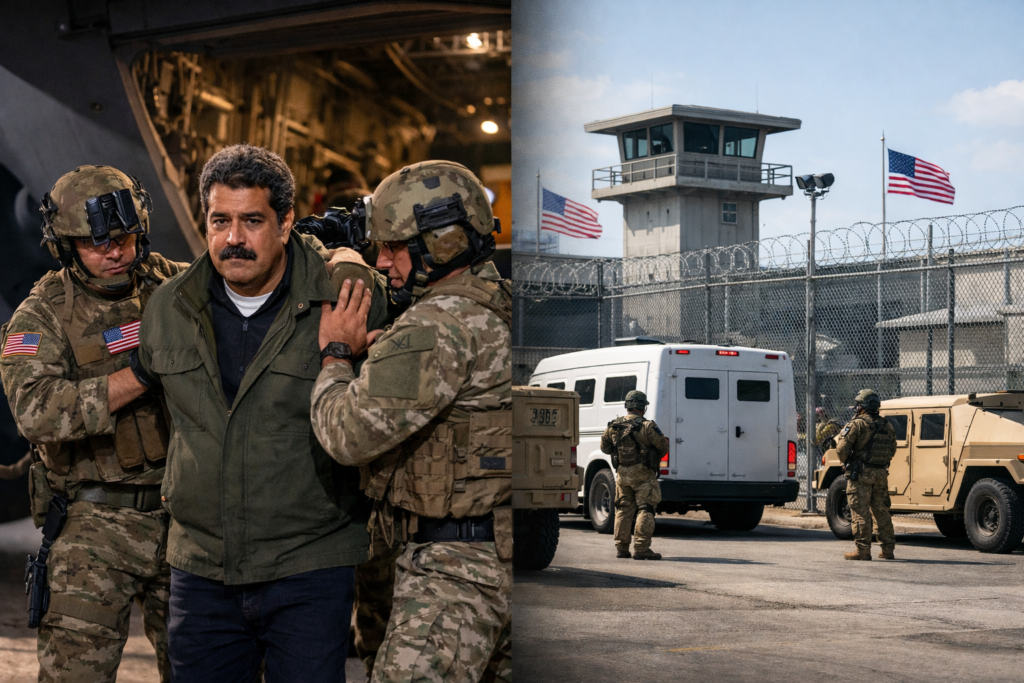
Image Credentials: Image Title: No Credible Evidence Maduro Talked to Putin After Capture, Experts Say Source: (sora.openai) Date: January 2026. Attribution: This image was created using AI-generated imagery (sora.openai) and does not depict a real-world scene.
By José Carlos Palma*
There are no credible reports that Venezuelan President Nicolás Maduro spoke by phone with Russian President Vladimir Putin after his capture by U.S. forces in early January 2026, according to analysts and official sources. Multiple reputable outlets confirm that Maduro was rapidly taken into U.S. custody following a military operation in Venezuela that resulted in his extrication from Caracas and transfer to U.S. jurisdiction.
Under U.S. law, individuals held in federal custody, particularly those facing serious charges such as narco‑terrorism, are typically placed in controlled detention with strictly limited communications. This means secure international phone calls, especially with foreign heads of state, are not permitted while investigations and pre‑trial procedures are underway.
Despite this, rumours of a call between Maduro and Putin have circulated widely on social media and among political commentators, driven in part by the symbolic relationship between Moscow and Caracas. While no evidence has surfaced to substantiate any direct contact after Maduro’s capture, the symbolic significance of the alleged connection remains politically charged for several reasons.
If Moscow were to claim that Maduro had direct communication with Putin after his capture, it would be used as a political statement against U.S. actions and legal authority over his detention. Russia has strongly condemned the U.S. military operation as unlawful under international law and has insisted that the Venezuelan government retains sovereign legitimacy.
Rumours of contact between Maduro and Russia, even if unfounded, can be employed as propaganda tools by loyalist factions within Venezuela, including armed Colectivos and remaining support networks aligned with the Bolivarian movement. Such narratives can serve to boost morale among supporters by implying Maduro retains outside backing.
Russia’s engagement with the Venezuelan leadership has broader strategic implications. Moscow publicly reaffirmed support for Venezuela after the capture by speaking with Vice President Delcy Rodríguez, not Maduro himself, signalling that Russia continues to frame the conflict as a breach of sovereignty. The Kremlin’s stance underscores ongoing geopolitical rivalry with the United States in the Western Hemisphere.
-
Maduro and his wife, Cilia Flores, have pleaded not guilty in U.S. federal court to narcotics‑related charges.
-
Russia’s Foreign Ministry has labelled U.S. actions as “armed aggression” and condemned the operation on legal grounds.
-
Russian foreign officials engaged with Venezuelan representatives, but no direct communication with Putin has been documented or verified.
In summary, while the idea of a post‑capture call between Maduro and Putin carries significant political symbolism, there is no credible evidence that it occurred. Claims to the contrary stem from misinterpretations, speculation, or political messaging rather than verified diplomatic activity.
The Grand Strategy Institute
Continue Exploring Strategic Analysis
Return to The Grand Strategy Institute for strategic assessments, long-form analysis and research examining geopolitics, military affairs, international security, emerging technologies and the changing international order.
← Back to The Grand Strategy Institute