
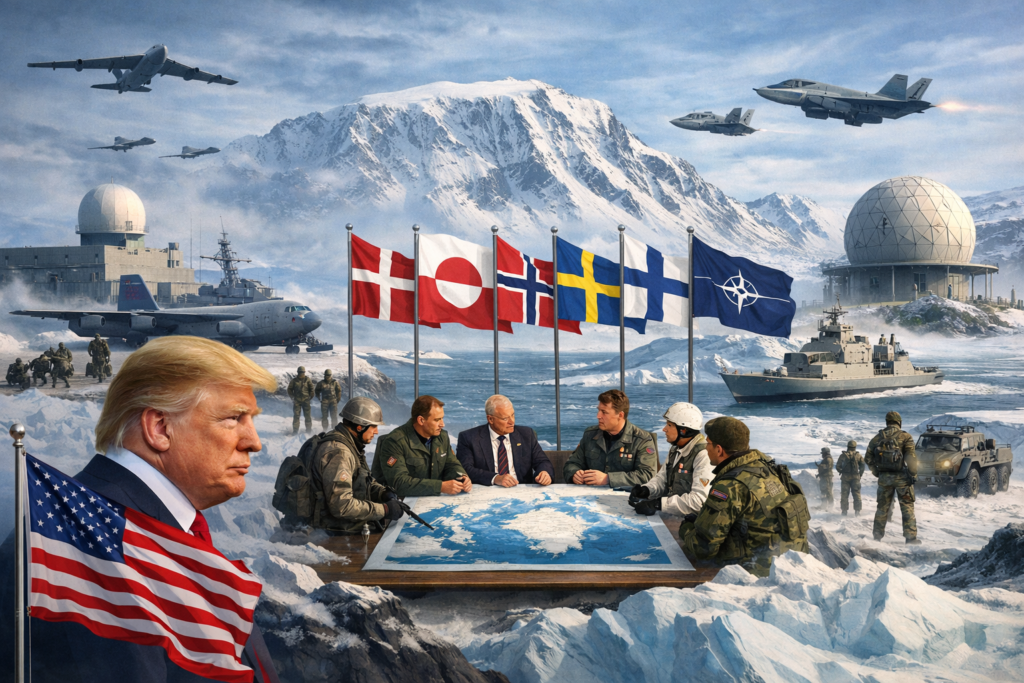
Image Credentials: Image Title: NATO’s Arctic Strategy in 2026, Partnership Over Possession Source: (sora.openai) Date: January 2026. Attribution: This image was created using AI-generated imagery (sora.openai) and does not depict a real-world scene.
By José Carlos Palma | Open Chronicle Editor-in-Chief
As geopolitical tensions rise across the High North, the question of how best to defend the Arctic without destabilizing the Western alliance has become one of the defining military debates of early 2026. While President Donald Trump has argued that direct United States control of Greenland is essential for American security, NATO and most European governments have reached the opposite conclusion. Their position is that the alliance-based architecture built around Greenland, Denmark, and the wider Nordic region offers stronger, more flexible, and more politically sustainable defense than any unilateral takeover could provide.
At the heart of NATO’s approach is a firm line on sovereignty. In January, seven European powers, including France, the United Kingdom, Germany, and Italy, issued a joint statement declaring that Greenland belongs to its people and that any change in its status must be decided only by Greenland and Denmark. The statement also emphasized the 1951 US-Denmark defense agreement, which already grants Washington extensive freedom to operate, build, and deploy forces in Greenland for defense purposes. Under this framework, the United States runs the Pituffik Space Base, formerly Thule, and operates early warning and space surveillance systems that form a critical part of North American and NATO missile defense. From the alliance’s perspective, the military access Washington seeks already exists, without the political shockwave that annexation or forced control would cause.
This legal and diplomatic foundation has been reinforced by a rapid expansion of NATO’s Arctic military posture. In early January, NATO launched Polar Shield 2026, a multinational exercise designed to demonstrate that integrated air and missile defense can be achieved through a distributed network rather than a single massive base. Sensors in Norway, Iceland, Canada, and Greenland are now fused into a common operational picture, supporting what NATO planners describe as deterrence by detection. Thousands of aerial and underwater drones are being deployed across the GIUK Gap, the strategic choke point between Greenland, Iceland, and the United Kingdom, making it far harder for Russian submarines, bombers, or missiles to move undetected into the Atlantic.
The timing is not accidental. Western defense planners are increasingly concerned about what they call a Eurasian Arctic axis, a growing alignment between Russia’s Northern Sea Route and transport corridors linked to Iran and other sanctioned states. Moscow has underscored its ambitions by deploying the Ivan Papanin, a nuclear-powered combat icebreaker, to assert control over Arctic shipping lanes it claims as internal waters. NATO’s response has not been to seize territory, but to ensure freedom of navigation through technology and multinational presence. Autonomous surface vessels, sometimes referred to as ghost fleets, are being tested to patrol contested waters and provide persistent surveillance without risking crews.
From a strategic perspective, NATO officials argue that partnership outperforms possession across every key metric. Annexing Greenland would likely fracture NATO, provoke legal challenges at the United Nations, and saddle the United States with enormous administrative and security costs. By contrast, the partnership model preserves alliance cohesion, allows Washington to invest only in the military infrastructure it needs, and keeps all operations grounded in international treaties.
Greenland itself has sought to shape this equation. Prime Minister Jens Frederik Nielsen has proposed what he calls a resource for security framework. Under this arrangement, Greenland would grant the United States and the European Union privileged access to rare earth minerals, which are vital for modern defense technology, in exchange for expanded security guarantees and infrastructure investment. For NATO, this offers a way to secure critical materials without crossing the political and moral red line of territorial seizure.
The broader Arctic defense system now extends well beyond Greenland. With Finland and Sweden joining NATO, the Nordic region has become a continuous strategic zone from the Atlantic to Russia’s border. The combined air forces of Denmark, Norway, Sweden, and Finland now operate roughly 250 modern fighters, including F-35S and Gripens, allowing them to function as a single integrated air fleet. This Nordic Shield gives NATO rapid response and deep defensive depth across the entire High North.
Maritime control remains anchored in the GIUK Gap. P 8 Poseidon patrol aircraft, underwater sensor networks, and surface forces based in Norway, Iceland, and the United Kingdom provide layered anti-submarine warfare coverage against Russia’s Northern Fleet. Iceland, despite having no standing army, continues to act as an unsinkable aircraft carrier in the middle of the Atlantic, further reducing any military need for US ownership of Greenlandic territory.
Joint exercises such as Nordic Response, which evolved from Norway’s Cold Response series, have demonstrated NATO’s ability to move thousands of troops and heavy equipment across Arctic terrain under extreme conditions. These drills focus on logistics, interoperability, and cold-weather combat skills, reinforcing the idea that defense in the High North depends on expertise and cooperation more than flags planted on ice.
Beyond hard power, NATO has also expanded its focus on search and rescue, environmental protection, and maritime safety as melting ice opens new shipping routes. Greenland’s own government, Naalakkersuisut, is increasingly involved in shaping these policies, ensuring that security measures also protect local communities and fragile ecosystems.
For NATO leaders, the conclusion is clear. In the Arctic of 2026, connectivity, technology, and alliance unity matter far more than territorial ownership. A unilateral US takeover of Greenland would risk shattering the very alliance that makes Western Arctic defense credible. By treating Greenland as a sovereign partner within the Kingdom of Denmark and the Nordic region as a unified front, NATO believes it can secure the High North more effectively and far more safely than any modern-day land grab ever could.
The Grand Strategy Institute
Continue Exploring Strategic Analysis
Return to The Grand Strategy Institute for strategic assessments, long-form analysis and research examining geopolitics, military affairs, international security, emerging technologies and the changing international order.
← Back to The Grand Strategy Institute