
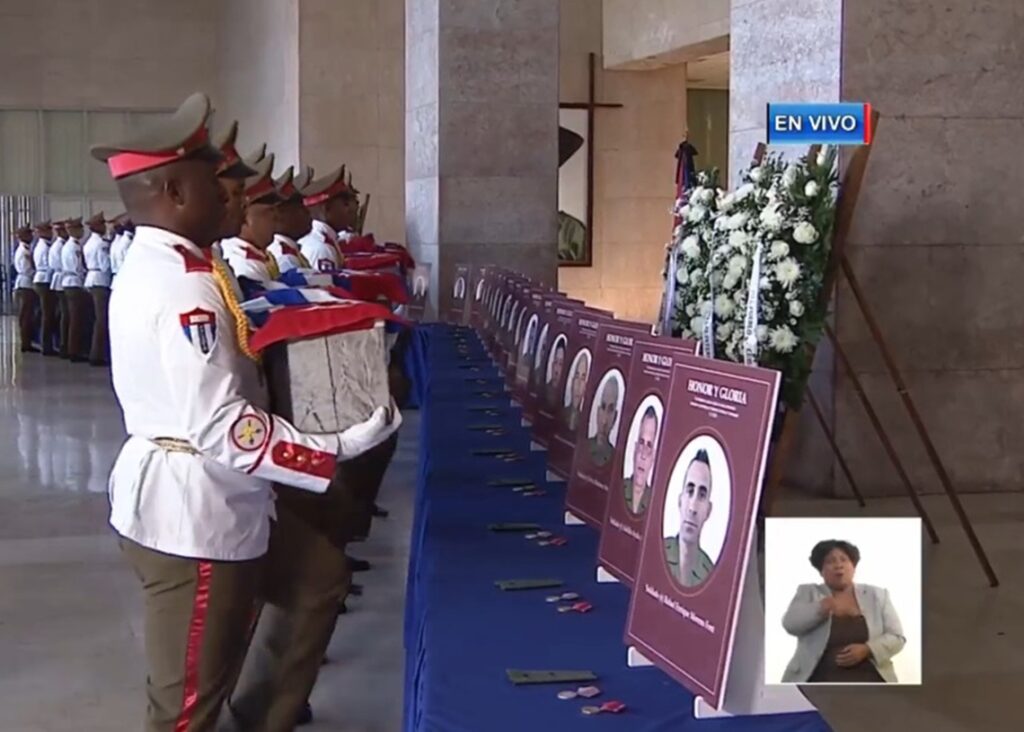
Image: from OnCubaNews X@OnCubaNews
By Open Chronicle International Affairs with Agencies
HAVANA — Thursday, January 15, 2026 — A somber atmosphere has descended upon the Cuban capital as the remains of 32 soldiers and security personnel arrived home today. The fallen, who served as an elite protection detail for Nicolás Maduro, were killed during the January 3 U.S. special forces operation in Caracas. This repatriation marks a grim milestone in the rapidly shifting landscape of Caribbean geopolitics.
The remains of the 32 #Cubansoldiers who died during the U.S. attacks on Caracas aimed at capturing #Venezuelan President Nicolás Maduro arrived in #Havana on Thursday. pic.twitter.com/rFduL6tneX
— OnCubaNews (@OnCubaNews) January 15, 2026
Military Honors and Public Mourning
Draped in the Cuban national flag, the caskets were met with full military honors at the airport before being transported to the Ministry of the Armed Forces. The Venezuelan interim government reports that over 100 people perished during the raid, making this the deadliest direct engagement between Cuban and U.S. forces since the 1961 Bay of Pigs invasion.
The government has authorized a period of public viewing, allowing citizens to pay their respects to those they consider “martyrs of sovereignty.” A massive protest is already organized for Friday morning outside the U.S. Embassy in Havana, preceding the final interments in municipalities across the island.
The “Donroe” Squeeze: Energy Crisis Looms
The human loss is compounded by a catastrophic economic outlook. President Donald Trump has intensified pressure on Havana, declaring that the island is “ready to fall.” Crucially, the new interim administration in Caracas, led by Delcy Rodríguez, has confirmed it will halt all subsidized oil shipments to Cuba.
For a nation already struggling with daily blackouts and severe food scarcity, the loss of Venezuelan oil is a potential death blow. Since the era of Hugo Chávez, Venezuela has been Cuba’s primary benefactor, exchanging oil for medical and security services.
The Collapse of the Caracas-Havana Axis
| Category | Pre-January 3 Status | Current Crisis (Jan 2026) |
| Energy Supply | Regular Venezuelan oil tankers. | Shipments halted by Rodríguez govt. |
| Security Ties | Thousands of Cuban advisors in Caracas. | Massive casualties; U.S. oversight in Venezuela. |
| Economic Stability | Fragile but supported by subsidies. | Risk of total electrical grid failure. |
| Diplomatic Status | Strong regional alliance. | Isolated, facing U.S.-led “Donroe” pressure. |
Resistance vs. Reality
While the Cuban government vows to continue its resistance against the “imperialist embargo,” the mood on the ground is one of profound anxiety. “We are mourning our sons, but we are also terrified of the dark,” said one resident, referring to the imminent threat of permanent power outages.
Washington’s strategy appears to be one of maximum pressure, utilizing the “Donroe” Doctrine to sever the financial and energy lifelines that have sustained the communist-run island for over two decades.
The return of the 32 soldiers is more than a funeral; it is the physical manifestation of the end of an era. With Maduro in U.S. custody and Venezuela’s new leadership aligned with Washington, Cuba stands alone in the crosshairs of a resurgent American policy that prioritizes regional resource control and the dismantling of socialist alliances.