
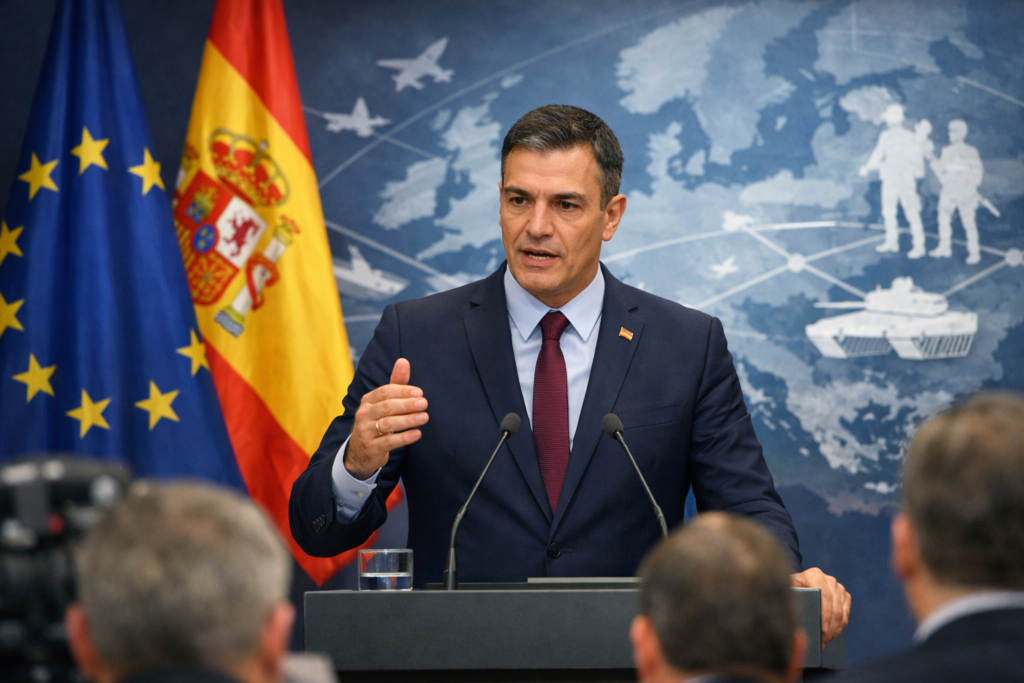
Image Credentials: Image Title: Sánchez Urges EU to Build Common Defense, Even Without Full Bloc Support Source: (sora.openai) Date: January 2026. Attribution: This image was created using AI-generated imagery (sora.openai) and does not depict a real-world scene.
By Open Chronicle News Desk with Agencies | January 20, 2026
MADRID / BRUSSELS – Spanish Prime Minister Pedro Sánchez has called for a radical shift in European security policy, stating that the European Union must move forward with a unified defense strategy even if some member states are reluctant to participate.
Speaking amid escalating transatlantic tensions and the ongoing Greenland dispute, Sánchez argued that Europe can no longer afford to wait for total consensus while its security environment rapidly deteriorates. The Prime Minister suggested that a “coalition of the willing” within the EU should lead the way in integrating military capabilities and defense procurement.
Strategic Autonomy in a Volatile World
“The time for hesitation is over,” Sánchez told reporters on Tuesday. “Europe must be able to defend its interests and its values. If we cannot reach a unanimous agreement among all 27 members, those of us who are ready must move forward together.”
The proposal aligns with the concept of “enhanced cooperation,” a mechanism that allows a group of EU countries to work together in specific areas without the involvement of the entire bloc. Sánchez’s comments are seen as a direct response to the “transactional diplomacy” of the Trump administration, which has recently threatened European allies with massive tariffs and questioned the future of the NATO alliance.
Defying the “Greenland Pressure”
The Spanish leader’s push for common defense also serves as a pushback against Washington’s attempts to use economic leverage to influence European territorial sovereignty. By strengthening internal military ties, Sánchez believes the EU can better resist external coercion.
“We value our partnership with the United States, but we cannot be dependent on the political winds of Washington for our survival,” a senior Spanish diplomat noted.
Reactions in Brussels
While France and Germany have signaled support for deeper defense integration, other nations—particularly those in Eastern Europe—remain concerned that a separate EU defense pillar could undermine the NATO structure. However, the current trade war initiated by the U.S. has reportedly shifted the needle for several “neutral” members who now see strategic autonomy as a necessity.
Sánchez is expected to present a formal roadmap for this “Common Defense Initiative” during the emergency EU summit in Brussels this Thursday, where leaders will also coordinate their response to the U.S. tariff threats.